

On an otherwise calm morning in early August of 2022, all hell broke loose at the Tribar Technologies facility in Wixom, Michigan.
Tibar, an electroplater for Ford, Toyota, General Motors, Fiat Chrysler, Rivian, and Magna, among others, notified state officials of an accidental discharge of 10,000 gallons of liquid containing hexavalent chromium — estimated to be about 20 pounds — into the local sewage treatment system.
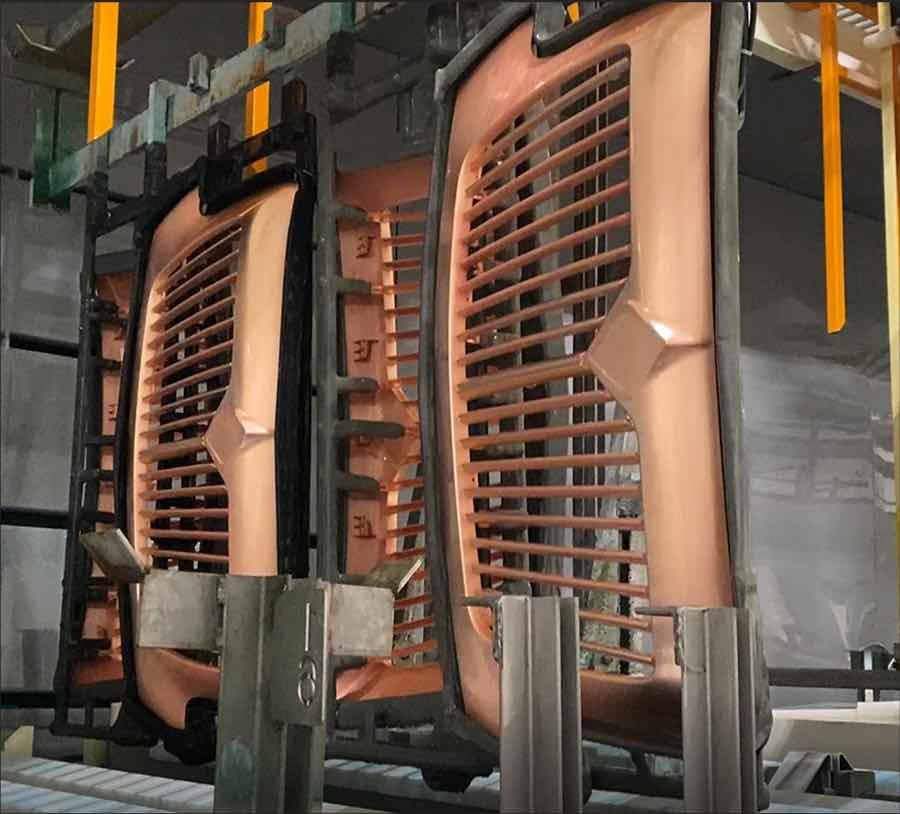 Tribar was an electroplater that listed among its customers Ford, Toyota, General Motors, Fiat Chrysler, Rivian, and Magna, among others. It plates on metal and plastic surfaces.Tribar says it released “several thousand gallons of a liquid containing 5% hexavalent chromium into the sewer system” of the Wixom Sewage Treatment Facility. Officials from Michigan’s Environment, Great Lakes, and Energy (EGLE) division soon reported that Tribar discovered the release on a Monday, “but indicated it may have started as early as Saturday morning,” according to Wixom city officials.
“It is believed that much of the contaminant already made its way through the treatment plant by the time the release was discovered,” EGLE officials said.
What Tribar and other officials soon discovered was that an employee deliberately discharged approximately 10,000 gallons of insufficiently treated wastewater from a holding tank at Plant 5. According to the U.S. Attorney’s Office for Michigan, the employee “disabled approximately 460 alarms and discharged the wastewater to the Wixom sanitary sewer system and ultimately to the Wixom POTW without completing the treatment necessary to remove chromium from the wastewater, as required by Tribar ‘s Industrial Pretreatment Program Permit.”
“Tribar’s failure to adequately train and supervise its employees jeopardized the safety and quality of local water resources. This sentence recognizes the importance of strict adherence to regulatory standards and best practices intended to protect human health and the environment.”
That was the beginning of the legal trouble for Tribar, which faced numerous criminal cases and civil lawsuits before announcing in 2025 that it was being sold and that its Adept Plastic Finishing division would close and lay off 188 employees.
What follows is a timeline of events spliced together from court records and public documents to show what occurred that day in 2022, and how one of the largest plating facilities in North America soon came to become a shell of itself after the incident.
A Failure to ‘Adequately Train and Supervise its Employees’
 Julie BeckIn April 2025, the U.S. Attorney’s Office for the Eastern District of Michigan announced that Tribar was sentenced to pay a $200,000 criminal fine, pay $20,000 in restitution, serve five years of probation, and implement an environmental management system and compliance plan within the first six months of probation after pleading guilty to violating the Clean Water Act when it “discharged insufficiently treated wastewater, a misdemeanor.”
According to Julie A. Beck, then Acting United States Attorney, on July 23, 2022, Tribar Plant 5 accumulated approximately 15,000 gallons of untreated wastewater with high concentrations of hexavalent chromium. Tribar employees attempted to treat this wastewater, but by July 29, 2022, it still contained high levels of hexavalent chromium, which required further treatment before it could be released into Tribar’s wastewater treatment system.
On the evening of July 29, 2022, a Tribar employee discharged a batch of approximately 10,000 gallons of insufficiently treated wastewater from a holding tank into Plant 5’s wastewater treatment system. The discharge activated approximately 460 alarm bells, all of which were disabled, allowing the wastewater to be discharged into the Wixom sanitary sewer system. Tribar did not report this illegal discharge until August 1, 2022.
“Tribar’s failure to adequately train and supervise its employees jeopardized the safety and quality of local water resources,” Beck said at the time of Tribar’s court appearance. “This sentence recognizes the importance of strict adherence to regulatory standards and best practices intended to protect human health and the environment.”
The details of what went on between July 23 and August 1 were laid out in court filings.
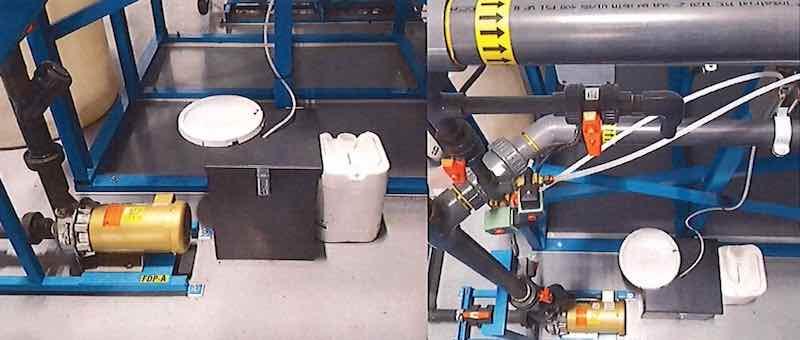 A monitoring point at Tribar's Plant 5, or Adept Plastic Finishing.
The United States of America vs. Tribar Technologies
In the United States District Court, Eastern District of Michigan, Southern Division, the case was the United States of America as the Plaintiff versus Tribar Technologies, Inc., the defendant.
In front of Judge Nancy Edmunds, the United States of America and Tribar reached a plea agreement under Federal Rule of Criminal Procedure 11. The plea agreement's terms were:
- Tribar would plead guilty to Count 1 of the Information, that they were negligent in violation of a pretreatment standard under the Clean Water Act under 33 U.S.C. §§ 1317(d) and 1319(c)(l)(A).
- Tribar’s maximum statutory penalty would be a $200,000 fine and five years of probation.
Also part of the agreement was that federal prosecutors would not bring additional charges “as long as the defendant fulfills its obligations under its obligations under its probation term.” and the required Corporate Compliance Plan, the United States Attorney's Office for the Eastern District of Michigan and the Environmental Crimes Section, Environment & Natural Resources Section, U.S. Department of Justice, said they would not bring additional charges against the defendant for any Clean Water Act violations by the defendant that occurred before the date of the agreement. This agreement was limited to criminal prosecution of the defendant and does not extend to any other parties involved in the violations.
Factual Basis
The following is from the United States District Court Eastern District of Michigan Southern Division:
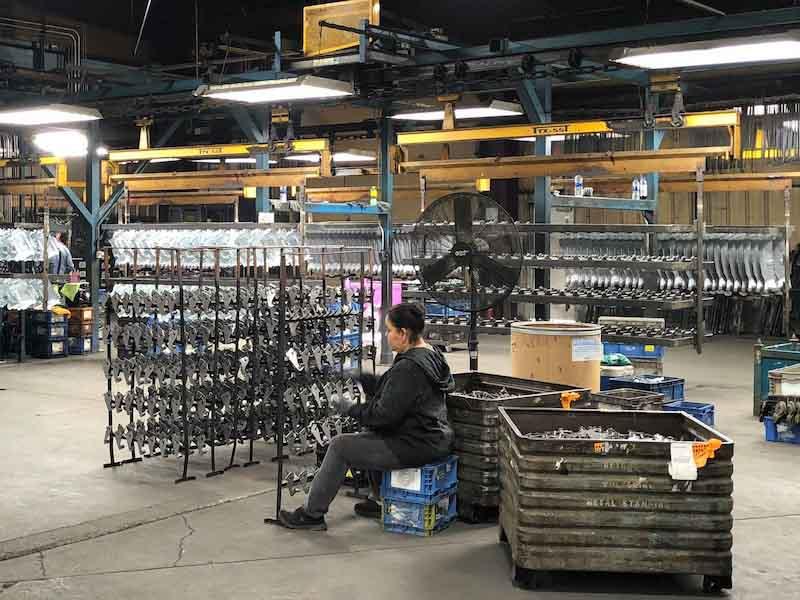
 Tribar Technologies operated five plants in southeast Michigan.Tribar Technologies operated five active plants in southeast Michigan; Plant 5 was a chrome plating facility that used an electroplating process to apply chrome finishing to plastic automotive parts. Plant 5 had a wastewater treatment system to pretreat wastewater before discharging to the Wixom sanitary sewer system. Tribar first collects wastewater in holding tanks, where some chemicals may be added to facilitate treatment. The wastewater is then sent from the holding tanks to a series of treatment tanks to remove pollutants, including chromium.
The system allows recirculation back to the beginning of the process for additional treatment before discharging to the sewer system, if monitors indicate that further treatment is needed to comply with Tribar's IPP Permit and the sewer use ordinance.
Between March 2022 and August 1, 2022, Tribar employed two operators on alternating 12-hour shifts to run its Plant 5 wastewater treatment system. An employee of Tribar (Employee A) worked the 12-hour shift from approximately 6:00 p.m. to 6:00 a.m. Employee A typically worked alone with no on-site supervision. More than once in this same time period, another employee of the defendant found Employee A asleep in a car in the parking lot during Employee A's shift, instead of operating Tribar's wastewater treatment system inside Plant 5.
Several times in this same period, multiple employees of the defendant observed and informed others that Employee A smelled of alcohol while working. Multiple employees notified management personnel at Plant 5 of Employee A’s failure to perform wastewater treatment operator job duties. Tribar took no action against Employee A before August 1, 2022, and allowed Employee A to continue working at Plant 5 with no changes in Employee A's supervision, training, or job duties.
“Fortunately, other processes at Tribar and the WWTP served to contain the hexavalent chromium prior to discharge from the WWTP.”
On or around July 23, 2022, Tribar Plant 5 accumulated approximately 15,000 gallons of untreated wastewater that contained high concentrations of hexavalent chromium. This wastewater had higher levels of pollutants than the wastewater technically generated from Plant 5 operations. During the week beginning Monday, July 25, 2022, employees at Plant 5 attempted to treat this wastewater in a holding tank to reduce the amount of hexavalent chromium before putting it into the Plant 5 wastewater treatment system. On Friday, July 29, 2022, the wastewater in the holding tank still contained high concentrations of hexavalent chromium and required more treatment before it could be put through the wastewater treatment system.
Starting on or around the evening of Friday, July 29, 2022, Employee A discharged approximately 10,000 gallons of insufficiently treated wastewater from the holding tank into the Plant 5 wastewater treatment system. Alarms in the wastewater treatment system were activated, indicating that the wastewater required further treatment before it could be discharged to the Wixom sanitary sewer system.
Employee A disabled approximately 460 alarms and discharged the wastewater to the Wixom sanitary sewer system and ultimately to the Wixom POTW without completing the treatment necessary to remove chromium from the wastewater, as required by Tribar's IPP Permit.
Tribar did not report the discharge of untreated wastewater to Wixom until Monday, August 1, 2022, at approximately 12:23 PM. They later claimed in a written document submitted to EGLE that it reported the discharge to Wixom at 8:30 AM on August 1, 2022.
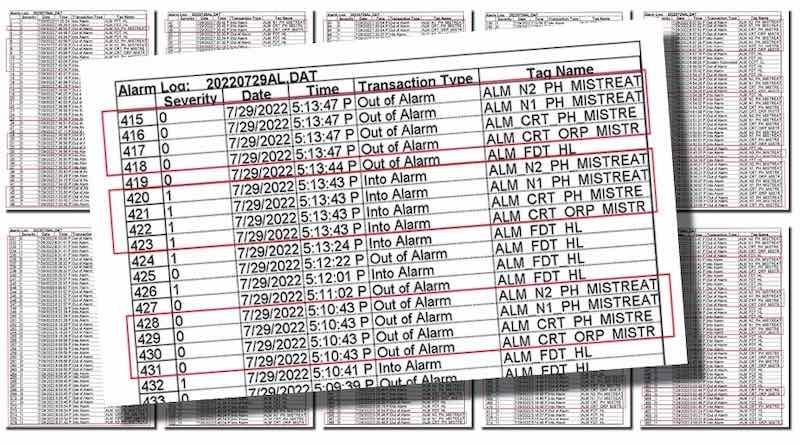 A printout of the alarms that went off on July 29 and for the next days.
Allowed to Re-Open in 2022
 Tribar's Plant 5, known as Adept Plastic Finishing.After being prohibited from discharge to the Wixom Wastewater Treatment Plant after the incident in 2022, Tribar Technologies was given conditional approval to resume wastewater discharge in late August 2022 after the city of Wixom had issued a cease and desist order prohibiting discharge.
“Fortunately, other processes at Tribar and the WWTP served to contain the hexavalent chromium prior to discharge from the WWTP as testing results, conducted at the time of the incident and after, indicated the WWTP discharge was compliant with regulatory guidelines,” the city said at the time.
Wixom and other regulatory agencies said all parties have worked toward “developing and implementing process improvements at Tribar to address the cause of this serious incident, prevent a recurrence, and as a requirement to resume discharge to the WWTP.”
The city required process improvements that include the following:
- A requirement that at least two operators with wastewater treatment experience must be working whenever the Tribar is generating and processing wastewater;
- Three additional probes to monitor compliance with the IPP requirements;
- The addition of an automatic WWTP shutoff valve to stop discharge to the WWTP and recirculate wastewater through the onsite Tribar treatment system in the event the probes determine non-compliance with IPP requirements;
- The automatic WWTP discharge shutoff valve and controls are located in a locked steel cage.
- Only the Tribar senior management team members will have the code required to resume discharge to the WWTP after the automatic WWTP discharge shutoff valve is activated.
- Comprehensive documentation of existing and new process controls/processes and associated training of Tribar staff in order to maintain ongoing compliance.
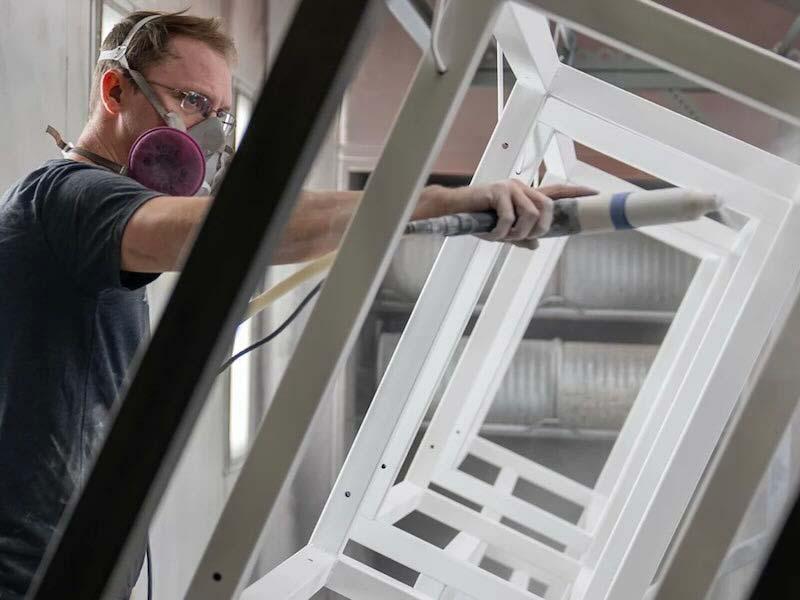
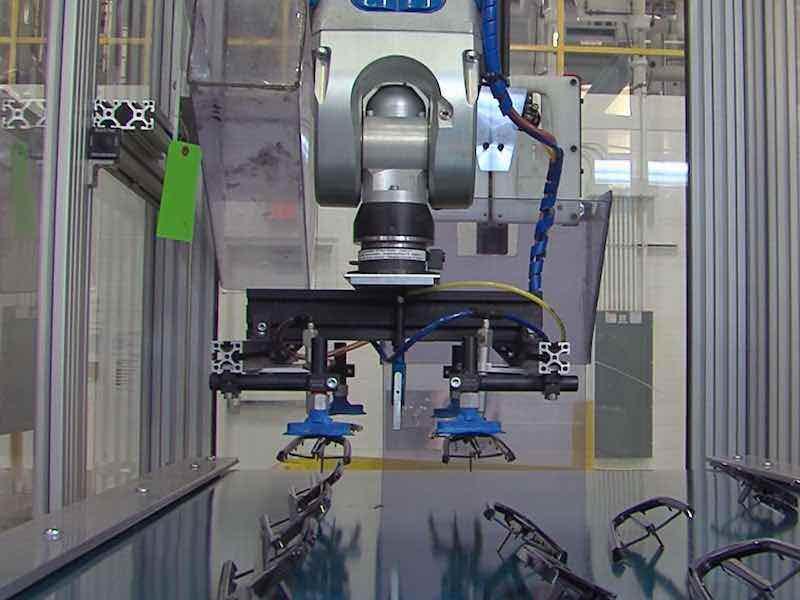
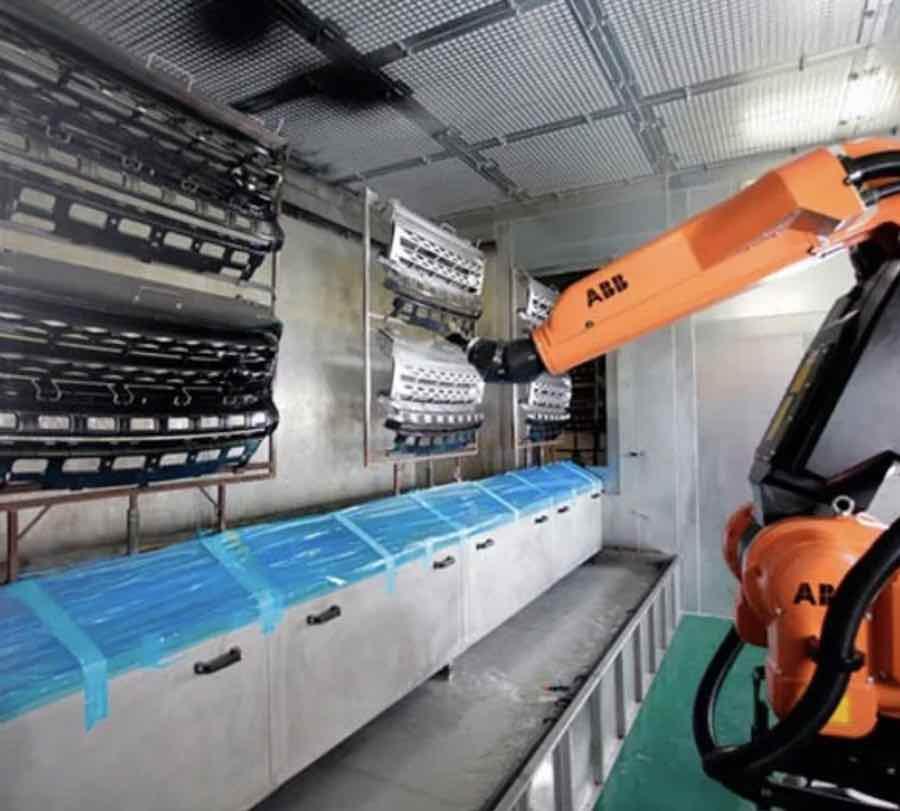 Tribar also performed robotic painting at the plant.After revisions and an on-site review of these process improvements, the City of Wixom issued a letter to Tribar in 2022 with conditional approval to discharge to the WWTP, subject to these process improvements.
“The process improvements that are required at Tribar Plant #5 address the non-compliance issues which led to the Cease and Desist order issued on August 1, and both the City and Tribar will actively monitor for ongoing compliance,” Wixom City Manager Steve Brown said. “Given these process improvements, we have issued a conditional approval for discharge to the Wixom Wastewater Treatment Plant for Tribar Plant #5.”
Tribar also stated getting approval to reopen.
“We want to thank the city for their close collaboration through this process and are pleased we have been able to resume normal operations,” the company said at the time. “As we have said from the beginning, we take our commitment to the community and the environment seriously. We are thankful our systems worked as intended. However, we are continuing to improve our internal systems and controls so something like this cannot happen in the future.”
Past Problems, and the City Opened a Criminal Investigation
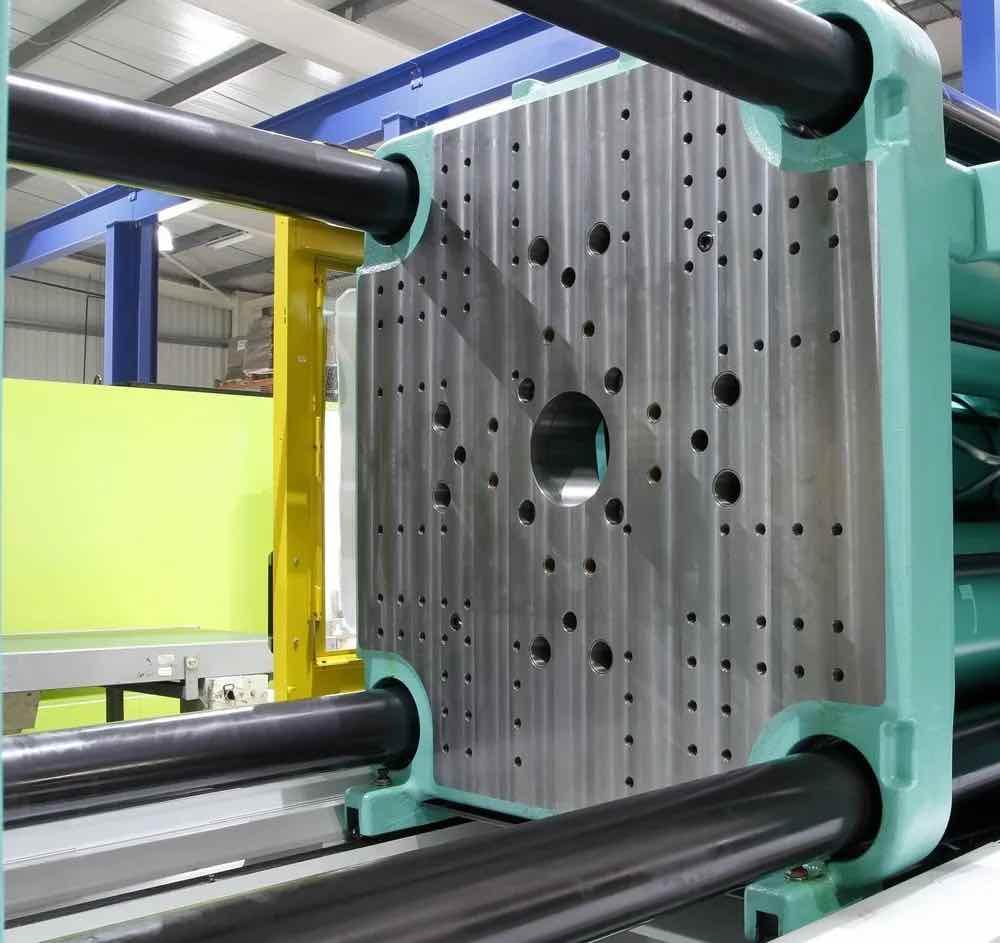 Tribar utilized plastics molds that then were plated at Adept Plastic Finishing.MLive.com reported that the Wixom Police Department has opened a criminal investigation into the hex chrome release.
“Was there criminal intent or was it an accident?” Lieutenant Mark Bradley told MLive.com. It was later reported that the FBI had interviewed the employee suspected of initiating the release, but no criminal charges were filed.
Michigan’s Environment, Great Lakes, and Energy (EGLE) Water Resources Division immediately served Tribar with multiple violation notices after the incidents. In fact, there were significant problems earlier than the August release, as EGLE’s Air Quality Division issued separate notices related to a July 21 inspection, before and not directly related to the release.
According to the WRD, they cited Tribar for violations, including:
- Failing to immediately notify EGLE after discovering the discharge, as required under the law and their industrial user discharge permit.
- Sending an unauthorized discharge of pollutants to the wastewater treatment facility resulted in interference with the treatment process, violating pretreatment rules in the Michigan Natural Resources and Environmental Protection Act (NREPA).
- Failure to maintain a properly updated Pollution Incident Prevention Plan (PIPP) and failure to certify compliance with NREPA rules regarding spillage of oil and polluting materials.
“Because records were not kept as required, the company could not show compliance with several pollutants, including volatile organic compounds and hazardous air pollutants, how much of certain chemicals were used in certain time frames, and the information to show that control equipment on the coating line was operating properly.”
EGLE’s WRD gave the company until August 20 to respond in writing to the violation notices, including responses to a series of questions “designed to determine exactly what happened, and when, that led up to the release. Repeated requests by EGLE investigators for this critical information have not been adequately addressed by Tribar.”
Due to the seriousness of the violations, EGLE says it initiated accelerated enforcement, which will, they say, initiate an administrative consent order process and seek full cost recovery from Tribar. Through its Environmental Investigation Section, EIS has both civil and criminal authority over violations of environmental and public health laws.
The AQD violations included:
- Metal treatment tanks are not being properly controlled, which may have allowed unauthorized emissions of nickel and total chrome.
- Failure to keep proper records that would document compliance with air permit conditions for various processes.
The AQD said the notices included multiple instances of records not being kept as required in the company’s air permits.
“Because records were not kept as required, the company could not show compliance with several pollutants, including volatile organic compounds and hazardous air pollutants, how much of certain chemicals were used in certain time frames, and the information to show that control equipment on the coating line was operating properly,” AQD reported. “The notices also include violations for not properly operating equipment to minimize and control emissions of nickel and total chrome.”
 A layout of the finishing and wastewater treatment operations at Tribat's Plant 5.
State Not Satisfied with Tribar Answers
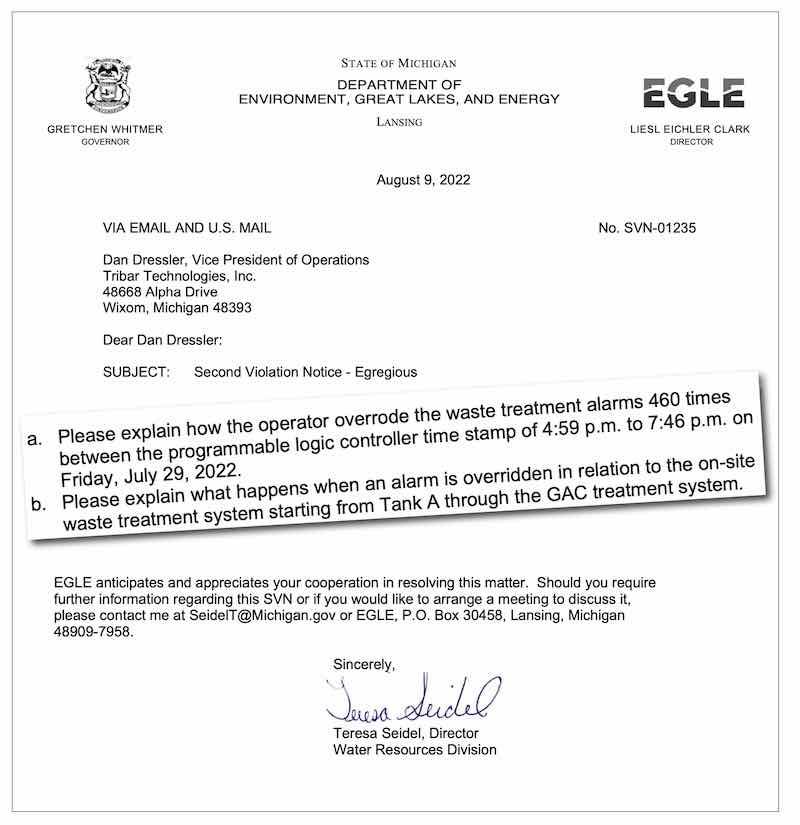
 Teresa SeidelTeresa Seidel, EGLE’s Water Resources Division Director, sent a letter to Dan Dressler, Vice President of Operations at Tribar Technologies, on August 9, 2022, asking pointed questions about how the violations were allowed to happen.
According to the letter, on Monday, August 1, 2022, at 3:51 p.m., Tribar’s Ryan O’Keefe notified EGLE’s Pollution Emergency Alert System Hotline of a release of hexavalent chromium to Norton Creek from Tribar’s Plant 5. EGLE staff confirmed with O’Keefe that the release was instead to the Wixom sanitary sewer system and ultimately to the Wixom Wastewater Treatment Plant (WWTP), which is authorized to discharge to Norton Creek.
On Wednesday, August 3, 2022, during an on-site inspection with EGLE, the agency says O’Keefe informed EGLE staff that he provided in-person notification of the hexavalent chromium release to the WWTP around 8:30 a.m. on Monday, August 1, 2022, after becoming aware of the release sometime between 6:00 a.m. and 7:00 a.m. on August 1, 2022. Per Tribar’s Sewage Disposal System Wastewater Discharge Permit, the agency says notifications of a slug discharge are required to be made immediately by telephone.
“We have been asking questions since the beginning, and Tribar has not answered them as we would like. And so that’s why we issued this violation notice, demanding answers.”
Seidel’s letter asked Tribar to explain in detail how the incident occurred, and specifically how on-site alarms were overridden 460 times between 4:59 p.m. and 7:46 p.m. that night — a period when the plant was not in production and “no one should be at the facility.”
“Why was a wastewater operator in the facility, unsupervised, during the weekend of Friday, July 29, 2022, to Monday, August 1, 2022?” Seidel asked in the letter.
Jill Greenberg, an EGLE spokesperson, told www.greatlakesnow.org that Tribar officials have not sufficiently answered investigators’ questions about the release.
“We have been asking questions since the beginning, and Tribar has not answered them as we would like,” Greenberg was quoted as saying. “And so that’s why we issued this violation notice, demanding answers.”
Tribar then issued a statement saying the company was reviewing the violation notices while conducting its own internal investigation. The company also confirmed that the employee involved in the alarm overrides “is no longer employed by our company.”
“Tribar has invested millions of dollars in sophisticated environmental controls to prevent an accidental release of wastewater prior to treatment at our facility,” the company said in the statement. “Based on an initial investigation, those automated controls were all functioning properly at the time the plating solution was released to the wastewater treatment plant. However, the controls were repeatedly overridden by the operator on duty while the facility was shut down for the weekend. That individual is no longer employed by our company, and we are in the process of further improving our internal controls to prevent a future occurrence.”
State and Federal Officials Call for Tribar to be Shut Down
Immediately after news reports began circulating about the incident at Tribar, local and state officials began demanding that the facility be shut down. Several federal officials joined the call for the company to be closed.
“I want them sued into oblivion,” Rep. Yousef Rabhi, D-Ann Arbor, told a crowd gathered at an event after the news broke. “Why should taxpayers have to clean up the mess that some company made?”
 Debbie DingellU.S. Congresswoman Debbie Dingell (MI-12) responded to the Tribar release by promptly urging the EPA to get involved in investigating the spill and helping to distribute public safety information. She later asked U.S. automakers to stop using hexavalent chromium in their supply chains, writing letters to the CEOs of Ford, Toyota, General Motors, and Stellantis, calling on the companies to only engage with environmentally responsible suppliers and stop the use of hexavalent chromium.
“On August 1, 2022, we learned of reports of a major hexavalent chromium release near the Huron River watershed from Tribar Technologies Inc., an automotive plating company, located in Wixom, Michigan,” Dingell wrote. “While most of the contamination was captured before it could make its way into the environment, this could have been a major environmental disaster, and the State of Michigan continues to conduct sampling out of an abundance of caution. According to reports, however, it is my understanding that Ford, General Motors, Stellantis, Toyota, and other companies currently use Tribar Technologies, Inc., which uses hexavalent chromium in its manufacturing process, as a supplier. This is unacceptable.”
Tribar Technologies is Sold and Adept Plastic Finishing Closes
In April 2025, Tribar Technologies announced that it had been sold and that its Adept Plastic Finishing division would close. According to a filing with the Michigan Department of Labor, the closure will result in the layoff of 188 employees.
In 2015, HCI Equity Partners in Washington, D.C., purchased it and merged it with Tribar Manufacturing. The layoff announcement sent to employees did not say which company purchased Tribar.
“We are writing to inform you that there will be a mass layoff on June 8, 2025, as a result of the shutdown of Adept Plastic Finishing, Inc.’s facilities located at 29835 Beck Road, 29883 Beck Road, and 48668 Alpha Drive in Wixom, Michigan,” wrote Bob Brewster, Director of Human Resources at Tribar Technologies. “We regret to inform you that your position will be eliminated by June 7, 2025. Your layoff is expected to be permanent. You are not entitled to any job bumping rights.”
“Michigan’s environmental laws exist to protect the air we breathe and the water we use from toxic chemicals. When companies cut corners or violate these protections, my office will use every tool available to hold them accountable and ensure proper cleanup and compliance.”
Brewster also sent a letter to the Michigan Department of Labor informing the state of the layoffs.
“This letter is to inform you that Tribar Technologies has been sold,” Brewster wrote. “The purchasing company has chosen to consolidate Tribar operations at the present Howell, MI location. The Wixom, MI, site will be ramped down over the next 60 days. The buyer will be interviewing Tribar, both hourly and salaried employees, for employment opportunities.”
Michigan Attorney General Files Complaint
 Dana NesselIn June of 2025, Michigan Attorney General Dana Nessel sued Tribar Technologies, Inc., and Adept Plastic Finishing, Inc. for allegedly violating the Natural Resources and Environmental Protection Act (NREPA). The complaint alleges past and ongoing illegal discharges and past unlawful air emissions from five automotive supply facilities operated by the companies in Wixom.
The suit, filed on behalf of the Department of Environment, Great Lakes, and Energy and the People of the State of Michigan, alleges multiple violations of Part 31, Water Resource Protection, and Part 55, Air Pollution Control, of NREPA, including the 2022 discharge of hexavalent chromium, a highly toxic chemical, from a chrome-planting facility into the Huron River through the Wixom Wastewater Treatment Plant.
The complaint also alleges failures by the automotive suppliers to comply with permitting requirements, including repeated violations of water and air pollution standards. While the companies have shut down the facilities, the complaint alleges that perfluorooctane sulfonate (PFOS)-laden stormwater continues to discharge from two of the Wixom sites.
“Michigan’s environmental laws exist to protect the air we breathe and the water we use from toxic chemicals,” Nessel says. “When companies cut corners or violate these protections, my office will use every tool available to hold them accountable and ensure proper cleanup and compliance.”
Chronology of Events: Tribar Manufacturing Release of 5% Chromium Solution:
A chronological timeline of the events at the Tribar Technology Plat 5 as compiled by the Michigan Department of Environment, Great Lakes, and Energy (EGLE). All notations are from public record of the EGLE website.
- July 23, 2022 (Saturday) – Tribar moved 2670 gallons of chromic acid etch solution to Tank A and later added well water to the tank. This is according to Tribar’s 10-day Spill or Release Report.
- July 25, 2022 (Monday) – Tribar determined the chromic solution needed to be wasted and began the “process of pretreating the material in the Tank before sending it to the wastewater treatment system”.
- July 25, 2022 (Monday) – July 29, 2022 (Friday) – Each day, Tribar added 35 pounds of dry sodium bisulfite to Tank A. On July 29, 2022, 5 gallons of 30% hydrogen peroxide was added to Tank A to reduce hex chrome. According to Tribar’s Slug Report, received on August 5, 2022, the contents of Tank A were being bled into the treatment system between July 25 – 29, 2022.This information was amended in their response to the Second Violation Notice (received 8/19/22) that the wastewater from Tank A was not bled into the treatment system during this time.
- July 29, 2022 (5:33 PM) (Friday) – The time record for operator, Employee A, begins his shift, (according to the information provided by Tribar)
- July 29, 2022 (8:37 PM) (Friday) – The time record for operator, Employee A, ends his shift (according to the information provided by Tribar)
- July 29, 2022 (5:40 PM) (Friday) - The release from Tribar reportedly occurred Friday evening, flowed through the Tribar treatment system, then through the Wixom sanitary sewer system, into the Wixom Wastewater Treatment Plant (WWTP), and finally into Norton Creek and the Huron River. The time of the release noted here was included in Tribar’s 10-Day Spill or Release Report, received on August 11, 2022.
- Tribar did not upgrade PLC software at Plant 5, so it would be functional and could be tracked remotely.
- The alarm system appears to be visual (red light) and audible, but reportedly allows the water to move through the wastewater system unimpeded (basically the alarms are ignored).
- The alarm system was not designed for Plant 5, so it would conflict with the wastewater operations with alarms going off all day, every day. The operators would acknowledge the alarms in order to keep the system moving.
- Operators got used to hearing them and ignored them because they were a constant feature.
- July 30, 2022 (1:30 AM) (Saturday) - First slug of the chromium solution arrives at the Wixom WWTP.
- July 30, 2022 (Saturday) – Ryan O’Keefe reportedly contacted a former coworker familiar with the wastewater treatment system asking for help because he had a problem at Tribar. The person he contacted told him that this is a “time sensitive” situation and notifications to the appropriate authorities need to be made ASAP. O’Keefe made the first notifications on Monday, 8/1/22.
- July 31, 2022 (7:00 AM) (Sunday) – Wixom 24-hour final effluent composite sampler is started.
- July 31, 2022 (10:30 PM) (Sunday) – First portion of the release is captured in Wixom’s influent composite sampler
- August 1, 2022 (6:00 AM) (Monday)– Tribar’s first shift operator, Kyle Rieger, noted Tank A was empty and contacted Ryan O’Keefe.
- August 1, 2022 (6:00 AM) (Monday) – Wixom WWTP operators notice abnormally low pH and blue tint to the influent. There was no indication of a problem by the WWTP operators on Saturday and Sunday during the 4 hours the operators were onsite.
- August 1, 2022 (7:00 AM) (Monday) – Samples taken of the influent and effluent. We believe the vast bulk of the total chromium load (14 pounds) was discharged in a 2-day period.
- August 1, 2022 (6:00 AM – 7:00 AM) (Monday) - Ryan O’Keefe tells EGLE investigators on 8/3/22 that he learned of the release from Kyle Rieger on Monday morning.
- August 1, 2022 (8:30 AM) - Ryan O’Keefe tells EGLE investigators on August 3, 2022, that he provided an in-person notification to the Wixom WWTP (he drove there). We learn from the WWTP operators, the Ryan O’Keefe did not come to the WWTP until 12:29 PM.
- August 1, 2022, the Pollution Emergency Alerting System (PEAS) reports were submitted to EGLE to report a release of 10,000 gallons of a chromium acid etch material solution that we believed contained 4170 pounds of hexavalent chromium. Ryan O’Keefe from Tribar called PEAS at 3:21 PM and Ruben John from the Wixom WWTP called PEAS at 3:28 PM.
- August 1, 2022 - EGLE initiated sampling of Norton Creek and the Huron River.
- August 3, 2022 (10:00 AM – 11:30 AM) - Chris Veldkamp and Laura Verona interview Wixom WWTP personnel (Tim Sikma-DPW Director and Ruben John- WWTP Superintendent) to get as much information that they know about the release.
- Wixom staff tell EGLE that the operator responsible for the release had resigned.
- August 3, 2022 (~11:45 AM- 3:00 PM) – Chris Veldkamp (EGLE) and Laura Verona (EGLE) conduct inspection and interview at Tribar. Dan Dressel and Ryan O’Keefe of Tribar and Paul Bohn, Fausone Bohn, LLP, Tribar’s Attorney, were present.
- Ryan O’Keefe stated he provided in-person notification of the hexavalent chromium release to the Wixom WWTP around 8:30 AM on Monday August 1, 2022.
- Ryan O’Keefe actually arrives at the Wixom WWTP at 12:29 PM and provided the in-person notification (confirmed by WWTP cameras).
- Ryan O’Keefe stated that on July 29, 2022, he made a visual observation of the water level in Tank A at approximately 3:30 – 4:00 PM and then left for the day. He says the 15,000-gallon Tank A was 2/3rd full, equaling about 10,000 gallons.
- Tribar states via email on August 9, 2022, that Ryan O’Keefe left for the day on July 29, 2022 at 2:30 PM
- August 3, 2022 (4:54 PM) – Veldkamp called Tribar attorney, Paul Bohn, to make request for PLC data. Bohn said he would provide it.
- August 5, 2022 (2:52 PM) (Friday) – Paul Bohn submitted via email to Wixom WWTP and EGLE, the Upset, Slug, or Accidental Discharge Report required by the Sewage Disposal System Wastewater Discharge Permit (SIU permit) issued by Wixom WWTP.
- August 8, 2022 (1:23 PM) (Monday) – Received limited set of PLC data from Tribar.
- August 8, 2022 (6:31 PM) (Monday) – Bohn reports for the first time that the water in Tank A “passed through the wastewater treatment system without being completely treated” prior to discharge to the Wixom WWTP.
- August 9, 2022 (9:36 AM) – Veldkamp sent an email to “formally” request additional PLC data that captures events before and after the release.
- August 9, 2022 – Second Violation Notice (SVN-01235) was issued to Tribar Technologies.
- August 10, 2022 (6:51 PM) – Veldkamp sent an email to Shane Gibson at MacDermid Enthone Industrial Solutions (as suggested by Tribar attorney Paul Bohn) to get composition information for each of the chemicals listed on their SDSs. Gibson did not respond.
- August 11, 2022 (4:40 PM) (Thursday) – Tribar submits 10-Day Spill or Release Report via email to Wixom WWTP, EGLE, and MDHHS.
- August 11, 2022 (5:34 PM) (Thursday) – Tribar submits Conceptual Fate of Chromium in Wastewater Report via email to EGLE and MDHHS.
- August 11, 2022 (10:54 AM) - Veldkamp sent an email to Ronald Mahoney at MacDermid Enthone (as suggested by Tribar attorney Paul Bohn) to get answers to question regarding the original PLC data. Mahoney did not respond.
- August 15, 2022 (8:54 AM) – Veldkamp emailed a second request for the additional PLC data and advised that MacDermid did not respond. Bohn stated in an email that he would send it with Tribar’s response to the Second Violation Notice.
- August 19, 2022 (3:30 PM) (Friday) – Tribar submits response to the Second Violation Notice via MiWaters. The response is deficient. A letter will be sent to Tribar acknowledging receipt of their response and that it was deficient.