


Is Your Chemistry Correct? And Not the Kind in the Tanks
The chemistry of your culture deserves the same attention as the chemistry of your process.


The chemistry of your culture deserves the same attention as the chemistry of your process.

Last month we covered how to evaluate a finishing business you are thinking about buying. This month we turn to the next question we typically get: how do you pay for it?

Earlier this year I wrote the article “Fabrication to Finishing to Assembly: A Stronger Voice by Aligning Affiliated Industries.”

Two spent hard chromium plating solutions were regenerated using an industrially viable electroseparation method to remove metal impurities.

After more than 40 years in the electroplating and surface finishing industry, I have witnessed significant change—though for decades, that progress moved at a deliberate crawl.
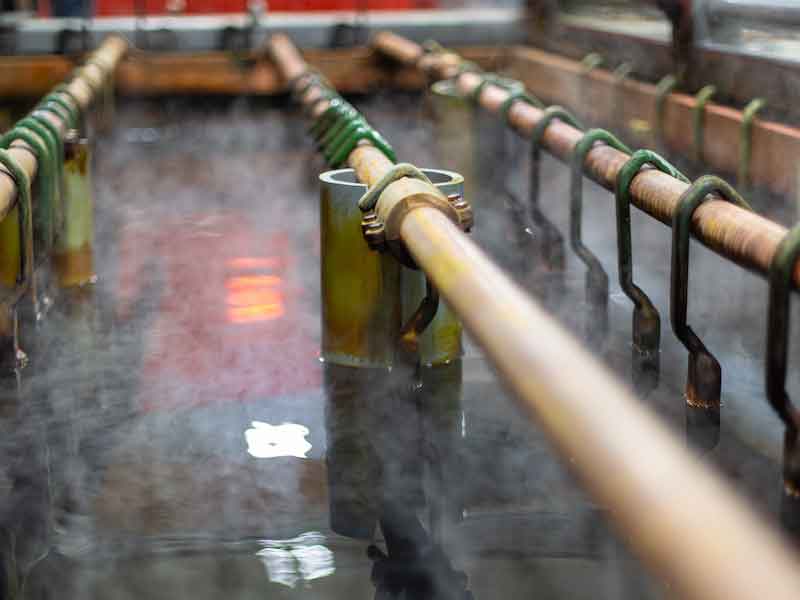
Rhode Island environmental regulators have issued a “Notice of Intent to Enforce” against Electrolizing Inc. following an inspection of the company's Providence chrome plating facility.

If you weren’t hiding under a rock in the last few months, you’d be familiar with the national news story of “The Quality Learing (sic) Center,” a supposed day care located in Minneapolis, MN, and spotlighted by freelance journalist Nick Shirley.

Everything we’ve written for www.FinishingAndCoating.com this year has focused on educating business owners thinking about a succession plan.

Back in the 1930s, I doubt Dr. Richard O. Hull, when applying for a patent for his test plating cell, ever dreamed this unique tool would become the main service tool in the decorative plating industry today.

A shop manager wrote to me about an issue with salt spray testing.

This research examines the corrosion behavior of tin-zinc alloy electrodeposits on a steel substrate.

MacDermid Enthone’s parent, Element Solutions, says it has canceled its $14.5 billion agreement to be acquired by Solstice Advanced Materials, just two months after announcing the deal.
For a metal finishing operation in its 80th year, Cincinnati-based Varland Plating has spent decades doing something most shops avoid: continuously reinventing itself.

I recently experienced a bad attitude from a young mechanic at my local auto repair shop.

Chromium-free zinc flake coatings (zinc-rich paint) are used for automotive parts and construction parts, etc. that require a high degree of corrosion protection.
For decades, the finishing industry has sought something many believed would be nearly impossible to achieve: a practical, cost-effective replacement for hard chromium plating that meets the performance requirements of demanding industrial applications.

Large quantities of hazardous waste, most in aqueous solution or as sludges, are being produced at numerous metal plating and processing facilities in the U.S. Regulatory pressures, future liability, and limited landfill space have driven the cost of metal waste disposal to levels that are becoming nonviable.

A shop owner wrote me the following note about barrel plating back in 2005, but it still holds today.
For more than three decades, Great Lakes Metal Finishing’s management team has always expected the best and braced for the worst when it comes to keeping their high-volume zinc and zinc-nickel plating operations in production.
Editor's Note: Few individuals have influenced the exchange of technical knowledge within the metal finishing industry as profoundly as Ted Mooney, P.E. Engineer, consultant, educator, author, and co-founder of Finishing.com, Mooney has spent nearly six decades helping platers and surface finishers solve problems and advance the industry. In this first-person reflection, he shares highlights from a remarkable career that began in 1967 and continues to inspire finishing professionals worldwide.

Plasma electrolytic oxidation (PEO) has emerged as a leading surface engineering technology for improving the tribological and corrosion performance of lightweight structural alloys, including aluminum, magnesium, titanium, and zirconium.