

The architectural anodizing industry has used alkaline etching for many decades.
 Sascha WegnerDespite the introduction of alternative etching technologies, alkaline etching still accounts for a significant share of architectural aluminum finishing. However, not all alkaline etch technologies are the same, and they differ significantly in operating cost and achieved quality.
The finish produced by this process, commonly designated as E6, has a uniform matte appearance with low gloss values, typically 8-15 GU. As a result, alkaline etching is a critical step in architectural anodizing, primarily used to reduce the visibility of extrusion streaks, die lines, and other surface imperfections.
During etching, a controlled layer of aluminum dissolves from the surface, removing extrusion-related defects, minor scratches, and surface irregularities. This controlled metal removal generates a homogeneous surface texture that provides the distinctive decorative matte finish required for high-quality architectural applications.
Traditional Alkaline Etching
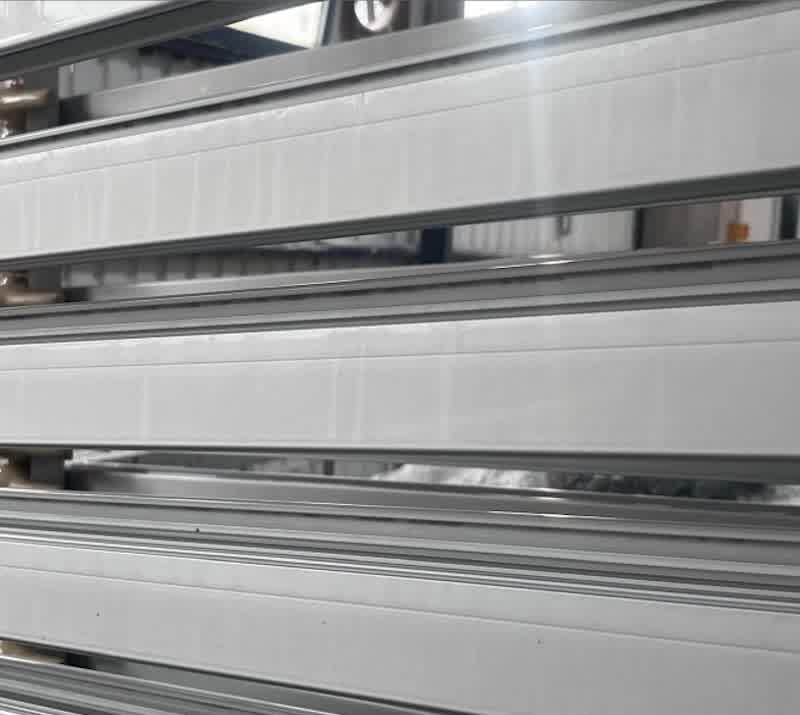 Tiger Stripes are vertical streak patterns that can appear on the finished extrusion.Traditional alkaline E6 etches typically operate at approximately 50–80 g/L sodium hydroxide (NaOH) and can accommodate dissolved aluminum concentrations of around 120–150 g/L. To maintain bath stability and prevent undesirable precipitation as aluminum concentrations increase, these etches use proprietary additives, typically at concentrations of 30–50 mL/L.
In the E6 alkaline etching process, etch additives control the dissolution rate of aluminum and ensure a uniform, aesthetically consistent matte surface across the entire component. Additives help prevent localized over-etching, smut formation, and surface defects caused by alloying elements such as Fe and Si, thereby improving surface homogeneity. They also stabilize bath performance, resulting in more consistent surface roughness and appearance. As a result, etch additives enhance process reliability, surface quality, and downstream anodizing performance, which are critical requirements for architectural and decorative E6 finishes.
In general, higher dissolved aluminum concentrations, typically in the range of 150–220 g/L, can produce highly desirable aesthetic finishes with lower gloss values. However, increasing aluminum concentration also increases etch-solution viscosity. This can lead to excessive drag-out, higher chemical consumption, increased foam generation, Tiger Stripes, poor rinsability, and solution retention in narrow-profile channels. The result is higher operating costs, rework, and greater demands on wastewater treatment.
Traditional etch additives generally reach their practical operating limits around 150g/l of dissolved aluminum. At this point, part of the bath may need to be decanted and diluted to restore acceptable operating characteristics.
The primary challenge is bath viscosity. As viscosity increases, more etch solution adheres to the aluminum surface and becomes trapped within narrow channels instead of draining freely back into the process tank.
The Development of Low Viscosity Alkaline Etches
A newer generation of alkaline etch additives has been formulated specifically to address the viscosity limitations of traditional systems.
These products let anodizers operate at much higher dissolved aluminum concentrations, potentially reaching 220 g/L, while maintaining acceptable drainage and process performance. This technology is sometimes referred to as a "Never-Dump" alkaline etch.
Where conventional baths require periodic decanting to control viscosity or dissolved aluminum concentration, reducing or eliminating these decants provides an additional opportunity to lower operating costs and waste generation.
Rather than periodically removing large quantities of etch solution to control aluminum concentration, the bath can approach an operating equilibrium in which aluminum dissolved into the solution is balanced by aluminum removed through normal process drag-out. This represents an important change in the economics of alkaline etching.
Reducing Drag-Out and Chemical Consumption
When comparing traditional and advanced alkaline etch technologies at equivalent dissolved aluminum concentrations, modern additive systems significantly improve solution drainage from the workpiece and play a critical role in controlling bath viscosity during the E6 etching process. Under these operating conditions, reductions in drag-out of approximately 20%–30% may be achievable compared with conventional technology. This directly reduces consumption of sodium hydroxide and etch additives.
The economic impact extends beyond the value of the etch chemistry itself. In addition, better drainage reduces chemical drag-out into subsequent rinse stages, lowering rinse-water contamination, decreasing water consumption and wastewater treatment requirements, and improving the process's overall environmental sustainability.
Where conventional baths require periodic decanting to control viscosity or dissolved aluminum concentration, reducing or eliminating these decants provides an additional opportunity to lower operating costs and waste generation.
Viscosity and ‘Tiger Stripes’
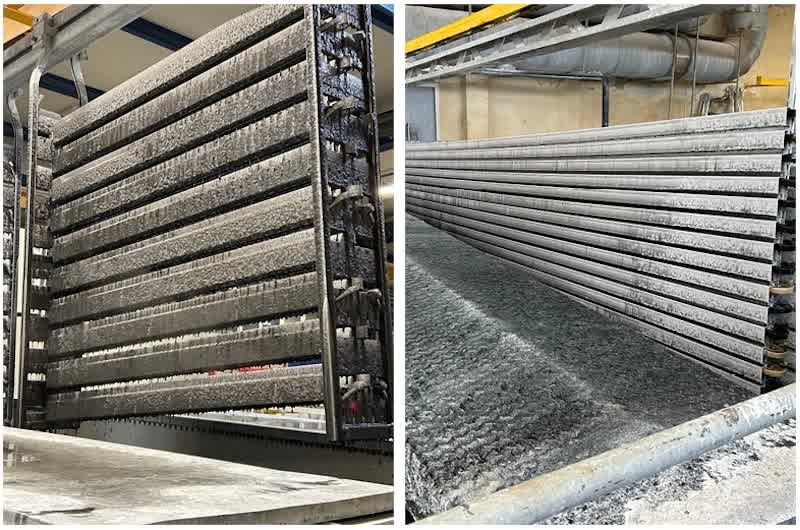 Before and after using a new etch that lowers viscosity of the E6 etching bath.One of the most important, but frequently overlooked, relationships in architectural alkaline etching is the connection between solution viscosity, drainage, and Tiger Stripe formation.
Anyone familiar with architectural anodizing will recognize Tiger Stripes as vertical streak patterns that can appear on the finished extrusion.
High-viscosity etch solutions can contribute to this problem because the solution does not drain uniformly from the aluminum surface when the load is removed from the etch tank. Residual alkaline solution can remain on certain areas of the extrusion and continue reacting with the aluminum during the transfer from the etch tank to the first rinse.
The result can be localized differences in etching that become visible after subsequent anodizing and finishing operations.
A common response is to shorten the drain and transfer time between the etch and first rinse. While this may help reduce continued etching on the surface, it creates even more solution carry-over that physically enters the rinse system.
New-generation alkaline etch additives address the underlying problem by improving the bath’s drainage characteristics. When the solution drains more freely from the extrusion, it reduces the potential for localized continued etching while minimizing chemical carry-over into subsequent rinse stages. Improved drainage also facilitates more efficient rinsing.
Modern additive technology provides enhanced control, enabling more efficient smut removal during the deoxidizing/desmutting stage. This leads to cleaner surfaces, reduced residue carryover, and more consistent subsequent anodizing or finishing operations.
Why Wetting Agents are Not Necessarily the Answer
Attempts are sometimes made to improve the drainage characteristics of conventional alkaline etches by adding surfactants or wetting agents to reduce surface tension.
This approach is limited and can vary considerably with operating conditions and bath chemistry. More importantly, choosing the wrong surfactant can cause substantial foam generation.
The result is lower, more consistent gloss values, improved hiding of extrusion defects, and elimination of Tiger Stripes.
During periods of heavy production or high etch loading, foam can potentially reach the extraction ducts or overflow the process tank. Beyond the resulting housekeeping problems, allowing caustic-containing solution to enter an extraction system can create operational, Health & Safety, and Environmental (HSE) concerns.
The objective of modern alkaline etch formulation is therefore not simply to reduce surface tension. Instead, the additive package must balance viscosity control, drainage, bath stability, surface quality, foam control and rinsability.
Conclusion
New generation alkaline etch technology represents an important advancement for architectural anodizers.
By controlling the operating characteristics of highly loaded alkaline solutions, advanced additives can enable anodizers to maintain higher dissolved aluminum concentrations while retaining good drainage and rinsability.
The result is lower, more consistent gloss values, improved hiding of extrusion defects, and elimination of Tiger Stripes. Lower drag-out, reduced caustic and additive consumption, eliminated bath decanting, and lower wastewater treatment requirements will generate operational savings.
The real advantage is the ability to operate at elevated aluminum concentrations without accepting the viscosity-related disadvantages associated with highly loaded traditional alkaline etch technologies.
Sascha Wegner is the Business Development Director for Light Metal Solutions in the Americas for MacDermid Enthone Industrial Solutions. Please visit www.macdermidenthone.com.