

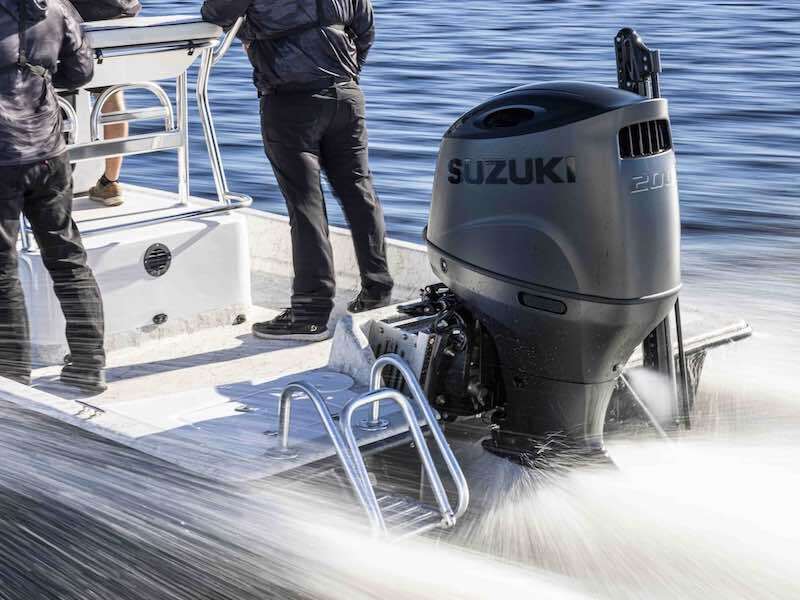
Suzuki Marine USA has introduced Suzuki Edge eCoat, an advanced engine anodizing process that it says delivers superior corrosion protection for saltwater use and significantly reduces environmental impact.
 Brandon CerkaThis new factory process was first used in August 2024 to manufacture Suzuki’s popular DF140B outboard. As of September 2025, the application of Suzuki Edge eCoat was expanded to include the DF140BG, DF140B, DF115BG, and DF115B models, and will progressively be adopted across Suzuki Marine’s model line-up.
Suzuki Motor Corporation developed this anodizing process specifically to protect key engine components, including the cylinder block, cylinder head, and crankcase. It is designed to withstand high temperatures and provide superior corrosion resistance by uniformly coating cooling-water passages and other engine components that come into contact with it. As Suzuki outboards are extremely popular in bays, oceans, and other marine environments, this new level of protection will benefit boaters across many regions of the United States.
Looking For Ways to Improve Products
“Suzuki Edge eCoat is a premium finish that performs,” says Brandon Cerka, Vice President Sales and Marketing for Suzuki Marine USA. “We are always looking for ways to improve our products and provide a more robust, reliable product for the boating industry and boaters nationwide. This latest development from our factory in Japan accomplishes this, while providing a significant environmental advantage as well.”
The Suzuki Edge eCoat process immerses aluminum components in an electrolytic solution and applies an electric current to create a porous surface layer. The formation of an aluminum oxide coating enhances corrosion resistance. By innovating the immersion process to prevent air pockets, Suzuki can uniformly treat the complex geometry of the cooling-water passages.
Cerka says superior heat resistance is another key advantage of this process. By employing a low-temperature sealing treatment using metal hydrates to close the fine pores on the surface, Suzuki can maintain corrosion resistance even at 300 °°C (572°F). This treatment is the first of its kind to be adopted for mass-produced outboard motor engine components.
Suzuki’s new anodizing process also provides special protection for the cast-iron sleeve integrated into the cylinder block. Because this sleeve can pit if it contacts the electrolytic solution, Suzuki has developed a sealing technology using a dedicated jig to protect the critical sleeve throughout the anodizing process.
50% Reduction in CO2 Emissions
 In 2025, Suzuki Motor developed a new technology that applies a corrosion-resistant anodizing treatment that can withstand high temperatures on the engine components of outboard motors, including the cylinder block, cylinder head, and crankcase.This process not only provides superior protection for key internal engine components but also enables an approximately 50% reduction in CO2 emissions compared to traditional methods, which previously involved a chemical treatment followed by painting. This change eliminates the energy used to dry and bake the paint.
“Finding ways to reduce the environmental footprint of recreational boating is an ongoing process at Suzuki Marine,” Cerka says. “From expanding our successful Micro Plastics Collecting Device, to finding better alternatives to pack and ship our parts and motors, to making our entire operation more energy efficient, we are always looking for ways to improve. With this new process, we are making our engines more durable while simultaneously reducing energy consumption. That’s what I call a win-win.”
Guiding Suzuki Marine’s conservation ethos is the company’s Clean Ocean Project, a far-reaching program that includes grassroots cleanup events, technological advancements, and waste reduction efforts to minimize the environmental impact of boating worldwide. This ongoing commitment helped Suzuki Marine win the inaugural 2025 Epic Award in the Sustainability Category from Soundings Trade Only Magazine.
According to the Epic Awards website, the Sustainability Category was established to “recognize projects that use inventive design to meaningfully reduce harm to the environment,” and for “developing products with consideration for end-of-life cycles, a thoughtful utilization of materials for packaging, shipping, industrial design, and components.”
Enriching the Boater Experience
Cerka says the introduction of Suzuki Edge eCoat is a testament to Suzuki Marine’s passion for enriching the boater experience through technological innovation, while simultaneously pursuing its sincere responsibility to preserve our oceans for future generations.
Suzuki is a leading manufacturer of 4-stroke outboard motors, ranging from the ultra-portable 2.5-horsepower model to the flagship DF350 V-6 with contra-rotating dual propellers. Over the years, Suzuki outboards have won nine Innovation Awards from the National Marine Manufacturers’ Association (NMMA) for motors as small as 25 horsepower, underscoring Suzuki’s commitment to delivering the best technology to the widest possible audience.
Suzuki Marine USA opened a U.S. Marine Technical Center in Panama City, Florida. It relocated to a new corporate headquarters in Tampa, Florida, to be closer to the heart of the U.S. boating industry and the country's boating capital. Through its Clean Ocean Project, regional cleanup and habitat restoration efforts worldwide, and company-wide plastic waste reduction initiatives, Suzuki has demonstrated a commitment to protecting coastal and marine habitats at home and abroad.
Visit https://www.suzukimarine.com.