


The effect of aromatic sulfo compounds on the internal stresses in nickel deposits is governed by the degree of their conversion into intermediates and the extent of their incorporation in the deposits.
In the case of thiourea, the internal stress changes as a function of its concentration, corresponding to the extremes in its conversion kinetics. An analogous pattern was observed in class II brighteners—the lower the degree of hydrogenation of the additive, the stronger its effect on the internal tensile stress. The internal stress in deposits obtained in the presence of a mixture of additives was found to depend on their competitive adsorption, with attendant changes in conversion kinetics and in incorporation of the constituent additives. Knowledge of these regularities permits optimized design of additive compositions in terms of minimal internal stress.
The nature of the internal stress of the deposits is one of the most important physico-mechanical features of nickel electroplating.1-3 It depends on the composition of the electrolyte and on the plating regime.4-13 Class II brighteners—depending on their type and concentration—are known to increase the stresses sharply,1,2,12-16 to the point of cracking.17 By contrast, class I additives are known to reduce internal tensile stress; saccharin, p-toluene sulfonamide, benzene sulfonamide, naphthalene trisulfonic acid and certain other compounds have gained widespread application in this context.12,13,18-25 Divalent sulfur is an important factor in this: Thiourea and its derivatives are known to induce drastic changes—depending on their concentration—in the internal stress of nickel deposits.19,23,26
Various hypotheses have been advanced with regard to the conflicting effects of the two classes,1,2,7,9,27 but there are no general criteria at present for evaluation of additives (and their possible combinations) in terms of minimal internal stress. The difficulty in pinpointing the relevant mechanism undoubtedly stems from the complexity of the electroplating process, which involves high overvoltages and evolution of hydrogen.28-32Under such conditions, most additives of both classes undergo conversions in the adsorbed layer, which in turn determine the degree of inhibition and incorporation of the additives and their decomposition products in the deposits.33-51
In this study, the interrelationship of the behavior of the additives in the adsorbed layer, the degree of their conversion, and their effect on internal stress, was investigated in this context.
Note: This paper was originally presented in 1994.
Experimental Procedure
The experiments were carried out with a Watt's type electrolyte, composition (g/L): NiSO4 · 7H2O, 280; NiCl2 · 6H2O, 45; H3BO3, 30; without forced agitation. The compounds used as brighteners of both classes are listed in the table. The internal stresses were determined contractometrically and calculated from the deflection of the free end of the strip cathode in the course of the electroplating process.52 The consumption rate of the additives was determined from the changes in their concentration. The incorporated sulfur was determined spectrophotometrically,53 and the carbon, volumetrically.54 The incorporation rate of these two elements from thiourea was determined radiometrically, using the 14C and 35S isotopes.55 Incorporation of acetylene-based additives and their conversion products was determined by gas chromatography, preceded by ethyl-ether extraction.56
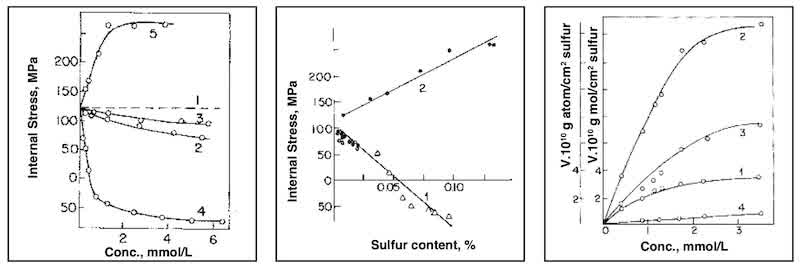
Fig. 1—Dependence on additive concentration in Watts electrolyte of internal stress level in nickel deposits: (1) without additive; (2) sodium benzene sulfonate; (3) sulfanilic acid; (4) benzene sulfonamide; (5) pamino benzene sulfonamide; ik, 2 A/ dm2; 20°C, pH 4. Fig. 2—Effect of incorporated sulfur content on internal stress level in nickel deposits made from solutions containing: (1) sodium benzene sulfonate (°), sulfanilic acid (•), benzene sulfonamide (D); (2) pamino benzene sulfonamide; i , 2 A/dm2; 20°C, pH 4. Fig. 3—Dependence of incorporation rate of (1) sulfur; (2) carbon; and of consumption (3) and incorporation rate (4) of pamino benzene sulfonamide on its concentration; i , 2 A/dm2; 20°C, pH 4.
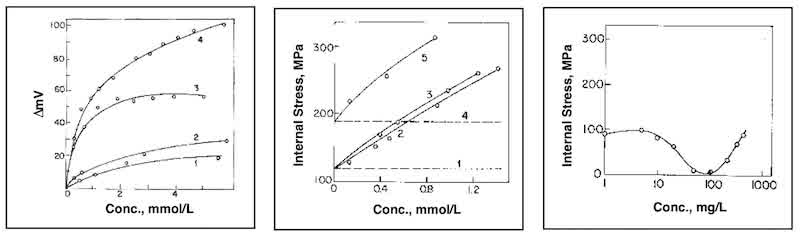
Fig. 4—Dependence of cathode polarization on additive concentration in Watts electrolyte: (1) sodium benzene sulfonate; (2) sulfanilic acid; (3) benzene sulfonamide; (4) pamino benzene sulfonamide; i , 2 A/dm2; 20°C, pH 4. Fig. 5—Effect of additive concentration in Watts electrolyte on internal stress level in nickel deposits: (1) without additive; (2) pamino benzene sulfonamide; (3) aniline; (4) 50 mg/L aniline; (5) pamino benzene sulfonamide in the presence of 50 mg/L aniline; i , 2 A/dm2, 20°C, pH 4. Fig. 6—Effect of thiourea concentration in Watts electrolyte on internal stress level in nickel deposits; i , 2 A/dm2, 20°C, pH 2.5.
Results and Discussion
Figure 1 shows that the benzene sulfonic acid derivatives differ in their internal stress effect. Three of them—sodium benzene sulfonate, sulfanilic acid and benzene sulfonamide—reduce the stresses. The action of the last-named compound is especially strong, actually transforming tension into compression.
Introduction of an amino group, in the para position, into benzene sulfonamide drastically alters the effect. For example, even minute concentrations of pamino benzene sulfonamide cause a steep increase in the tensile internal stress (Fig. 1, curve 5). Comparison of these data with those of consumption, conversion and incorporation of sulfo additives, indicates a close connection between the degree of their conversion and their effect on internal stress. According to Zheimyte et al.,38 they undergo complete decomposition on the nickel cathode and only the sulfur is incorporated in the deposit, so that in the absence of counteractive factors, the sulfur content determines the magnitude and sign of the internal stress (Fig. 2, curve 1). The absence of such a dependence, combined with increase of the internal stress with sulfur content, in the case of pamino benzene sulfonamide (Fig. 2, curve 2) and of other additives indicates,20,21,23 however, that their interaction with the cathode is rather more complex.
Figure 3 shows that an amino group in the benzene sulfonamide molecule drastically increases its rate of consumption and that of incorporation of sulfur, carbon, and pamino benzene sulfonamide molecules (curve 4). It was also established that some of the carbon belongs to an intermediate—aniline—which undergoes partial desorption and passes into the solution. This indicates that adsorbed pamino benzene sulfonamide molecules are dissimilarly affected on different active centers of the cathode. Some are incorporated as they are; others undergo partial decomposition into intermediates with sufficient adsorbability; still others decompose completely, so that only nickel sulfide is incorporated. The lower degree of conversion of the pamino benzene sulfonamide molecules tends to cause greater coverage of the cathode surface, compared with the other additives mentioned earlier, and is reflected in increased polarization (Fig. 4) and in alteration of the crystalline structure. This effect largely offsets the opposite action of the incorporated foreign particles, and no internal stress reduction is observed as the sulfur content in the deposit increases (Fig. 2, curve 2). According to Zheimyte and Matulis,49 aniline is a strong inhibitor and its formation and presence on the cathode merely augment the action of the original additive (Fig. 5).
The relationship between the degree of conversion of the additives and their internal stress effect also provides an indication of the extreme behavior of the internal stress curves as function of the concentration of the thio additives.19,23 Figure 6 shows that at low thiourea concentrations, the internal tensile stress increases; at somewhat higher concentrations, it drops steeply, and eventually increases again. A similar trend is observed for other properties of the deposits obtained with this additive (Fig. 7). The first maximum in the brightness, leveling and catho-depolarization patterns appears at 5 to 10 mg/L thiourea; upon increase to 50 to 100 g/L, the brightness drops sharply, the cathode is depolarized and negative leveling sets in; upon further increase, the brightness and leveling reappear and the polarization increases.
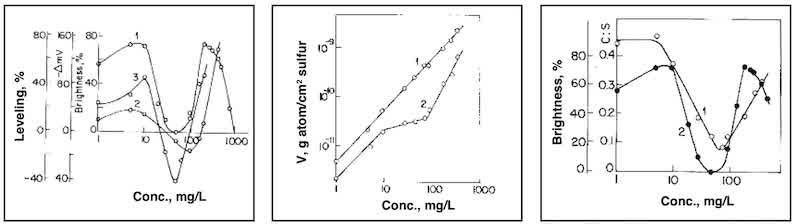
Fig. 7—Effect of thiourea concentration in Watts electrolyte on: (1) brightness; (2) leveling; (3) cathode polarization of nickel; i , 2 A/dm2; 20°C, pH 2.5. Fig. 8—Dependence on thiourea concentration in Watts electrolyte of incorporation rate of: (1) sulfur; (2) carbon; i , 2 A/dm2, 200°C, pH 2.5. Fig. 9—Effect of thiourea concentration in Watts electrolyte on: (1) incorporated carbon and sulfur (C:S) ratio; (2) brightness of nickel deposits; ik, 2 A/ dm2; 20°C, pH 2.5.
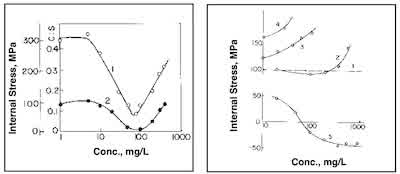
Fig. 10—Effect of thiourea concentration in Watts electrolyte on: (1) incorporated carbon and sulfur (C:S) ratio; (2) internal stress level in nickel deposits; i , 2 A/dm2; 20°C, pH 2.5. Fig. 11—Dependence of internal stress level in nickel deposits on additive concentration in Watts electrolyte: (1) without additive; (2) butynediol; (3) quinaldine; (4) propinol (2propyn1ol); (5) sac charin; i , 2 A/dm2; 20°C, pH 4.
Table: Organic Additives Used
- Sodium benzene sulfonate: C6H5SO3Na
- Sulfanilic acid: NH2C6H4SO3H
- Benzene sulfonamide: C6H5SO2NH2
- p-amino benzene sulfonamide:NH2C6H4SO2NH2
- Saccharin: C6H4, CO, NH, SO2
- Aniline: C6H5NH2
- Thiourea: NH2CSNH2
- Butynediol: HOCH2C=CCH2OH
- Propinol (2-propyn-1-ol): HC=CCH2OH
- Quinaldine: C10H9N
- Acetonitrile: CH3CN
The reason for this nonlinear behavior was sought in the conversion kinetics of the additive. Figure 8 shows that the rate of sulfur incorporation increases linearly with additive concentration (curve 1) and coincides with that of its consumption. Rather more complex is the kinetics of carbon incorporation, which proceeds at all concentrations, at a rate lower than that of the sulfur, which is a consequence of breaking of the CS double bond. The nonlinearity of the pattern of carbon incorporation (curve 2), comprising three distinct regions, is thus dictated by that of its sulfur counterpart. Accordingly, the C:S ratio in the deposit was determined as the measure of conservation of the thiourea as it passes from the solution into the deposit. Figure 9 shows that in the 1-to-400 mg/L range of the additive, the C:S ratio curve has a well-defined minimum around the 90 mg/L point (curve 1), as do the brightness and internal stress curves (Fig. 10). The brightness and leveling curves and the ratio curve begin to diverge only at both concentrations, but this is attributable to excessive coverage of the cathode by undecomposed thiourea and to onset of the limiting discharge current of the nickel ions.
The dissimilar behavior of the additives in the adsorbed layer indicates also the internal stress effect of the class II brighteners. Figure 11 shows that the widely used butynediol has almost no effect up to 500 mg/L without agitation; a steep increase of the tensile internal stress sets in only at high concentrations. By contrast, propinol (2-propyn-1-ol) and quinaldine strongly intensify the stresses already existing at low concentrations, almost doubling them at 50 to 100 mg/L, above which the deposits actually crack. These data, correlated with the consumption, conversion and incorporation patterns of the above additives, clearly demonstrate the interlinkage of the processes in question. Accordingly, propinol and quinaldine are less sensitive to cathodic action than butynediol; according to Matulis et al.,47 only three percent of the molecules of the latter are incorporated, compared with 30 percent for propinol; the percentage for quinaldine is also high.51 In these circumstances, these two additives, as well as others exhibiting conversion lower by one order of magnitude, compared with butynediol, are stronger inhibitors of the cathodic process. They bring on sharp increase of the polarization and change the relation between the rates of hydrogen evolution and nickel deposition.
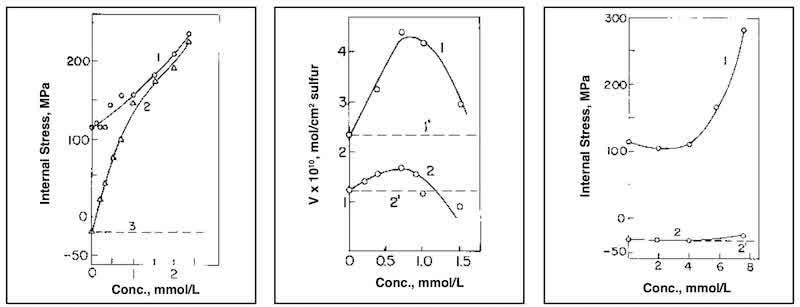
Fig. 12—Dependence of internal stress level in nickel deposits on additive concentration in Watts electrolyte: (1) quinaldine; (2) quinaldine + 1.244 mmol/L saccharin; (3) 1.24 mmol/L saccharin; ik, 2 A/dm2; 20°C, pH 4. Fig. 13—Dependence of consumption rate of 1.24 mmol/L saccharin (1) and incorporation rate of sulfur (2) on quinaldine concentration in Watts electrolyte; dotted lines—consumption rate of 1.24 mmol/L saccharin (1') and incorporation rate of sulfur (2') without quinaldine; i , 2 A/dm2; 20°C, pH 4. Fig. 14—Dependence of internal stress level in nickel deposits on additive concentration in Watts electrolyte: (1) acetonitrile; (2) acetonitrile + 1.24 mmol/L saccharin; (2') 1.24 mmol/L saccharin; ik, 2 A/dm2; 20°C, pH 4.
Eventually, the amount of hydrogen in the deposit increases, the structure of the deposits and the amount of crystal dislocations change, and the tensile internal stresses are intensified. This trend can be counteracted by supplementing the electrolyte with sulfur-based class I brighteners which, used separately, cause a drastic reduction of the stresses. Their effectiveness, however, depends also on the degree of conversion of the other additives. Figure 12 shows that the internal stress-reducing action of saccharin is in evidence only in the presence of small amounts of quinaldine; at higher concentrations of the latter, the effect vanishes (curve 2 almost coincides with curve 1), with the attendant changes in their interaction and degree of conversion. Admixture of as little as 7 mmol/L quinaldine drastically increases the rates of saccharin consumption and sulfur incorporation, which reach a maximum, as shown in Fig. 13. At still higher concentrations, the saccharin is gradually expelled from the cathode, both rates begin to drop, and the internal stress increases. Completely different is the internal stress pattern in deposits obtained with other class II brighteners, such as acetonitrile and butynediol (Fig. 14), which undergo more significant conversion than quinaldine. Their hydrogen-desorbing action is stronger and their coverage of the cathode is low, so that the expulsion of saccharin is weaker, leaving sulfur incorporation in the deposit unimpeded over a wide range of additive concentrations.
Finally, it should be emphasized that the observed connection between the internal stress and the degree of conversion of the additives and their mixtures is of more than purely theoretical interest. Through this connection, mistakes can be avoided in designing additive compositions for high-quality brightened nickel deposits with minimal internal stress.
Conclusions
- Aromatic sulfo compounds that undergo complete decomposition on the cathode, with only the sulfur incorporated in the deposit, reduced the internal stress in accordance with the amount of sulfur.
- Introduction of an additional functional group, such as NH2, alters the interaction kinetics of the compounds with the cathode, whereby the consumption and incorporation rates of the original molecules and of their decomposition products are increased. This is reflected in stronger inhibition of the crystallization process and in intensification of the tensile internal stress.
- In the presence of thiourea, the internal stress, the polarization effect, and the brightness and leveling of the deposits are governed by the undecomposed part of the additive. These characteristics are a function of the C:S ratio in the deposit, which in turn is a measure of conservation of the incorporated thiourea.
- In deposits obtained in the presence of class II brighteners, the internal stresses are determined by the rates of adsorption and hydrogenation of these brighteners on the cathode. The lower the hydrogenation rate, the stronger its inhibitory action, which alters the crystalline structure and the number of dislocations, leading to hydrogen intake and intensification of the internal stress. The best compounds of this class are the ones that, over a wide range of concentrations, do not inhibit adsorption of their class I counterparts used for reducing internal stress. Knowledge of these constants permits optimized design of additive compositions for high-quality nickel deposits with minimal internal stress.
About the Authors
Professor Avraham Bodnevas is a researcher at the Israel Institute of Metals, Technion City, Haifa 32000, Israel, where he continues his work in the theory and practice of nickel plating. He was formerly chief of the Multilayer Nickel and Metal Ceramic Deposit Department at the Institute of Chemistry and Chemical Technology of the Academy of Sciences of Lithuania. His research interests include electrochemistry and electroplating, in particular the behavior of additives, their chemisorption, conversion and incorporation mechanisms in the electrodeposition of nickel.
Dr. Joseph Zahavi is the director of the Israel Institute of Metals. He is also heading the Corrosion, Surface Treatment and Laser Laboratories at the Metal Institute. He has published numerous papers and scientific reports in the fields of electrodeposition, erosion, and corrosion, as well as material processes and laser-induced deposition in both gaseous and liquid media on substrates such as semiconductors, polymers and ceramics. He holds several U.S. patents for laser-induced direct plating and received the AESF Best Published Paper Award in 1983 and 1984.
References
1. R. Subramanian, C. Balasingh and B.A. Shenoi, Metal Fin., 65(3), 67; (4), 54; (5), 58; (6), 101 (1967).
2. R. Weil, Plating, 57, 1231 (Dec., 1970); 58, 50 (Jan.), 137 (Feb., 1971).
3. T.E. Such, Trans. Inst. Met. Fin., 66(1), 1 (1988).
4. B. Martin, Proc. 32nd AES Tech Conf., 206 (1944).
5. A. Brenner, V. Zentner and C. Jennings, Plating, 39, 865, 933 (1952).
6. M.B. Diggin, Met. Prog., 66, 132 (1954).
7. H. Fischer, Elektrolytische Abscheidung und Elektrokristallisation von Metallen, Springer Verlag, 1954.
8. D.A. Fanner and R.A. Hammond, Trans. Inst. Met. Fin., 36, 32 (1958).
9. A.T. Vagramjan and Y.S. Petrova, The Mechanical Properties of Electrolytic Deposits, New York, 1962.
10. R. Bilfinger and A. Strauch, Wiss. Zeit. Hochsch, für Elektrotech., Ilmenau, 8(4), 327 (1962).
11. W.H. Safranek, Properties of Electrodeposited Metals and Alloys, AESF, Orlando, FL, 1974.
12. R. Brugger, Nickel Plating, R. Draper Ltd., Teddington, UK, 1970.
13. J.K. Dennis and T.E. Such, Nickel and Chromium Plating, 2nd ed., Butterworths, 1986.
14. M.P. Zhukaite, J.K. Vegys, A.I. Bodnevas and J.J. Matulis, Trudi AN Lit. SSR, Serija B, 1(48), 23 (1967).
15. M.P. Vaimlavicene, A.I. Bodnevas and J.J. Matulis, ibid., 2(57), 49 (1969).
16. O.S. Zheimyte, G.K. Kupetis, A.A. Cheika and A.I. Bodnevas, Proc. Isledovanija v oblasti elektrooszahdenija metallov, 131, Vilnius (1974).
17. T.E. Such, Metal Fin. J., 7, 371 (Oct., 1961).
18. Harold J. Read, Plating, 49, 602 (June, 1962).
19. S.A. Watson, Trans. Inst. Metal Finish., 40, 41 (1963).
20. R.J. Kendrick, ibid., 19.
21. O.S. Zheimyte, A.I. Bodnevas and J.J. Matulis, Proc. Isledovanija v oblasti elektroosazhdenija metallov, 26, Vilnius, 1968.
22. O. Galdikene and A. Bodnevas, in Bright Electrolytic Coatings (in Russian), J. Matulis, Ed., Mintis, Vilnius, 1969; Ch. V., pp. 557584.
23. A. Knödler and E. Rauh, Metalloberfläche—Angew. Elektrochemie, 27(2), 48 (1973).
24. C.H. Huang, Plat. and Surf. Fin., 71, 104 (May, 1984).
25. ShihMin Lin and TenChin Wen, ibid., 78, 70 (Sept., 1991).
26. J.K. Vegys, A.I. Bodnevas and J.J. Matulis, Zaschita metallov, 1(5), 525 (1965).
27. M.J. Popereka, Vnutrenie naprazhenija elektroliticheski osazhdemch metallov, Novosibirsk, 1966 (in Russian).
28. P.V. Kichas and J.J. Matulis, Trudi AN Lit. SSR, serija B 1(28), 111 (1962).
29. J. Matulis and R. Slizhys, Electrochim. Acta, 9, 1177 (1964).
30. J. Elze, Metalloberfläche, 24(3), 73 (1970).
31. J. Epelboin and R. Wiart, J. Electrochem. Soc., 118(10), 1577 (1971).
32. Z.P. Shaltene, A.V. Petrauskas, and A.I. Bodnevas, Trudi AN Lit. SSR, Serija B, 6(157), 36 (1986).
33. E. Raub and M. Wittum, Z. Elektrochem. 46, 71 (1940).
34. S.E. Beacom and B.J Riley, J. Electrochem. Soc., 106, 309 (1959).
35. A.I Bodnevas and J.J. Matulis, Trudi AN Lit. SSR, serija B, 1(32), 49 (1963).
36. J.K. Vegys, A.I. Bodnevas and J.J. Matulis, Zaschita metallov, 2, 201 (1966).
37. J. Edwards and M. Lewett, Trans. Inst. Met. Fin., 39, 33, 45, 52 (1962); 41, 140, 147, 157(1964); 44, 27 (1966); 45, 12 (1967).
38. O.S. Zheimyte, A.I. Bodnevas and J.J. Matulis, Trudi AN Lit. SSR, serija B, 4(55), 49 (1968).
39. J. Matulis, A. Bodnevas and M. Vainilavichene, Plating, 56, 1147 (Oct., 1969).
40. J. Matulis, A. Bodnevas and O. Zheimyte, 20th Meeting, CITCE; Extended Abstracts, 197, Strasbourg (1969).
41. A. Knödler, OberflächeSurface, 10, 398 (1969).
42. J. Dubsky and P. Kozak, Metalloberfläche, 24, 423 (1970).
43. J.K. Vegys, L. Belskene, A.V. Petrauskas and A.I. Bodnevas, Proc. Isledovanija v oblasti osazhdenija metallov, 69, Vilnius, 1971.
44. R.P. Shirvyte, A.I. Bodnevas and J.J. Matulis, Trudi AN Lit. SSR, Serija B, 5(72), 29; 6(73), 25 (1972).
45. E.V. Gavelyte, J.K. Vegys and A.I. Bodnevas, Proc. Isledovanija v oblasti elektroosazhdenija metallov, 113, 119, Vilnius (1974).
46. J.K. Vegys and A.I. Bodnevas, ibid., 108.
47. J. Matulis, A. Bodnevas and R. Shirvyte, OberflächeSurface, 16, 222 (1975).
48. O.S. Zheimyte, A.I. Bodnevas and J.J. Matulis, Trudi AN Lit. SSR, Serija B, 1(122), 13 (1981).
49. O.S. Zheimyte and J.J. Matulis, ibid., 4(89), 41(1975).
50. A. Bodnevas, 37th Meeting, ISE, Extended Abstracts, 11, 42, Vilnius (1986).
51. A. Bodnevas and J. Zahavi, Plat. and Surf. Fin., 80, 53 (July, 1993).
52. A. Bodnevas and J. Matulis, Trudi AN Lit. SSR, Serija B, 1(32), 49 (1963). 53. C.L. Luke, Analyt. Chem., 21, 1369 (1949).
54. O.S. Zheimyte, A.I. Bodnevas and J.J. Matulis, Trudi AN Lit. SSR, Serija B, 3(58), 63 (1969).
55. J.K. Vegys, A.I. Bodnevas and J.J. Matulis, Zaschita metallov, 3(2), 201 (1966).
56. O. Nivinskene, D. Mockute and A. Bodnevas, “Incorporation of Organic Compounds from Butynediol in Nickel Coatings,” Deposited Doc., LIINTI (Lithuanian Research Institute for Science and Engineering Information). N1091—Li, Vilnius, May, 1987.