

What can go wrong when you buy new cleaning equipment? What can go wrong when you change the cleaning process? Lots.
In Part 3 of this series, we discussed how money alone won’t buy happiness or effective cleaning, which led to the idea that more power does not necessarily make for better cleaning. In this episode, we cover three additional situations that impede successful process change.
In the first example, a manufacturer designed and commissioned cleaning and surface equipment to cover all eventualities likely to be encountered. The second covers attempts to make overhead parts washers do the job of more costly cleaning equipment. Finally, we discuss people who may thwart your process-change efforts and suggest that you lean into the joy of surfing a Tsunami.
Can a Single Piece Of Equipment Handle All Cleaning Contingencies?
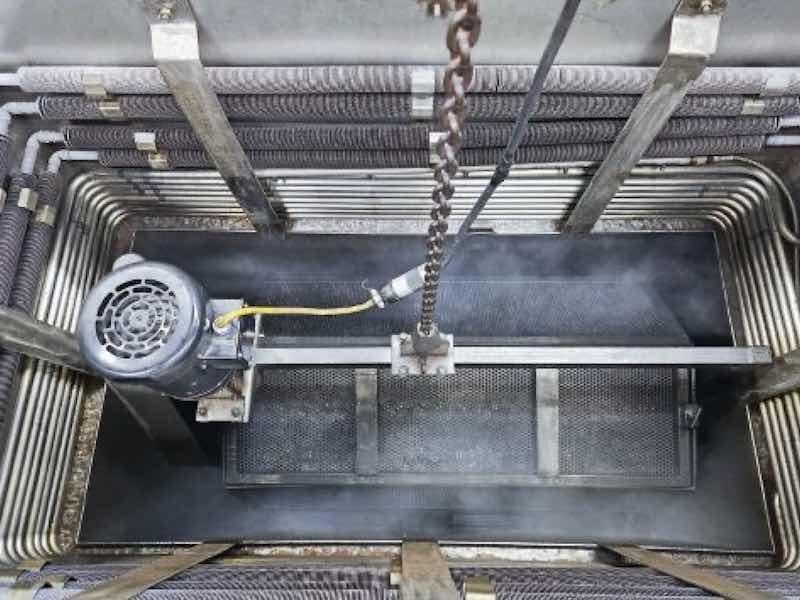
Some cleaning equipment is designed to allow cleaning with several types of solvent-based or even both water-based and solvent-based cleaning agents; such equipment can be very successful, but not always. One product manufacturer purchased a custom cleaning line that was supposed to provide for all cleaning needs in a single piece of equipment. Based on a review of the cleaning specs, the manufacturer requested 15 or so process baths, each containing a specific cleaning agent, including a rinse bath with or without additives. There was also some drying capability. The system was controlled by a series of automated robots programmed according to the written process specs. The equipment was well-designed. However, because the system was meant to cover all likely cleaning eventualities, it was very large. People needed to move product back and forth through the facility to the cleaning equipment. Further, because most of the tanks in the big cleaning machine were unused most of the time, the product had to be moved from the unused wash baths to the rinse baths. This, unfortunately, would allow flash drying, resulting in adherent soil and recontamination of the product by ambient air. The production folks largely ignored the official cleaning machine. For nearly all of fabrication and assembly, what the people doing the work really needed was a simple system consisting of a wash tank, several rinse tanks, and a drying chamber.
Can Very Inexpensive Cleaning Equipment Do the Job?
At the other end of the spectrum, someone may say, “Don’t spend any more time on cleaning. I’ve solved the problem. It’s silly to spend six figures on a new cleaning system – I just ordered a cabinet washer. Look at this brochure! It says the washer works for precision applications and removes heavy lubricants as well as those nasty solvents the EPA says we can’t use anymore.” Cabinet washers can be the best approach depending on the product line. We have to consider factors such as the materials of construction, shape, and design. It also depends on the throughput and on what you and your customers agree on the all-important issue of how clean is clean enough. We applaud success stories in which a large open-top degreaser using halogenated solvents is replaced by a simple cabinet washer using aqueous cleaners. Wherever you can achieve more effective cleaning with simpler systems using easier-to-manage cleaning agents that are safer for workers and the environment – go for it.
Cabinet washers have specific applications. A cabinet washer might consist of a single chamber with a turntable and a few spray bars that shower the parts with either water or aqueous cleaning agent. Picture yourself standing in a shower with a single shower head. A shower can be effective; picture yourself as a turntable and move slowly in a circle. You would have to clean one foot at a time, or stand on your head. Safety warning: DO NOT stand on your head in the shower. When cleaning large parts, an assembler might turn the part upside down and rerun the cycle, which might be the best approach for certain large parts with low throughput. Cabinet washers use line-of-sight spray cleaning, not immersion cleaning or ultrasonics; they may not have the cleaning action required for the job. Many cabinet washers do not provide rinsing, and they are unlikely to include drying mechanisms. A cabinet washer may not be suited to the final steps of precision or critical cleaning, where removing small amounts of residue and achieving high levels of technical cleanliness are paramount.
Roadblocks and Agendas
The question: how many therapists does it take to change a lightbulb? The answer: first, the lightbulb has to want to change. You may be convinced that, to improve product cleaning efficacy, your company must invest in new cleaning equipment, review new cleaning chemicals, and optimize the cleaning process. However, as the head of the process change effort, you may encounter one or more people who make every effort to thwart it.
Ask yourself why – why is this person undercutting your efforts? Unearth and address the root causes. The person may not understand how cleaning works. If the mechanisms of cleaning are a complete mystery to this individual, they may assume that one system is very much like another. They may be misled by wording in product literature; a $25,000 system may be indicated as suitable for high-precision cleaning or degreasing that, on the surface, sounds very much like those made for a $750,000 multi-chamber cleaning system. A technical explanation may explain why a complex, costly system is needed.
A few people can’t be reasoned with. These individuals don’t care if a new cleaning process fails. They don’t want to change. The person may be convinced that cleaning is an unnecessary exercise. They are cleaning the product because Mom said they had to wash their hands, so they do, but they grumble. The person may insist on using inexpensive, unsuitable cleaning equipment to provide lip service to the process change effort, while hoping the replacement process will fail. They don’t really want to change; they may want a rationale to insist that they must use a cleaning agent under regulatory duress. Or they hope to pass the problem along to another division of the company. Or they expect to move to another division, change companies, change careers, or even retire and leave the problem for someone else to solve. They may feel that regulatory agencies will all go away. They may assume that military/aerospace exemptions or FDA concerns will provide a pathway for the original cleaning process to continue. They may assert that only one cleaning agent is reliable, that life as we know it will cease to exist if the cleaning process is modified. They may cite the difficulty of establishing that the new process will meet specs or standards. They may debate the results of studies designed to demonstrate the equivalency of the new process to the original benchmark cleaning process; these debates have been known to continue for decades. They may assert, not without some justification, that flammable or combustible solvents can under no circumstances be used in the facility.
They may insist on purchasing cleaning equipment that is not appropriate for your application. We have found suspicious clues about this passive-aggressive, roadblock approach in assorted reports, which, for this article, shall remain unidentified. Such whitewashed reports may contain wording to the effect that the company has identified cleaning equipment that will take care of the problem for under, say, $30,000. They assert that the company plans to order the equipment, or that it has already been ordered. The reports may contain assertions that the new equipment will save the company gargantuan piles of money and eliminate tons of evil solvent usage. We have taken the opportunity to follow up on some apparently glowing reports to see if the simple systems were ever put into production. Because we have been unable to find published reports or even verbal indications of success, we strongly suspect that someone blocked the change to the cleaning process.
Surf the Tsunami
In the days of yore, when Barbara was the Freon Lady in aerospace, she was tasked with replacing ozone-depleting chemicals (ODC) in a large corporation. This involved changing cleaning processes across more than 6 dozen divisions worldwide. For many of the products, there were critical safety issues. It seemed that everyone objected to every possible solution. She was overwhelmed; she felt like she was surfing on a Tsunami. Giving up was not an option – so she leaned into the challenge. Gradually, it became sort of fun (almost). An old friend recently told me that other engineers adopted the surfing concept.
What do you do if you are overwhelmed? Don’t run away. Purchasing new cleaning equipment does not guarantee excellent surface quality. Be aware of the technical, personality-related, regulatory, economic, and political difficulties. Avoid overspending or underspending. Managing human roadblocks who are bound and determined to thwart your efforts is another matter. Take joy in the aggravation! Hear the naysayers; listen to why the new cleaning process “can’t work.” Sometimes, understanding the intractable problems inherently contains the germ of the solution. Most importantly, don’t surf alone. Involve your team; get buy-in from key people. Key people often involve managers (including CEOs), technical folks, the technicians who build the product, and your customer. Keep going. Surf the Tsunami!
Barbara and Ed Kanegsberg founded BFK Solutions in 1994 as a critical cleaning consulting service and the go-to resource for eliminating cleaning, surface quality, and contamination problems — or, even better, preventing them altogether. Barbara, widely known as “The Cleaning Lady,” is an expert and trusted adviser in critical cleaning. Ed is known as “The Rocket Scientist.” They write Clean Source, an approximately monthly e-newsletter that provides practical ideas to improve cleaning, contamination control, and product quality. They are co-editors and contributors to the acclaimed two-volume “Handbook for Critical Cleaning,” CRC/Taylor & Francis, 2011. Visit https://bfksolutions.com