

Boeing teams have qualified a paint stripper to help prevent small holes, known as pits, that used to appear on aluminum fuselage skins.
The previous paint-stripping formula caused a chemical reaction that could corrode the metal, a problem frequently documented by field operators and maintenance teams.
Even tiny pits require inspection and potential repair, and can delay an aircraft's return to service. Reducing the pitting issue reduces rework and allows maintenance teams to focus on scheduled maintenance rather than repairs.
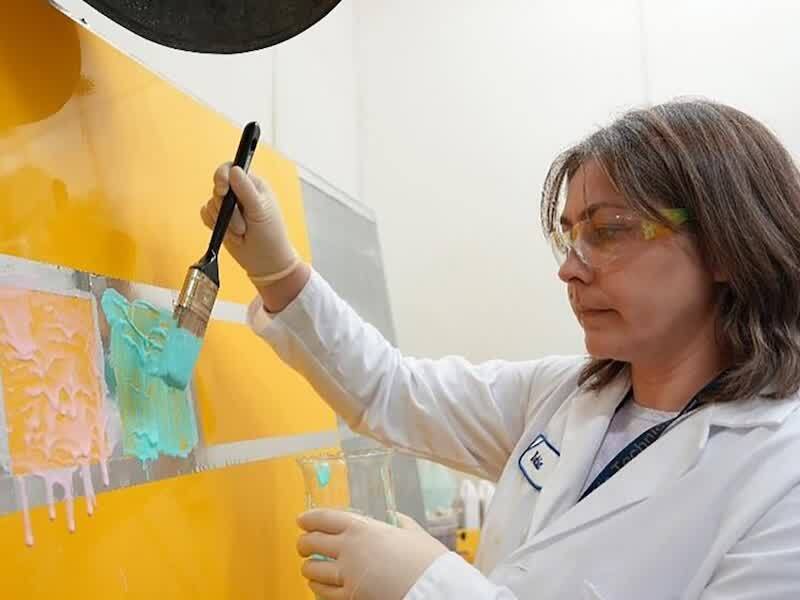
Top photo: Katia Badaeva, a paints and coatings engineer, tests different paint stripper formulations to find a solution to fuselage skin pitting. Her work helped qualify a reformulated paint stripper to reduce corrosion pits while maintaining stripping performance. (Maddie Chesbro-Crisalli photo © Boeing)
Finding the Root Cause
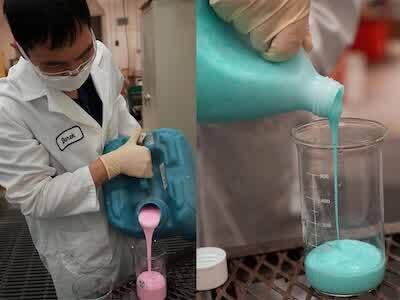 Boeing engineers worked with paint technicians and suppliers to reformulate a paint stripper to effectively prevent corrosion pitting on fuselage skins. The new formula is dyed a distinct color, shown at right, to help crews quickly identify it and avoid mixing with other products. (Maddie Chesbro-Crisalli photo © Boeing)Engineers recreated the problem in the lab and tested variables such as temperature, application method, and chemical combinations. The team, which includes Katia Badeva, Mark Johnson, Derek Mar, Harry Prepotente, Ryan Anderson, Elizabeth Lam, and Christopher Meyer, identified three critical factors:
- The pitting appeared where a specific yellow pigment in the paint interacted with the paint stripper.
- Damage occurred when acid- and peroxide-containing strippers were mixed and applied to the skin.
- A particular acid-activated product applied at elevated temperatures (>85°F) also created the damage.
“We tested countless paint pigments for interaction with the paint stripper,” says Mark Johnson, chemical engineer. “Only one caused the pitting.”
Electron microscopy and pigment testing revealed a reaction at the pigment-metal interface where metallic ions in the yellow pigment precipitated as nanoparticles, creating micro-cathodes that drove localized galvanic corrosion.
Collaboration Leads to a Solution
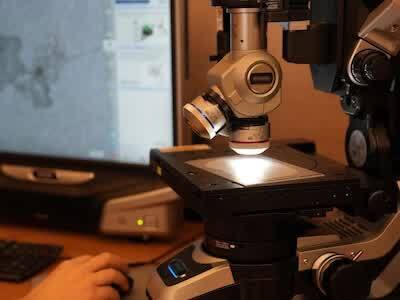 An engineer uses a microscope to examine corrosion pits on clad aluminum test panels. The work helped identify the chemical reaction between paint pigments and stripper components that caused the damage, using a material representative of the aluminum fuselage skin. (Maddie Chesbro-Crisalli photo © Boeing)Boeing shared its findings with the paint stripper manufacturer, who reformulated the product to remove reactive ingredients while maintaining performance. The supplier tested at least five versions before achieving a formula that can:
- Eliminate the reactive pit formation pathway
- Maintain or improve stripping speed
- Spray thicker and cling to paint better for consistent coverage,
- It is used in temperatures above 85°F
- It is dyed a distinct color so crews can identify it quickly and avoid intermixing with peroxide-containing strippers.
“Knowing which chemicals cause the skin pitting helped us focus on the solution,” Katia Badaeva, paints and coatings engineer, explained. “Changing the chemistry affected performance in other ways, so we had to iterate to keep efficiency while preventing damage.”
Previously, operations above 85°F risked creating pits, limiting stripping in hot environments. With the new stripper, teams can more safely remove paint on airplanes across a wider range of temperatures without added inspections or repairs, reducing cycle time and cost.
Visit https://www.boeing.com.