


Most adhesion failures attributed to a coating were decided before the coating arrived.
Not by the formulator, and usually not by the applicator either — but by how the surface underneath was defined, prepared, and confirmed.
This is an uncomfortable statement for anyone who owns a coating line, because it moves the failure upstream to a place where the language is often vague.
It is also the most useful thing to understand about adhesion, because the upstream place is where the cheap fixes are.
“Clean” is Not a Specification
Ask what state a surface must be in before coating and the answer is frequently a phrase: clean, dry, free of contamination, properly prepared. Each of these describes an intention. None of them defines a method, a limit or a decision.
The practical consequence is that two suppliers can fully comply with the same wording and deliver surfaces that behave completely differently. One rinses and dries. Another wipes and leaves an invisible film. Both can truthfully say the surface was cleaned. The coating makes the difference, not the paperwork.
A specification that can be checked needs three things that a phrase does not carry: what the surface was before preparation, what was done to it, and how that was confirmed. Those three statements are what turn a requirement into a repeatable result.
What Preparation Actually Has to Achieve
 It helps to be concrete about the mechanisms, because different coating systems fail for different reasons.
Adhesion by mechanical key: requires a specific surface profile, and more profile is not better. A profile that is too coarse leaves peaks the coating cannot cover, and those peaks become the start of a corrosion cell. A profile that is too fine gives insufficient key. The useful range depends on the coating thickness and the service environment, and it must be stated numerically, not described as “roughened”.
Adhesion by chemical bonding — as with conversion coatings and some pretreatments — depends on surface chemistry rather than roughness. This is where residue does the most damage. A surface that looks and feels clean can carry an organic film that blocks the conversion reaction across the whole area, producing a coating that cures normally and fails in service.
Adhesion by wetting depends on surface energy and the absence of low-energy contamination — oils, release agents, and fingerprint films, all invisible under ordinary light.
The important point for a shop is that these mechanisms need different acceptance checks. A single “clean and dry” wording cannot cover them, and a visual inspection cannot detect the most likely failure mode.
Where Preparation Goes Wrong
Four failure patterns account for most of what we see.
Preparation treated as an interval, not a step: Suppose preparation is defined only as “before coating”; it has no owner and no completion criterion. Nobody can say when it is finished or who confirms it. This is the single most common structural fault, and it is organizational, not technical.
A method suited to one substrate applied to another: Blasting media that produce a correct profile on carbon steel can embed in an aluminum surface and create a site for corrosion. A chemical pretreatment correct for one alloy can attack a neighboring one. Where dissimilar materials are prepared in the same shop, the method must be stated per material, not per line.
Delay between preparation and coating: A freshly prepared surface begins to change immediately — oxide regrows, moisture adsorbs, contamination settles. The hold time is a process parameter and must be stated. If the rule is “coat within a stated window”, that window is part of the specification; if there is no rule, the coating outcome depends on the scheduling of that particular day.
Verification that cannot be repeated: Water-break tests, tape tests and solvent rubs are useful and all operator-dependent if the method is not written down: the same test at a different angle, pressure or dwell gives a different answer. That does not make the test useless; it means the test has to be defined.
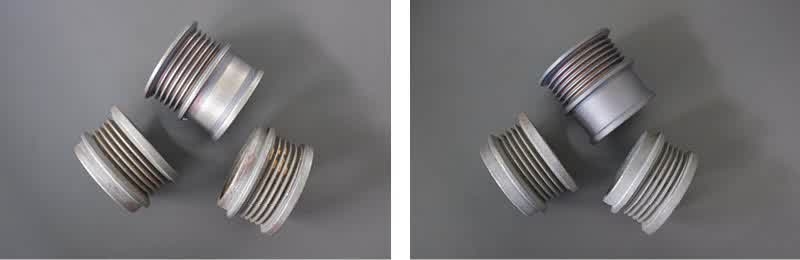 At left, before cleaning. At right, after cleaning.
What A Shop Can Check Without a Laboratory
The reasonable objection to all of the above is that it sounds like laboratory territory. Mostly it is not.
A workable acceptance regime for preparation, using shop-floor means:
- A defined visual check under defined light. State the illuminance and the viewing angle. Many contamination films are visible under grazing light and invisible under diffuse light; without specified conditions, the check is not reproducible.
- A water-break test with a stated method. A continuous film for a stated dwell time, applied by a stated method. Cheap, fast, and highly informative about surface energy.
- A profile check with a stated instrument and location. Comparator or portable gauge, on a stated area of a stated sample, one part per batch, recorded.
- A hold-time record. Time from preparation to coating, on the route card, with a stated maximum.
- A solvent rub with stated solvent, pressure, and strokes.
None of these requires a new instrument, and each converts a vague requirement into a pass/fail two people can agree on.
The Substrate Question: When Two Materials Meet
Preparation becomes materially harder when a part carries more than one material, or when an assembly is prepared before joining. The reason is that the methods have different optima.
Consider the common case of an aluminum component with steel inserts. A blasting step chosen for the steel will likely be too aggressive for the aluminum and may embed ferrous particles that later rust and stain the coating from beneath. A chemical pretreatment suited to aluminum may not activate the steel. Whichever is chosen, one surface is being prepared off-optimum, and the coating on that surface will fail first.
A record cannot fix a genuine capability gap. If a process cannot deliver the required profile or cleanliness in the available time, no amount of logging closes that gap; that is the honest case for new equipment.
The practical answer is to treat the two surfaces as separate objects with separate preparation statements, even though they are one part on one route card. That may mean two preparation steps with a masking stage between them — which carries its own risk, since masking residues are a classic cause of localized adhesion failure. Where the complexity is unavoidable, apply the acceptance rule to each surface separately and record which surface was judged by which rule.
Retrofitting Preparation On an Existing Line
Most shops facing an adhesion problem are not building a new line. They are trying to fix one, and the order that works is to instrument before investing.
Establish a baseline on the current process using the acceptance rule you intend to keep — not a rough rule you plan to replace later, since a baseline measured with a different rule cannot be compared afterward. Then record the variables that are currently invisible: hold time, media age, bath concentration, operator. It is common to find one of these has been drifting for months and that the “coating problem” tracks it exactly. Then change the cheapest controllable variable and measure again; frequently the answer is a renewal schedule or a dose check, not a new installation. Only then consider equipment, which adds variables rather than reducing them.
What We Do Not Claim
We build surface finishing equipment, so a reader should apply the usual discount. Three limits stated plainly:
No measured test data, no customer case, and no third-party certification is presented here. What is described is production practice and the reasoning behind it, offered as a way of framing a preparation problem, not as evidence that a particular change will deliver a particular adhesion result.
A record cannot fix a genuine capability gap. If a process cannot deliver the required profile or cleanliness in the available time, no amount of logging closes that gap; that is the honest case for new equipment.
And no specification substitutes for a qualified finish specification where the service conditions demand one. Where a coating carries a structural, corrosive or regulatory duty, the requirement must come from a competent engineering authority, not from a production document.
The argument is narrower than it may sound: define the surface, prepare it to a stated method, confirm it with a stated check, and record the three together. That is not a laboratory program. It is a few fields on a route card — and it is the difference between a coating that fails for a reason you can find and one that fails for a reason nobody can.
Max Xu is in Sales at SurfacePolish (Xiamen Jin Tai Jin Grinding Technology Co., Ltd.), working on deburring, grinding, polishing, and surface preparation for precision metal components. He can be reached at service@surface-polish.com.