


A finishing operation had an air-agitated wastewater treatment basin made of concrete, with a “gate” that is made of aluminum 6061 alloy.
 Frank AltmayerSome of the gate parts are 316 stainless steel, and over several years, the aluminum gate has suffered severe corrosion (Fig. 1) and has had to be replaced. Because the treatment tank contains bio-organisms, they were told that the corrosion may be the result of biological action.
However, they were aware of numerous other installations using aluminum gates in tanks with biological treatment, and they have not experienced this problem. They wondered what was going on in this situation.
A number of factors are most likely involved. Let’s first look at the data:
| Parameter | 6061 Requirements (%) | Analysis of Alloy (%) |
| Silicon | 0.6 | 0.61 |
| Copper | 0.28 | 0.21 |
| Magnesium | 1.0 | 0.88 |
| Chromium | 0.2 | 0.13 |
| Zinc | — | 0.02 |
| Iron | — | 0.24 |
| Titanium | — | 0.01 |
| Aluminum | Balance | Balance |
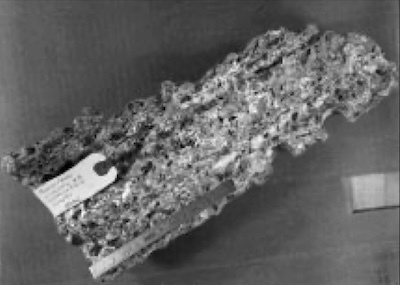 Fig. 1—Corroded aluminum part.A spectrographic analysis of the aluminum alloy yielded the following:
A microscopic cross-section showed that the corroded aluminum part exhibited both intercrystalline and exfoliation corrosion (Fig. 2). The corrosion appeared to travel between grain boundaries and rolling faults outlined by physical inclusions deposited along the same boundaries.
The physical structure of the aluminum indicated the presence of inclusions that appeared to be precipitated at grain boundaries. X-ray analysis of these inclusions indicated that they were composed almost entirely of silicon (whereas 6061 alloys typically contain inclusions composed of both magnesium and silicon, where the ratio of magnesium to silicon is 1.73:1).
The surface of the corrosion product was found to contain significant quantities of the following elements:
| Corrosion Surface | Cross-section |
| Aluminum | Aluminum |
| Sulfur | Sulfur |
| Chloride | Chloride |
| Copper | Copper |
| Calcium | Calcium |
| Iron | — |
| Phosphorus | — |
| Oxygen | Oxygen |
| Silicon | Silicon |
 Fig. 2—Cross-section of corroded part.Quantitative analysis of the corrosion products for chloride and sulfate (common corrosives for aluminum) indicated that the corrosion product contained 0.1% sulfate, 0.1% copper, 0.1% iron, and 0.5% chloride.
As for the possibility that the corrosion was caused by biological action, we refer to information from Oliver Siebert*:
Aluminum is an active metal and oxidizes rapidly when exposed to water or air. The corrosion resistance of aluminum depends upon the stability and continuity of this film or passive layer. Suppose the film is locally damaged under conditions that prevent normal self-healing, localized corrosion, such as pitting or intergranular corrosion, results. Unfortunately, the stability and continuity of the protective film are affected by aggressive ions (e.g., chlorides and other halides), complexing agents, local pH fluctuations, and crevices.
Aluminum is very susceptible to microbiologically influenced corrosion (MIC). Corrosion attack occurs in both aerobic and anaerobic systems. Among the several bacteria and fungi, the sulfate-reducing bacteria, SRB, are a type.
Is the Alloy Correct?
 Fig. 3—Corrosion on gold plate.The aluminum part supplied meets alloy 6061 compositional requirements.
The use of 6061 alloy in this application may be questioned, because this alloy is more susceptible to intergranular corrosion than a 5xxx series alloy.
Referring to Metals Handbook, Ninth Edition, Volume 13, page 586:
5xxx Wrought and Cast Alloys—have high corrosion resistance, and this accounts in part for their use in a wide variety of building products, chemical processing, and food-handling equipment, as well as applications involving exposure to seawater. Alloys in which the magnesium is present in amounts that remain in solid solution, or is partially precipitated as AL8Mg5 particles dispersed uniformly throughout the matrix, are generally as resistant to corrosion as commercially pure aluminum and are more resistant to salt water and some alkaline solutions such as those of sodium carbonate and amines.
6xxx Wrought Alloys—Moderately high-strength and very good resis-tance to corrosion make the heat-treatable wrought alloys of the 6xxx series (aluminum-magnesium-silicon) highly suitable in various structural, building, marine, machinery, and process-equipment applications, The Mg2Si phase, which is the basis for precipitation hardening, is unique in that it is an ionic compound and is not only anodic to aluminum, but also reactive to acidic solutions.
When the magnesium and silicon contents of a 6xxx alloy are balanced (in proportion to form only Mg2Si), intergranular corrosion is slight in most commercial environments; however, if the alloy contains silicon beyond that needed to form Mg2Si or contains a high level of cathodic impurities, susceptibility to intergranular corrosion increases.
The spectrographic analysis of the aluminum indicates that it has approximately 20 percent more silicon than that required to form Mg2Si. The proper magnesium content for 0.61 percent silicon would be 1.0 percent. Therefore, while the supplied aluminum met the requested contract specification, it did not achieve the best corrosion-resistance performance. Also, a 5xxx series alloy would have been a better choice for the gate.
The corrosion product analysis indicates that the aluminum has formed primarily sulfate, copper, iron, and chloride compounds. The water in the wastewater treatment plant contained significant amounts of chloride, copper, iron, and sulfate, which contributed to the corrosivity of the liquid to which the aluminum was exposed. The literature indicates that aluminum alloys are subject to accelerated corrosion in the presence of copper ions.
Given that other installations around the country have aluminum alloy components exposed to microbial activity and do not corrode at the same accelerated rate, we suspect corrosion in this case resulted from exposure of this alloy to water containing corrosives and copper ions.
Further, stainless steel and aluminum (any alloy) will form a galvanic couple, with the aluminum behaving anodically to the stainless steel (resulting in the dissolution of the aluminum). The presence of chloride and sulfate in the liquid in which the two metals are immersed provides a very conductive electrolyte for this “battery.” Copper makes an additional anodic metal for aluminum. Because copper is far more noble than aluminum, one can expect the dissolved copper ions to deposit onto the aluminum, creating additional “batteries.”
The stainless steel components on the gate should be replaced with aluminum components (or, better yet, the gate should be replaced with a stainless steel gate).
Frank Altmayer is a Master Surface Finisher, an AESF Fellow, and the technical education director of the AESF Foundation and NASF. He owned Scientific Control Laboratories from 1986 to 2007 and has over 50 years of experience in the metal finishing industry. He received the AESF Past Presidents Award, the NAMF Award of Special Recognition, the AESF Leadership Award, the AESF Fellowship Award, the Chicago Branch AESF Geldzahler Service Award, and the NASF Award of Special Recognition.