


We investigated the effect of increasing concentrations of NH4+, Li+, Na+, and K+ on plating rate and bath stability in a lactate-acetate EN plating solution.
 Glenn Mallory and
Konrad ParkerThe relationship between sulfate and phosphite salt solubilities and metal turnovers was studied. We also determined deposition potentials, microstructures, and phosphorus contents.
Since its industrial development in the 1950s, electroless nickel (EN) has found increasing use on a wide variety of parts, primarily for functional engineering applications requiring corrosion and/or wear resistance. Although its growth has slowed in the last few years, the total value of EN coatings in the U.S. is estimated at $200 million.1
EN plating has three major disadvantages compared to electrolytic nickel plating:
- High chemical cost ($0.40 to 0.70/L)
- Limited plating bath life (3 to 6 MTO)
- Expensive spent bath treatment or disposal
Limited bath life results from the continuous accumulation of phosphite and sulfate salts as byproducts of the plating reaction. To maintain optimum pH, frequent alkali addition is necessary. The main reactions are:
(1) Reduction NiSO4 + 3MH2PO2 → Ni0 + 2MH2PO3 + MHSO4 + P + 1/2H2
(2) pH adjustment (4.5 to 6.0) 2MOH + MH2PO3 + MHSO4 → M2HPO3 + M2SO4 + 2H2O
Note: This article was published in 1994, and some financial data may not be adjusted.
Table 1 shows the rapid increase in salt concentration with each nickel turnover (MTO = 1, initial nickel concentration is replenished once) in a typical EN plating bath containing nickel sulfate, sodium hypophosphite, and sodium salts of organic acids, with potassium carbonate as the pH adjuster. Increased salt content increases the solution's density and viscosity, decreases the plating rate, and induces precipitation of nickel phosphite. The NiP deposit properties deteriorate, as evidenced by increasing porosity and tensile stress. Blistering on aluminum is common after three MTOs.
Table 1: Salt Concentrations in mol/L
| MTO | [SO4-2] | [HPO3-2] | [Na+] | [K+] |
| 0 | 0.1 | 0 | 0.6 | 0 |
| 1 | 0.2 | 0.27 | 0.9 | 0.2 |
| 2 | 0.3 | 0.54 | 1.2 | 0.4 |
| 3 | 0.4 | 0.81 | 1.5 | 0.6 |
| 4 | 0.5 | 1.08 | 1.8 | 0.8 |
| 5 | 0.6 | 1.35 | 2.1 | 1.2 |
| 6 | 0.7* | 1.62** | 2.4 | 1.2 |
*100 g Na2SO4; **200 g Na2HPO3
Table 2: Solubilities of Monovalent Salts Of Phosphorous Acid
| Phosphite | Solubility; g/L 0C | Other |
| NH4(H2PO3) | 620 | 75040 |
| 1710 | 260031 | |
| Li2HPO3 | 90 | 30100 |
| Na2HPO3 | 800 | 100050 |
| NaH2PO3 · 5/2H2O | 500* | 193042 |
| KH PO | 220030 | |
| NiHPO3 | 7 | 3100 |
Table 3: Solubilities of Monovalent Salts of Sulfuric Acid
| Sulfate | Solubility; g/L 0°C | 100°C |
| (NH2)4SO4 | 706 | 1038 |
| Li2SO4 | 261 | 230 |
| Na2SO4 | 48 | 427 |
| K2SO4 | 120 | 241 |
| NiSO4 | 293 | 837 |
Table 4: Generic Plating Formulations
| MTO-0 | M |
| Nickel Sulfate | 0.102 |
| Lactic acid | 0.306 |
| Acetic acid | 0.25 |
| M Acetate | 0.25 |
| Hypophosphorous acid | 0.306 |
| Lead | 0.5 ppm |
| MTO-3 Add | |
| M SO | 0.306 |
| Phosphorous acid | 0.84 |
| MOH | to pH 4.6 |
| MTO-6 Add | |
| M4SO4 | 0.612 |
| Phosphorous acid | 1.68 |
| MOH | to pH 4.6 |
M = NH4+; Li+; Na+; K+
Table 5: Plating Solutions without Sulfate
| Constituent | Concentration M MTO-0 | MTO-6 |
| Nickel hypophosphite | 0.102 | 0.102 |
| Hypophosphorous acid | 0.102 | 0.102 |
| Lactic acid | 0.306 | 0.306 |
| Acetic acid | 0.25 | 0.25 |
| K acetate | 0.25 | 0.25 |
| Phosphorous acid | — | 1.68 |
| Lead; ppm | 0.5 | 0.5 |
| KOH | to pH 4.6 | |
| Temperature | 87 ± 2°C |
Table 6: Plating Experiment Results
| MTO | 0 | 3 | 6 | 0 | 3a | 6b | 0 | 3 | 6c | 0 | 3d | 6b |
| Plating rate m/h | 13 | 9 | 5 | 19 | – | – | 15 | 11 | – | 13 | 9 | – |
| Phosphorous content wt % | 9.6 | 9.9 | 10.0 | 10.2 | – | – | 10.0 | 10.1 | – | 10.1 | 10.3 | – |
| Intrinsic stress KSI | 0.02 | 0.28 | 8.3 | -0.03 | – | – | 0.07 | 0.3 | – | -2.2 | 3.2 | – |
| Intrinsic stress MPa | 0.14 | 2 | 58 | -0.2 | – | – | 0.5 | 2 | – | -15 | 22 | – |
| Initial deposition potential mV (86C) | -604 | -606 | -610 | -589 | – | – | -590 | -602 | – | -597 | -614 | – |
a. Precipitate forms at 85°C; b. Not run; c. Precipitate forms after about 30 min of plating; d. Light precipitate forms during make-up; dissolves on heating
Table 7: Summary of X-ray Data
| Sample | d A | D A |
| NH4+ MTO-0 | 2.01 | 14 |
| NH4+ MTO-3 | 2.01 | 15 |
| NH4+ MTO-6 | 2.01 | 13 |
| Li+; MTO-0 | 2.01 | 15 |
| K+; MTO-0 | 2.01 | 15 |
| Na+; MTO-0 | 2.02 | 15 |
Table 8: Lithium Phosphate Removal 1.75 MTO
| Constituent | Initial Concentrations; M w/sulfate | w/o sulfate |
| NiSO4 | 0.102 | |
| Ni(H2PO2)2 | 0.102 | |
| H3PO2 | 0.102 | 0.102 |
| Lactic acid | 0.306 | 0.306 |
| Acetic acid | 0.25 | 0.25 |
| Li acetate | 0.25 | 0.25 |
| Li2SO4 | 0.275 | |
| H3PO3 | 0.47 | 0.47 |
| Lead | 3.86 x 10⁻⁶ | 3.86 x 10⁻⁶ |
| LiOH | to pH 4.6 | to pH 4.6 |
| Temperature | > 95°C | > 95°C |
The solubilities of alkali phosphite and sulfate salts are shown in Tables 2 and 3. As expected, the ammonium salts are most soluble. The nickel and lithium phosphites have the lowest solubilities in water. Because a mixture of sodium and potassium sulfates is present in the used plating bath, the actual phosphite solubilities are lower than in water alone. The nickel phosphite solubility depends on the chelating acids used in the EN formulation, which control the “free nickel” ion concentration.2
Sodium and potassium sulfate often crystallize when the spent bath is stored below 5 C. The phosphite anion can precipitate as a calcium or magnesium salt; however, the plating solution will then contain calcium or magnesium cations that impair deposit properties.3 The use of lithium salts in an EN bath has not been previously reported. In an electroless copper bath, lithium hydroxide was superior to sodium and potassium hydroxide in improving the plating rate and the mechanical properties of the copper deposits.4 One early reference found a sodium glycolate bath to plate at 21 mm/hr at 97°C and an initial pH of 4.5, compared to a rate of 16 mm/hr for an ammonium glycolate bath.5
This investigation explores the effect of varying the monovalent alkali ions in an EN plating solution.
Experimental Procedure
For all plating experiments, 4L solutions were used. Because only the sodium salts of hypophosphorous acid are commercially available, the other alkali hypophosphites were prepared in situ from the acids by neutralization with the appropriate alkali or ammonium hydroxide. The initial and simulated three- and six-turnover generic formulation baths are as shown in Table 4.
We prepared the three- and six-MTO baths from MTO0 by adding the calculated amounts of sulfuric and phosphoric acids, then neutralizing with the appropriate alkali or ammonia to reach the desired salt concentrations. Plating was performed in thermostatically controlled 4L Pyrex beakers. The initial pH of all baths was 4.6. Plating was carried out at 87°C ±2 for 1 to 2 hr. Plating rates were determined by measurement of deposit thickness. Initial deposition potentials were measured against Ag/AgCl with a digital multimeter at 85°C. Deposit composition was obtained by foil analysis using an electron beam microprobe (EDS). Intrinsic stress measurements were made with a spiral contractometer. The MTO0 deposit crystal structures were examined on foils with an X-ray diffractometer. Plating solutions containing potassium salts, but no sulfate ions, were prepared and evaluated as listed in Table 5.
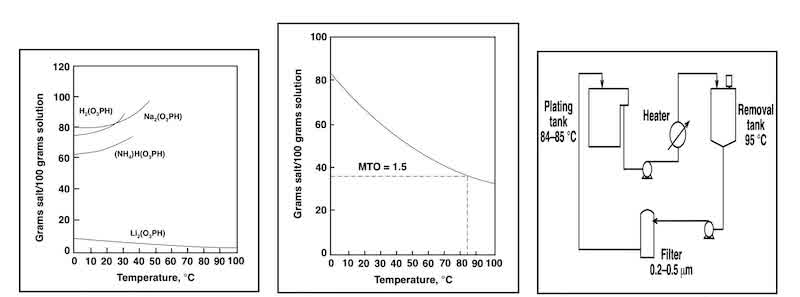
Fig. 1—Solubility of anhydrous phosphites; Fig. 2—Solubility of lithium phosphite; Fig. 3—Lithium phosphite removal.
Results and Discussion
The results of the initial experiments are shown in Table 6. The plating rates of all the baths decreased by about 30 percent after three metal turnovers. Surprisingly, the lithium bath showed the fastest initial plating rate and produced a deposit with relatively low potential and slightly higher phosphorus content.
The ammonium bath plated the slowest; however, it yielded six turnovers without precipitation. Both results can be attributed to the nickel complexing action of ammonia. Tensile stress increased considerably with turnovers in deposits from the ammonium and potassium baths. Comparison of X-ray diffraction diagrams of the MTO0 foils reveals no microstructural differences among the various cation deposits (Table 7).
In the absence of sulfate, the potassium plating bath initially plated at 12.5 mm/hr. After adding 68 M potassium phosphite (6 MTO), the plating rate decreased to 5 mm/hr. The deposition potential also decreased from 590 to 620 mV.
Because lithium phosphite has lower solubility than other monovalent cation phosphites (Figs. 1 and 2), we investigated the possibility of phosphite reduction in a used lithium plating bath. A 1.75 MTO solution was simulated with lithium acetate, sulfate, and hydroxide (Table 8). Filtration at 95°C through a 0.5 µm membrane reduced the phosphite content from 39 to 30 g/L. It increased the plating rate from 16.3 to 17.5 mm/hrmA/hmay be possible to remove part of the accumulating phosphite during plating by continuous filtration, as shown in the diagram of Fig. 3. The operating life of the lithium bath would thereby be extended, and the plating rate increased.
Summary
Electroless nickel plating solutions containing lactic and acetic acids as complexants and buffers were prepared with hypophosphorous acid and ammonium, lithium, sodium, or potassium hydroxide at 0, 3, and 6 metal turnovers. At 87°C and pH 4.6, the lithium bath had an appreciably faster initial plating rate, but it precipitated after a few metal turnovers. The ammonium bath had the slowest initial plating rate; however, it was the only solution that plated at six metal turnovers without precipitation. Further investigation is warranted into removing lithium phosphite by filtration during plating to extend the life of an EN plating bath.
Findings
The four monovalent cations investigated have diverse effects on the operation of an electroless nickel plating system. The low solubility of the accumulated potassium sulfate limits the potassium bath. Sodium ions have a similar effect on the process at greater MTOs, but for different reasons. In the all-sodium bath, nickel phosphite is the principal precipitate, at about three MTOs.
When ammonium ions are used, the amine group's complexing effect with nickel enhances nickel solubility at the expense of nickel phosphite precipitation. Also, ammonium ions increase the solubility of the sulfate anion relative to sodium and potassium sulfate. However, the deposition rate decreases with increased NH+ concentration.
Finally, the lithium ion has two positive effects on the EN plating system. First, the rate of deposition increases in the all-lithium bath. Second, and most importantly, the low solubility of dilithium phosphite (Li2HPO3) at 88°C can control the accumulation of orthophosphite in the EN plating bath to about one MTO.
References
- Parker, Plat. and Surf. Fin., 79, 31 (Mar., 1992).
- O. Mallory, Plating, 61, 1005 (Nov., 1974).
- Parker, Plat. and Surf. Fin., 67, 48 (Mar., 1980).
- Matsuoka et al., Chemistry Express, 7(3), 181 (1992)
- Bosdorf and K. Muller. Metalloberfläche 12(5), 150 (1958).
About the Authors
Glenn O. Mallory is a founder of Electroless Technologies Corp. (ETC), 3860 Cloverdale Ave., Los Angeles, CA 90008. He specializes in electroless deposition and has more than 30 years’ experience in the surface finishing industry. He is a former vice president of R&D for electroless nickel development at Allied-Kelite Div. of Witco Chemical Corp. He holds a BS from UCLA and an MS from California State University, Los Angeles.
Konrad Parker is a specialist in electroless nickel plating. An MS graduate of the Illinois Institute of Technology, he holds many patents. He has authored numerous papers, including “The Formulation of Electroless Nickel-Phosphorus Plating Baths,” for which he received the AESF Gold Medal in 1988.