


A company contacted me about manufacturing a grounding strap consisting of copper braid with a crimped connector end made of tin-plated steel.
 Frank AltmayerThe opposite end of the strap is where the copper braid is soldered, and a stainless steel clip is bolted on. When the strap is installed underneath a car, a loose-fitting plastic sleeve protects the copper braid from impact. Figure 1 illustrates this product.
The company has experienced a significant number of corrosion failures, as illustrated in Fig. 2. The copper braiding is attacked. The stainless steel clip corrodes, and they asked for my opinion on how to fix the issue.
There are three major concerns I have about this component:
Dissimilar Metals Causing Galvanic Corrosion
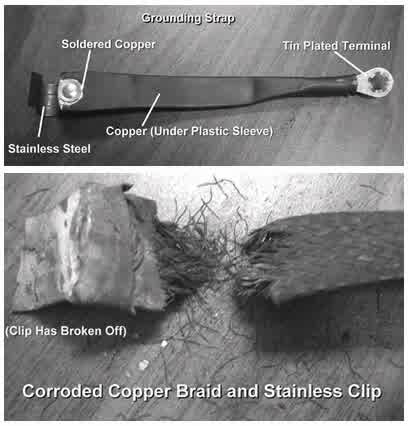 Fig. 1—Grounding strap. Fig. 2—Corroded braid.Corrosion can be produced when two different metals are in contact with a liquid that conducts current. This liquid may be water, or, in this case, most likely water containing highly conductive road salt. The two different metals that become the terminals of a battery need to be different in electrochemical activity. In other words, some metals are compatible and don’t form a galvanic corrosion cell when exposed to water, while others are incompatible. When an incompatible set of metals is in contact with water, one of these (the one that is more electrochemically active) will corrode. A classic example is copper and zinc, which will make a battery that generates about 1 volt when these two metals are exposed to water at the same time. The zinc is more electrochemically active than the copper, so the zinc corrodes.
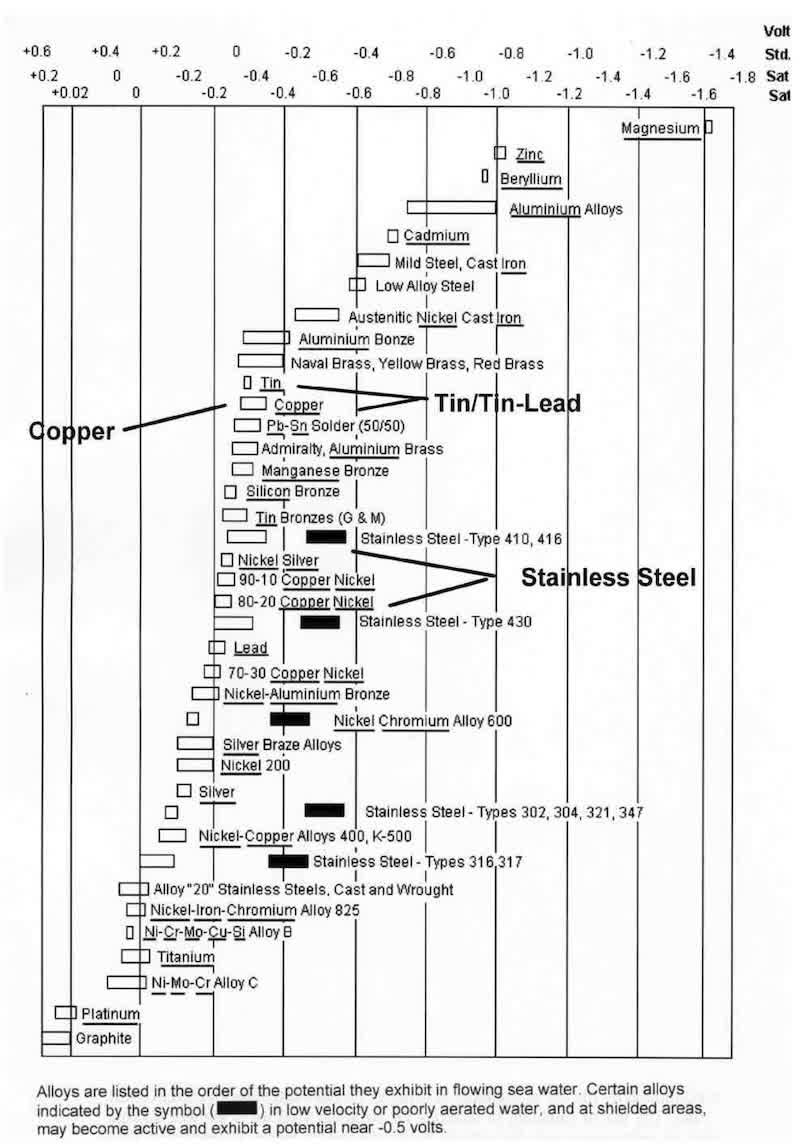
In the company’s case, a copper braid is connected to a tin-plated terminal at one end. To see if copper and tin produce a battery in saltwater, we consulted a galvanic series in seawater. This can readily be obtained via the internet. Fig. 3 shows a galvanic series in seawater from www.corrosionsource.com. Since tin and copper are located very close to each other, they are considered a compatible couple, and we would not expect galvanic corrosion between the copper braid and the tin-plated terminal. However, the same chart shows that copper and stainless steel can form a galvanic cell, with the stainless steel as the corroding terminal. This is most likely what is causing the premature corrosion failure.
One fix would be to tin-plate the entire strap, eliminating any galvanic cell formation. An alternative overplate is electroless nickel (high phosphorus preferred), which can better cover a complex component such as copper braiding.
Oxygen Concentration Cell Corrosion
 The plastic sleeve is loosely attached over the copper braid. The gap between the plastic and the braid will act as a capillary, holding saltwater against the copper braid. This creates an oxygen difference between the strap surface not covered by plastic and the surface that is covered.
Whenever metal sees differences in oxygen, the oxygen-deficient surface tends to corrode. This is called oxygen concentration cell corrosion. In this case, the copper braiding corroded since the copper covered with plastic was oxygen deficient. The plastic sleeve should either be eliminated or bonded to the braiding to prevent liquid from contacting the clean copper.
Chemical Attack
Copper is chemically attacked by sodium chloride over time. In the absence of the plastic sleeve, this may occur too slowly to be a concern. However, in the presence of the plastic sleeve, which introduces another corrosion mechanism, the overall corrosion process accelerates.
A salt exposure test can readily confirm this. To protect the copper from chemical attack by road salt, it needs a protective over-plate such as the tin or electroless nickel discussed above.
Frank Altmayer is a Master Surface Finisher and an AESF Fellow and the technical education director of the AESF Foundation and NASF. He owned Scientific Control Laboratories from 1986 to 2007 and has over 50 years of experience in metal finishing. He received the AESF Past Presidents Award, NAMF Award of Special Recognition, AESF Leadership Award, AESF Fellowship Award, Chicago Branch AESF Geldzahler Service Award, and NASF Award of Special Recognition.