



Before Imran Shamsi joined his family’s finishing business in San Diego, he was working his way through the corporate ladder at a major U.S. company, where things were a bit different than where he is now.
 Imran Shamsi“In the corporate world, you develop relationships and you solve the problem by providing a solution,” says Shamsi, Vice President at Premier Metal Processing. “It’s the foundation of sales, which is listening as much as you can to get what you need to close and close. It’s not like that in the finishing world.”
What Shamsi realized when he joined the family business was that sales take much longer than they normally would in any other business. It was something he had to get used to when he first joined the company in 2007.
“I’ve seen it where it is hurry in, promise the world, then get it in your door, and that doesn’t work exactly in finishing,” he says. “In our experience, it doesn’t work. It may work for others, but in our experience, it has not been effective. For us, it is just a long play. I didn’t realize that there was a long game here, and for me it turned out to be much more beneficial.”
Developing Customer Relationships Pays Off
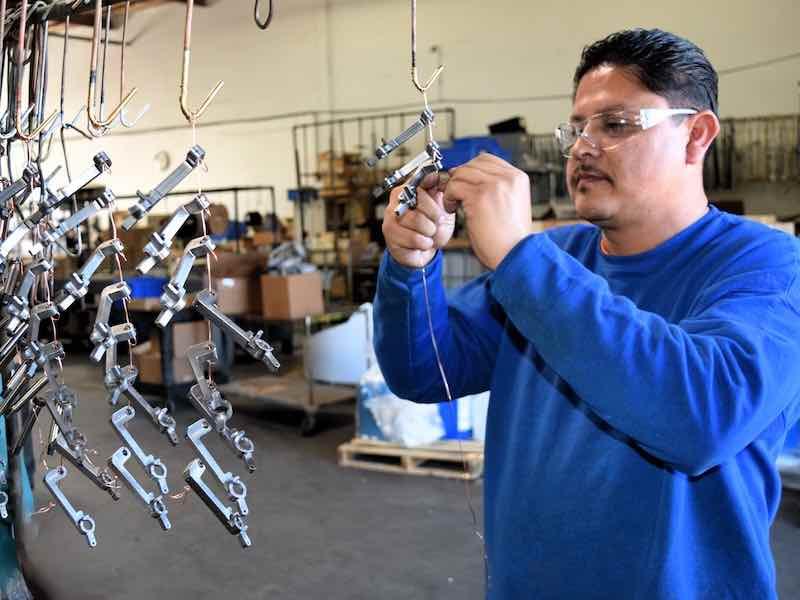 The company offers anodizing, electrolytic nickel, bright tin, chemfilm, electroless nickel, electropolish, passivation, and zinc to customers across various industries.But it wasn’t always that way for Shamsi; when he first switched to the finishing industry, he thought he was the world’s worst salesperson because he had trouble closing sales. It took time to realize that it could be months — or even years — before they get a customer they had chased, and it was often hard to grasp that reality.
“At that time, I thought the long game was going to drown us and we’re going to be out of business before the long game plays out,” Shamsi says. “It was just a weird gamble, and I didn’t realize I was playing the long game at the time. Then, all of a sudden, these relationships that I’ve been developing for six, eight, nine months to a year, all of a sudden they are coming together.”
The company has achieved sustainable growth by offering anodizing, electrolytic nickel, bright tin, chemfilm, electroless nickel, electropolish, passivation, and zinc to customers across various industries. The company serves customers in the aerospace and defense, medical, electronics, oil and gas, connectors, microwave, nuclear, automotive, and commercial sectors.
“It’s like we’re doing ultimate expedites. We’re trying to shorten the lead on less work, and it’s a very weird right dynamic we currently have. I feel as though maybe it’s just companies holding tight, waiting to see how the next round of economic changes or administration shifts will affect their actions.”
“We do hit quite a few industries, and we offer a pretty diverse amount of services,” Shamsi says. “We do everything but spray-on coatings.”
The diversity of business sectors among Premier Metal Processing’s customers has been a significant benefit to its growth.
“ We’ve purposely — as well as by luck — diversified so that we’ve always had the benefit of working with multiple industries,” Shamsi says. “We work within the aerospace industry, which is starting to be a little bit more constrictive for us. We do work a lot with parts destined for the Department of Defense, electronics, and semiconductors.”
Maintaining Workflows in Slower Economic Times
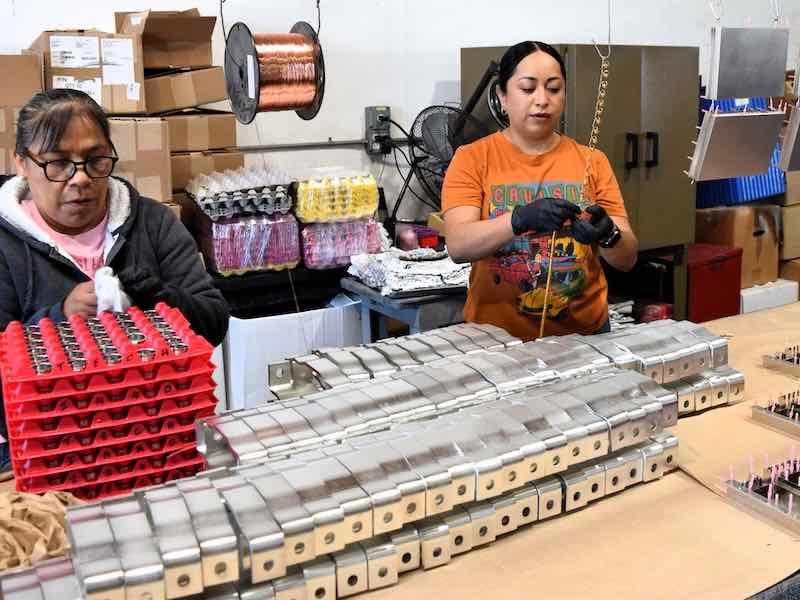 PMP serves customers in the aerospace and defense, medical, electronics, oil and gas, connectors, microwave, nuclear, automotive, and commercial sectors.The shop performs significant work with nuclear power reactors and underwater marine applications. It is that range of sectors that keeps Premier Metal Processing busy even in slower economic times, and it is not susceptible to the peaks and valleys of downturns in one particular industry.
“We’re not really a niche shop, so I can’t really say, ‘Oh, we’re great with connectors,’ or ‘We’re great with this,’” Shamsi says. “It’s been the saving grace. The benefit is that historically, one industry will go down, whereas we always have one industry we could rely on, or the other industries will do well.”
He says the only exception to that would be the last year and a half to two years, during which Shamsi notes the business model has undergone significant changes compared to the first 15 years he has been in the business.
Instead of an entire sector suffering a downturn, as has happened in the past, he sees an industry slowdown; yet several OEMs in the industry are still thriving.
“Take the Department of Defense, where certain primes in that area will be doing phenomenal, and the rest of them in that industry will not be doing well,” Shamsi says. “Now, it’s not really industry-specific that I see. It’s usually customer-specific or, more specifically, prime-specific. It’s a very unusual time, as I’ve been doing this for about 18 years. It’s the first time I’m seeing that in the last year and a half or two years.”
“It’s a matter of being on the same team with your customer and figuring out solutions that work for their buyer and their customer.”
In the current economic state, he says Premier Metal Processing is seeing a lot of companies holding tight on their inventories, and then producing components in bursts, which often puts a strain on the finisher/
“It’s like we’re doing ultimate expedites,” Shamsi says. “We’re trying to shorten the lead on less work, and it’s a very weird right dynamic we currently have. I feel as though maybe it’s just companies holding tight, waiting to see how the next round of economic changes or administration shifts will affect their actions. And then, eventually, they reach a point where we can’t hold on so tightly for so long, and it’s like opening the floodgates, and everything gets expedited. And then it’s like panic runs right now that we see here in what we do every day.”
Building on the Customer Partnerships
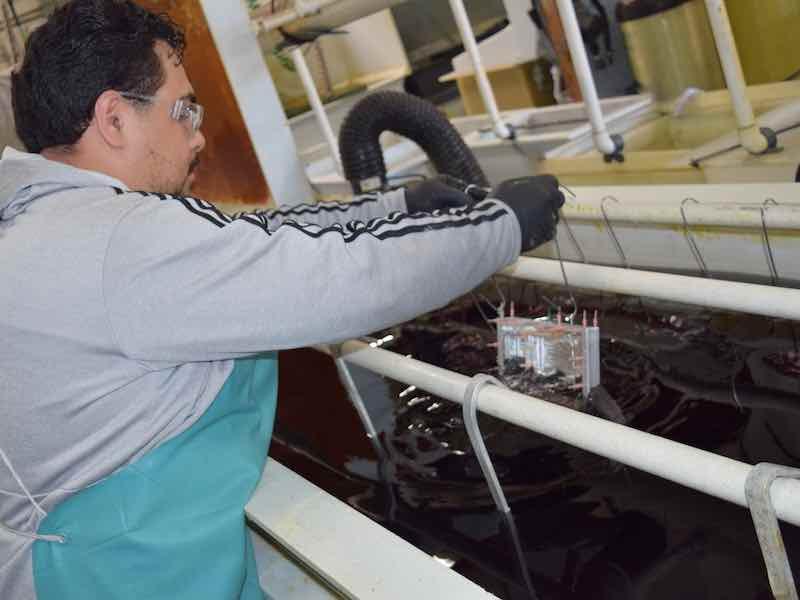 The shop performs significant work with nuclear power reactors and underwater marine applications.Where Premier Metal Processing has succeeded is in building on its partnership with customers once the work is in the door. The team works hard to ensure their finishes exceed customer expectations, so customers feel they are being treated in the best possible way.
Shamsi says that the only way Premier Metal Processing knows how to satisfy customers is by delivering exceptional service and quality.
“Once you get that relationship, it’s about performance,” he says. “The performance is the hardest, but you have to surpass step one, which is to get the shot at doing the work. When you’re taking on a new project, you are not necessarily going to hit it out of the ballpark day one. But if you already have that established relationship with them before you got the shot, they’re more willing to work with you.”
As an example, Shamsi says they may be asked to chemfilm a part for one customer who thinks the finished product is perfect. Another customer may request the same process but wants a different shade of yellow.
“You tell them it meets spec, but they say, ‘No, we want it to be that,’” he says. “So now we have to get ourselves accustomed to their needs, which are separate from the rest. Are we willing to work with them? Of course. But it’s a learning game. Performance is like quality; you’re just trying to always improve and try to make it not a pass-fail situation.”
“We had an electrician come out that day, and they miswired one of the two fail-safes on the liquid level and the overload fuse. We had both happen coincidentally, and unfortunately, at the first time we ran the second shift.”
Shamsi says Premier Metal Processing has taken the approach of being an extension of its customers, because it is not only trying to please its customers but also their customers’ customers.
“We’re both on the same team trying to figure out the same thing,” he says. “The reality is that if I work for a company like General Atomics or Northrop Grumman, they have a customer they’re selling to, and if they don’t continue to get work that funds that program, that work isn’t coming to us or anyone else in this industry. It’s a matter of being on the same team with your customer and figuring out solutions that work for their buyer and their customer.”
Mohammed Shamsi’s Decades of Experience in Finishing
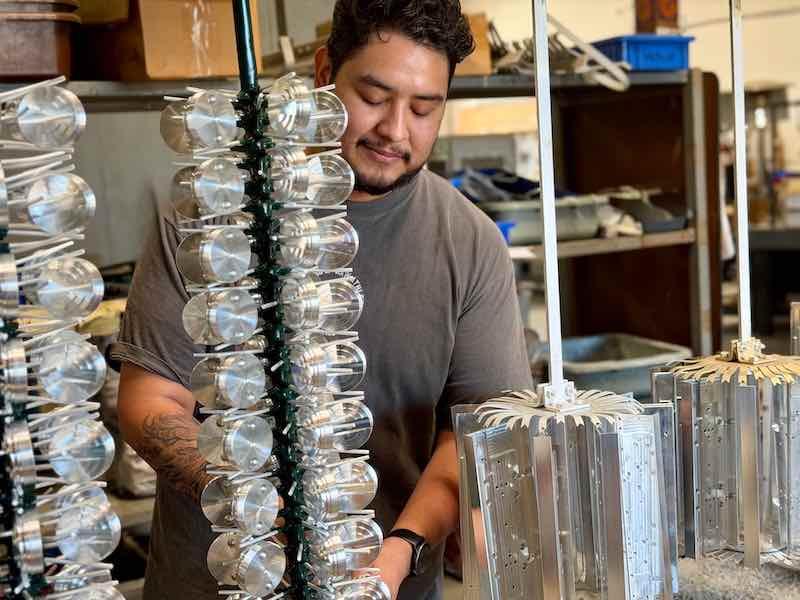 Where Premier Metal Processing has succeeded is in building on its partnership with customers once the work is in the door.Luckily for Shamsi, his father, Mohammed Shamsi, has worked in the industry for several decades in facilities throughout California. His knowledge of plating processes is immeasurable, and is a big reason many customers have come to Premier Metal Processing and stayed.
Mohammed Shamsi had been a General Manager for several major finishing operations, including All Metals Processing, Precision Anodizing, and Embee in Orange County, California.
Imran Shamsi says that when his father contemplated starting Premier Metal Processing in 2007, he was well-versed in the operational side of the business but less knowledgeable about the company's financial aspects.
“He’s always had a good, firm understanding of how to deal with individuals that come from different backgrounds and how to make a cohesive unit to get product out the door,” Imran says. “The business aspect of it was not something he was interested in whatsoever. It was just not his cup of tea, and it was not something he pretended to know, nor was it something that he even wanted to deal with.”
That is why Mohammed Shamsi brought his son on board — with his broad corporate experience — to handle the business side and to get the company off the ground.
“I make sure it gets done well and on time,” Shamsi says. “We coexist, and he was phenomenal at that. He was much better than I was, for sure.”
Second Shift Starts with a Scary Beginning
When things began to really take off for Premier Metal Processing in 2008 — just a year into their family venture — they decided to add a second shift because they were receiving a large number of orders and running out of space in the shop to store them while they were being finished.
Unfortunately, on the initial day of the second shift, Premier Metal Processing suffered a fire in its electroless nickel tank. Although the incident was quickly contained, it served as a reminder of how fragile the finishing industry can be.
“We had an electrician come out that day, and they miswired one of the two fail-safes on the liquid level and the overload fuse,” Imran says. “Essentially, we had a control fire because our second shift didn’t shut off the heater correctly. We had both happen coincidentally, and unfortunately, at the first time we ran the second shift.”
Premier Metal Processing has grown to a steady workforce of 15 people, and will occasionally add personnel when the work warrants it.
It is part of Shamsi’s business acumen to manage staffing levels properly. He says he has grown in the position and now better understands when to add staffing.
“It’s not just customer service, it’s the relationships. Perhaps I’m not the best fit for you, or maybe you’re not the ideal customer for us. It’s a matter of understanding that and trying to either sever that relationship or figure out a way to make it better.”
“We’ve been overstaffed many times, and it’s not a smart decision to carry on that much staff,” he says. “We should have downsized quite a few times for small periods of time, but then the way I always looked at it was we were always quick to act. Many of our competitors claim they need four, five, or six days to turn around parts, but not because they are overwhelmed; it’s because they have short staffing. They were sized appropriately in the business. We being oversized would be like, ‘Oh yeah, no problem.’”
Premier Metal Processing could turn the work around quickly, Shamsi says, because one, they didn’t have that much work, and two, they were overstaffed. That played to their benefit many times, and in others, not so much.
“We were quick to act during those downturns,” he says. “Was that a smart decision? I don’t know. Sometimes yes, sometimes no.”
Managing Ever-Changing Regulatory Demands
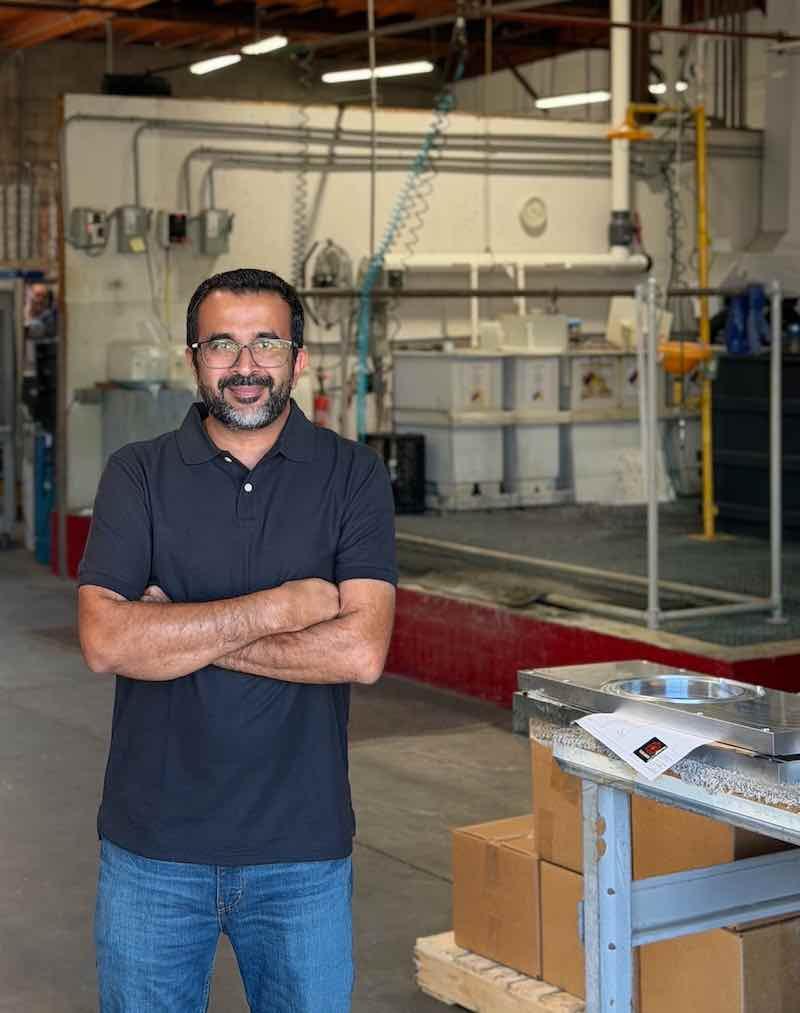 Shamsi says Premier Metal Processing will continue to focus on providing its customers with exceptional service.Aside from managing the business side of Premier Metal Processing, Shamsi is also integral to handling the ever-changing regulatory issues that metal finishers face in California. For example, after the 2008 fire, the company faced significant regulatory issues when it decided to relocate the business, inadvertently triggering regulations that a new business would typically face.
Shamsi says it was a trying time for him and the company when he thought he was undertaking a fairly simple process of moving to a different location.
“It was the worst time I could imagine in my life,” he says. “By far the most difficult time I ever had. We made a lot of missteps, including moving after the fire, but we didn’t realize that would set us up for a new business, even though we moved just a block and a half. It was just a logistical nightmare. When I compare everything to today, back then, it all seems easier.”
However, the Shamsis remain cautious about the state of the metal finishing industry in California, where regulators aim to phase out hexavalent chromium and other processes, citing concerns about their impact on local air quality. It is a major concern not only for Premier Metal Processing, but also for other finishing operations on the West Coast.
“In the last five to 10 years, I’ve noticed a change in California,” Shamsi says. “California has been a little bit more stringent in some areas, a little bit more lax in certain areas. The local government comes into play because it typically communicates with us about what’s happening. In San Diego County, we have quite a few regulatory bodies, and basically they’ll say, ‘Okay, at the state level, this is going into effect, and this is what we require of you.”
That has all changed in recent years, he says, and it is much harder to predict how new regulations will affect Premier Metal Processing and other operations going forward.
“Recently we had some politicians here talking about PFAS,” Shamsi says. “It’s a bad substance, there’s no doubt about it. There’s no way a plater could say it’s a good thing for the environment and the world as a whole. However, the way they’re looking at it is a frontline metal finishing industry problem, and that’s not entirely accurate. It’s like we turned into that scapegoat, and how do you battle that?”
Instead, Premier Metal Processing will continue to focus on providing its customers with exceptional service, grow relationships with existing clients, and attract new customers where there is a good fit.
“It’s not just customer service, it’s the relationships,” Shamsi says. “We all have customers that we don’t necessarily like dealing with, and it’s okay, but you have to understand where they’re coming from and try to sit in their shoes, too. Certain marriages are simply not meant to work, and it’s a matter of determining what’s best and most amicable in this situation. Perhaps I’m not the best fit for you, or maybe you’re not the ideal customer for us. It’s a matter of understanding that and trying to either sever that relationship or figure out a way to make it better.”
Visit https://pmpisd.com.