
In the earlier stages of the recovery effort, much of the focus centered around emergency response, demolition, insurance coordination, and stabilizing operations after the fire.
 Jim Wetherald and Dan RoseToday, the project has transitioned into a very different phase — one focused on reconstruction, modernization, and long-term operational planning.
Like many companies in the metal finishing industry, Elite Metal Finishing has evolved over the decades. As production demands changed, equipment was added, modified, relocated, and expanded over time. The fire forced everyone involved to step back and evaluate not only what needed to be rebuilt, but how the facility should operate moving forward.
As difficult as the event was for the company, employees, customers, and vendors, it also created an opportunity to address long-standing operational challenges and rethink portions of the facility from the ground up.
Read the previous articles:
Rebuilding After the Flames, Part I: Navigating Fire Remediation in a Plating Shop
Rebuilding After the Flames, Part II: Progress and Purpose in Fire Remediation
Major Progress Has Been Made
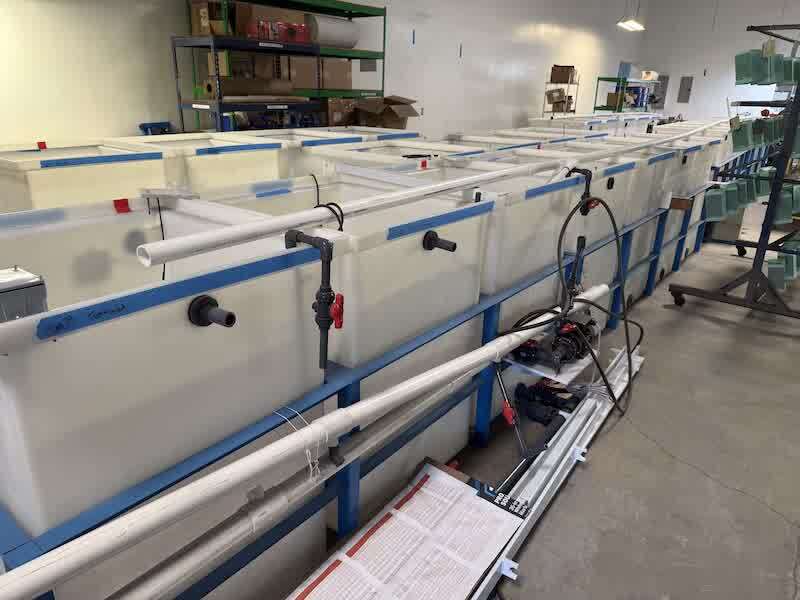 New tanks ready to be installed.Over the past several months, the rebuild effort has continued moving forward aggressively.
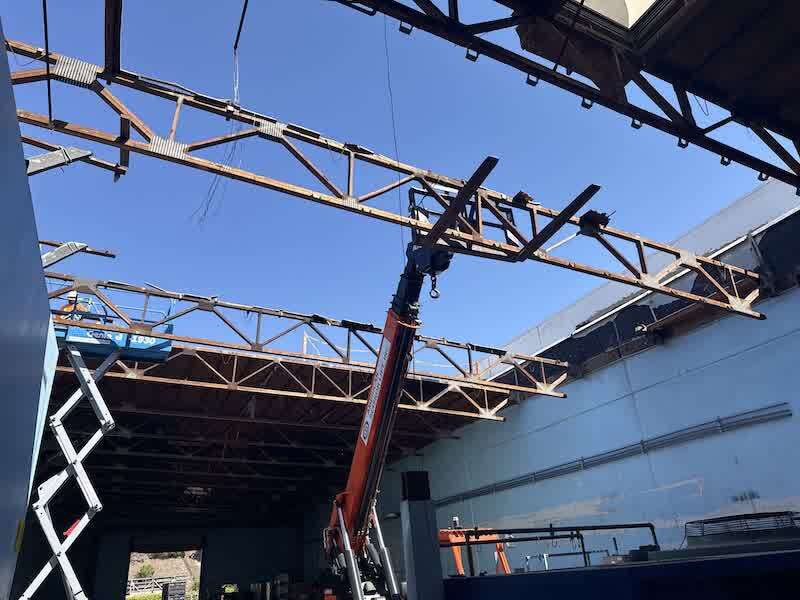
Elite has completed installation of the new roof structure and completed the majority of the required concrete work associated with the rebuild. In parallel, major long-lead equipment packages for the sulfuric anodize and supporting process systems have already been ordered to help maintain project momentum and reduce scheduling impacts later in the project.
From the fabrication side, a significant amount of process equipment manufacturing has also been completed. Ronatec has completed all tank fabrication that could reasonably be completed at this stage of the project, with remaining fabrication tied to final field coordination, utility confirmation, and ongoing installation sequencing.
One thing that became immediately clear during this rebuild is that industrial reconstruction is never a perfectly linear process. Engineering, demolition, civil work, ventilation planning, fabrication, electrical coordination, and utility routing all overlap simultaneously.
In many cases, portions of the engineering and fabrication work were intentionally accelerated early in the process to help avoid downstream scheduling bottlenecks later during installation.
The Hidden Damage After a Fire
 One of the realities many people outside our industry do not fully understand is that the visible fire damage is often only a fraction of the overall problem.
In a metal finishing facility, smoke, corrosive vapor contamination, soot, chlorides, and chemical residue can affect systems well beyond the immediate burn area. Electrical infrastructure, ventilation systems, control panels, structural steel, and even concrete surfaces all require careful evaluation.
As the rebuild planning process progressed, discussions expanded far beyond replacing damaged equipment alone. The project evolved into a broader evaluation of:
- Ventilation strategy
- Structural improvements
- Utility routing
- Operator accessibility
- Long-term maintenance
- Environmental controls
- Workflow efficiency
- Equipment redundancy
- Future expansion capability
The rebuild gradually became less about restoring what existed and more about building a stronger, more sustainable operation for the future.
Ventilation Became a Central Focus
 Ventilation quickly became one of the most heavily discussed portions of the rebuild.
In the metal finishing industry, ventilation systems do far more than simply remove air from the building. They directly impact operator safety, equipment life, corrosion control, maintenance requirements, and long-term operating costs.
As the engineering discussions progressed, significant focus was placed on:
- Capture efficiency
- Corrosion resistance
- Static pressure management
- Mist elimination
- Long-term maintainability
- Access for cleaning and service
- Future system flexibility
Historically, many industrial ventilation systems have been designed primarily around startup performance, while long-term maintenance realities have received far less attention. Over time, residue accumulation, inaccessible ducting, and difficult service conditions can create major operational challenges.
This rebuild created an opportunity to rethink that approach.
One of the more valuable aspects of the project has been the collaboration among Elite, Ronatec, contractors, engineers, and vendors, all of whom understood the realities of day-to-day production environments — not merely theoretical airflow calculations on paper.
The rebuild has become more than a recovery project. It has become an opportunity to modernize portions of the facility, improve long-term reliability, simplify maintenance, and position Elite Metal Finishing for the future.
Throughout the rebuild, there has also been constant balancing between long-term planning and the daily realities of operating a business after a major event. Fires impact far more than equipment. They impact schedules, customer confidence, employees, production planning, and day-to-day operations.
At times, the process can feel overwhelming because there are constant meetings, inspections, engineering reviews, insurance discussions, permit coordination, subcontractor scheduling, and operational decisions happening simultaneously.
However, one of the biggest takeaways from this experience has been the importance of relationships within the industry. The support received from customers, contractors, vendors, employees, and industry partners has made a tremendous difference throughout the recovery process.
Designing for the Future
 The new roof has been installed.One lesson repeatedly reinforced during this rebuild is that maintenance accessibility is often undervalued during initial facility design.
In the rush to maximize production density, facilities sometimes create layouts that become extremely difficult to maintain safely and efficiently years later.
As a result, the rebuild planning process intentionally focused on:
- Equipment accessibility
- Isolation capability
- Future expansion options
- Walkway access
- Drain routing
- Modular utility connections
- Simplified replacement of wear items
- Improved operator visibility
The philosophy became straightforward: a beautiful plating line on day one means very little if maintenance personnel cannot realistically service it on day 500.
Looking Forward
While significant work remains, the progress being made is encouraging.
The rebuild has become more than a recovery project. It has become an opportunity to modernize portions of the facility, improve long-term reliability, simplify maintenance, and position Elite Metal Finishing for the future.
As with many challenges in manufacturing, adversity often reveals the true strength of those involved. The fire may have started this process, but the rebuild is helping define what comes next.
James Wetherald is President of Ronatec C2C, Inc., a California/North Carolina-based leader in metal finishing chemistry, technology, and engineered systems. Ronatec designs and fabricates complete finishing lines for aerospace, defense, semiconductor, oil and gas, and industrial markets across North America. Dan Rose is President of Elite Metal Finishing, a California-based, state-of-the-art facility specializing in Electroless Nickel plating and light-metal processes such as anodizing.