

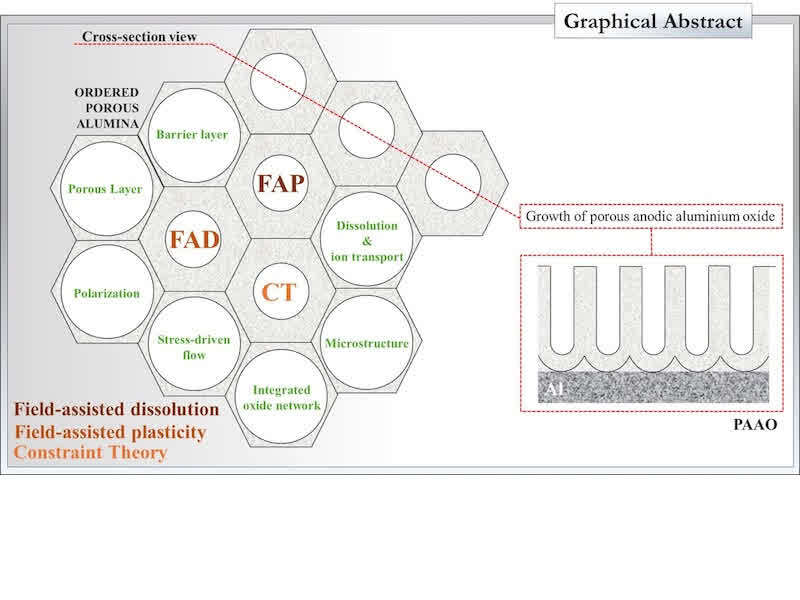
The growth of porous anodic aluminium oxide (PAAO) films during aluminium anodizing has been extensively investigated, leading to the proposal of several theoretical approaches.
 João Victor de Sousa AraujoAmong them, field-assisted dissolution (FAD), introduced at the University of Manchester Institute of Science and Technology (UMIST) in the 1970s, and field-assisted plasticity (FAP), developed at the University of Manchester (UoM) in the 2000s, remain the most frequently cited. FAD explains pore development by field-enhanced dissolution at the oxide/electrolyte interface, whereas FAP attributes it to electrostrictive flow of amorphous alumina under the electric field.
Recently, the Constraint Theory (CT) has defined anodizing as an ordered form of corrosion that integrates electrochemical transport, mechanical stress, and surface reconstruction. This review compares these models considering recent findings, highlighting both complementarities and points of divergence. It addresses the question: How do these theories, with their convergences and divergences, contribute to the advancing understanding of PAAO growth?
Original title: Evolution of Theories of Porous Anodic Aluminium Oxide Formation: From Field-Assisted Dissolution to Constraint Theory — A Historical Perspective
1. Introduction
Why does aluminium, when anodically polarized in an acidic electrolyte, develop a porous anodic aluminium oxide (PAAO)? This question has guided anodizing research and the development of theoretical models for PAAO formation for decades.[1,2] Anodizing is not only a surface finish but a physicochemical process in which an applied electric field drives ionic migration and oxide growth at the metal/oxide interface, accompanied by chemical dissolution at the electrolyte-exposed surface.[3,4] The metallurgy of aluminium and its alloys, together with surface polarization, governs the ordered formation of the PAAO,[5] which is formed in different electrolytes.
Over the past decades, several theoretical models have been developed to clarify the processes governing the development and structural organization of anodic aluminium oxide films.[1] These models reflect a progressive conceptual evolution, ranging from morphological descriptions[6] to frameworks incorporating ionic migration[7,8] and defect transport,[9,10] and, more recently, to perspectives that also account for mechanical responses[11–14] and substrate microstructure.[15]
The classical physical model establishes that when aluminium undergoes anodization in an acidic electrolyte, the oxide film is typically comprised of two distinct regions: a thin and continuous compact layer adjacent to the metal substrate and a thicker, porous outer layer containing vertically oriented cylindrical pores.[16] This structural arrangement, frequently illustrated in schematic diagrams such as Fig. 1, has been established as a conceptual model for describing PAAO.[1] Although this framework facilitates the understanding of morphological features, it represents an idealized view whose universality has been increasingly re-evaluated based on recent high-resolution observations.[14,17,18]
![Figure 1. Schematic representation of the surface arrangement and cross-sectional structure of an ideal porous anodic oxide, showing the hexagonal cell packing and the porous and barrier layers. Adapted from Fig. 6 (c) in reference.[19]](/images/images/whitepapers/deSousaAraujoa/Figure_1.jpg)
Figure 1. Schematic representation of the surface arrangement and cross-sectional structure of an ideal porous anodic oxide, showing the hexagonal cell packing and the porous and barrier layers. Adapted from Fig. 6 (c) in reference.[19]
Although several review articles[2,16,19–37] have examined the mechanism of PAAO formation, there has been limited critical comparison between the theoretical models. This oversight may create the misconception that earlier models remain fully valid, even though they were shaped and limited by the experimental conditions and understanding of the time. Notably, field-assisted dissolution (FAD), introduced at University of Manchester Institute of Science and Technology (UMIST) in the 1970s,[38] and field-assisted plasticity (FAP), developed at the University of Manchester (UoM) in the 2000s,[39] are among the most frequently referenced theoretical models and have had a substantial influence within Europe.[16,19,36,40–42] By contrast, the Constraint Theory (CT), recently proposed by Jude M. Runge, at the University of Illinois Chicago (UIC) in the 2000s[43] and further elaborated in her book on anodizing,[14,15,17,44] offers a contemporary framework that situates anodizing within the science of corrosion. The trajectory of these models, shaped by their historical moments and institutional origins, emphasizes the need for a critical comparative reassessment today.[45]
While FAD[3,4,7,46–48] and FAP[11,13,49–57] provided significant advances in understanding PAAO formation, subsequent studies indicated that these models do not fully address the coupling between electrochemical transport, mechanical response, and microstructural heterogeneity observed during anodizing. The CT[14,15,17,18,43,58–72] was later proposed as a paradigm-shifting framework that integrates electrochemical transport, polarization, and mechanical constraints into a corrosion-centered explanation of porous oxide growth. A comparative evaluation of these models highlights their contributions while underscoring the need for approaches that better align with experimental observations. These intersections and distinctions raise a central question: to what extent do these theoretical models converge, and where do they fundamentally diverge in explaining PAAO formation? In this context, it is worth noting that Arthur W. Brace, often regarded as “the Father of Anodising,” also emphasized, in one of his later contributions, the importance of revisiting and comparing existing explanations for PAAO formation, emphasizing the continued relevance of critically reassessing these models.[73–75]
To address this question, this review proposes a critical reassessment of the main models that have shaped current perspectives on aluminium anodizing. It examines the impact of concepts such as FAD, FAP, and the CT on the evolving understanding of PAAO formation mechanisms. Through a detailed assessment of the models' development, from electrochemical dissolution to electrostriction and metallurgical constraints, the article illustrates how successive theoretical and experimental innovations have shaped the evolution of scientific understanding over aluminium anodizing.
Anodizing is an engineered corrosion/oxidation designed to produce a structure rather than to destroy it.[61] This perspective underscores its broader scientific and technological significance. In this context, the present article revisits the development of anodizing theories, examining their origins, intersections, and specific insights into PAAO growth, with emphasis on nucleation and growth mechanisms on ideal aluminium surfaces.
2. From Natural Oxide to Engineered Corrosion
Before addressing the theoretical models of PAAO formation, it is essential to revisit the fundamental phenomenon that enables anodizing. Passivation refers to the spontaneous formation of a thin oxide film on a metal surface when it encounters an oxidizing environment.[76] This passive film acts as a protective barrier, reducing the reactivity of the metal and protecting it from corrosion.[77]
Aluminium has a strong natural tendency to passivate, forming a native oxide film in air that adheres firmly to the surface.[78] In aqueous media, aluminium and its alloys also corrode to form passive films in protonic acids such as sulfuric, chromic, oxalic, and phosphoric.[5,79] In these cases, the oxide layer covers the surface and contributes to surface stabilization. However, the naturally formed oxide film is typically non-uniform and lacks the mechanical robustness required for demanding applications.[80] This is particularly true in chloride-containing acids, where passivity is disrupted, initiating localized attack by pitting.[81]
Anodizing is a controlled electrochemical process that deliberately forms a thick, ordered, and functional oxide on metallic surfaces.[37,44] By applying an external anodic voltage to aluminium pieces immersed in a suitable acidic electrolyte, anodizing produces PAAO, a non-equilibrium structure whose formation and ordering are governed by surface polarization.[19] This oxide is fundamentally distinct from the naturally formed passive film, which is an equilibrium oxide removed during pretreatment. In this sense, anodizing can be regarded as a form of engineered corrosion, designed not only to create a protective layer but also to impart structural complexity and functional versatility.[5] Understanding this distinction provides the necessary context for examining the theoretical frameworks developed to explain the growth, evolution, and morphological features of PAAO films.[16] The following sections present these models in chronological order, each offering a distinct conceptual contribution to the advancing scientific understanding of aluminium anodizing.
3. Evolutionary Pathways in the Science of Anodizing
3.1 Early Structural Insights from Scanning Electron Microscopy (SEM): The Keller–Hunter–Robinson Model
Before Keller, Hunter, and Robinson proposed the first structural model of PAAO, anodizing had already benefited from decades of interdisciplinary knowledge and experimentation.[1] From the early production of aluminium in the 19th century to the recognition of its passivation behaviour, researchers progressively uncovered the electrochemical and materials science principles that would shape anodic oxidation.[1] This trajectory raised a series of fundamental questions: How did anodizing transition from a practical surface treatment to a subject of structural and mechanistic investigation? What did the anodic film look like beneath the surface? And how could its formation be systematically explained?
In 1953, Keller, Hunter, and Robinson (KHR) addressed these questions in a pioneering study that provided the first systematic visualization of porous anodic oxide films on aluminium.[6] Using replica-based electron microscopy, in which polymer casts of the pore bases were prepared after oxide stripping (formvar replicas) and mercury-amalgam replicas were made of the top surface, they obtained SEM images that revealed the scalloped pore bases, the hexagonally packed cellular architecture, and the thin barrier layer, despite some distortion inherent to the technique.
The key contribution of the KHR model was the introduction of a geometric framework that remains foundational to the science of anodizing. It established morphological parameters such as pore diameter, wall thickness, and barrier layer thickness in relation to formation voltage, a concept that later became a central principle in anodizing research. Barrier thickness was found to scale at approximately 1.0–1.2 nm V⁻¹, and cell diameter at ~2.5–2.8 nm V⁻¹, relations that provided a first quantitative framework for linking voltage to structure and that would later be refined by electrochemical models such as the FAD. This is illustrated in Fig. 2, which shows the structure of a 120-volt phosphoric acid anodic coating, including pore size, wall thickness, barrier thickness, and cell curvature radius.
![Figure 2. Keller–Hunter–Robinson (KHR) structural model of porous anodic oxide obtained at 120 V in phosphoric acid, showing pore geometry and barrier layer. Adapted from.[6]](/images/images/whitepapers/deSousaAraujoa/Figure_2.jpg)
Figure 2. Keller–Hunter–Robinson (KHR) structural model of porous anodic oxide obtained at 120 V in phosphoric acid, showing pore geometry and barrier layer. Adapted from.[6]
While the KHR model offered a sophisticated morphological description, it did not address the electrochemical mechanisms governing PAAO growth. Therefore, several questions remained unresolved, particularly concerning the migration pathways of ions and the precise locus of oxide formation under the electric field. These mechanistic aspects would be pursued in later theoretical works, notably by Hoar and Mott,[8] whose transport-based model provided a conceptual bridge between structural morphology and the kinetics of film growth.
3.2 Early Mechanistic Insights into Ion Transport: The Hoar–Mott Model
As previously mentioned, while the KHR model provided the first geometric and structural descriptions of the PAAO, it did not address the fundamental mechanisms governing its growth. In 1959, Hoar and Mott addressed the subject by introducing a transport-based mechanism derived from electrochemical principles.[8] They proposed that both aluminium cations (Al3+) and oxygen-containing anions migrate through the barrier layer under the influence of the applied electric field. In their view, hydroxide ions (OH⁻), generated at the oxide–electrolyte interface, could move inward more readily than oxygen ions (O2-) due to their smaller size and single negative charge. This formulation should be understood as a conceptual convenience, since many subsequent studies considered the effective migrating species to be O2- or related intermediates.
The Hoar and Mott’s approach was intended to rationalize ionic transport within the electrochemical framework available at the time. These OH⁻ ions would neutralize Al3+ at or near the metal/oxide interface, sustaining internal oxide growth while maintaining a constant barrier-layer thickness at the pore base. Simultaneously, the dissolution of oxide at the pore base, driven by the high local electric field, would remove material at a rate that balances inward oxide growth, allowing pores to remain open as the film thickens. Their interpretation emphasized internal deposition processes and did not yet fully account for the continuous consumption of the underlying metal. Nonetheless, their work established a bidirectional ionic transport framework. The balance between inward ion migration and pore-base dissolution proposed by Hoar and Mott is schematically illustrated in Fig. 3.
![Figure 3. Schematic representation of the Hoar–Mott model for porous anodic oxide formation. A: metal substrate; B: compact barrier layer; C: electrolyte; P: pore base, where oxide dissolution and ion transfer occur; M and N: metal/oxide interfaces associated with Al³⁺ migration. Arrows indicate the inward migration of oxygen/hydroxyl ions (OH⁻) through the barrier layer, neutralizing Al³⁺ at the interface. Adapted from.[8]](/images/images/whitepapers/deSousaAraujoa/Figure_3.jpg)
Figure 3. Schematic representation of the Hoar–Mott model for porous anodic oxide formation. A: metal substrate; B: compact barrier layer; C: electrolyte; P: pore base, where oxide dissolution and ion transfer occur; M and N: metal/oxide interfaces associated with Al³⁺ migration. Arrows indicate the inward migration of oxygen/hydroxyl ions (OH⁻) through the barrier layer, neutralizing Al³⁺ at the interface. Adapted from.[8]
As illustrated in Fig. 3, the barrier layer (A–B) thickness is maintained by the inward migration of OH⁻ ions through the oxide (arrows at P), which neutralize Al³⁺ cations originating from the metal side (M–N). At the same time, dissolution of oxide at the pore base (P) ensures that the thickness of the barrier layer remains constant. In contrast, the porous layer (B–C) continues to develop toward the electrolyte.
Although Hoar and Mott's work was not formalized into a standalone model, their contribution represents a pivotal moment in the development of anodizing theory. It bridged the gap between morphological description and ionic transport mechanisms, laying the groundwork for the FAD model developed in the 1970s.
3.3 Electric Fields and Dissolving Fronts: The Rise of the Field-Assisted Dissolution (FAD) Model
In 1970, O’Sullivan and Wood introduced the field-assisted dissolution (FAD) model,[7] a pivotal development in explaining the processes underlying PAAO formation, which offered a mechanistic perspective connecting electrochemical parameters to film morphology. It proposed that aluminium anodic oxide growth results from the simultaneous action of oxide formation at the metal/oxide interface and oxide dissolution at the oxide/electrolyte interface, both driven by a strong electric field. This mechanism is schematically illustrated in Fig. 4 (a), which also depicts the interfacial reactions at the metal/oxide and oxide/electrolyte boundaries, and in Fig. 4 (b), which emphasizes the ionic fluxes and the field-assisted dissolution region at the pore base.
![Figure 4. Schematic representation of interfacial processes during anodizing: (a) barrier-type anodic oxide, where O²⁻ migrates inward and Al³⁺ migrates outward across the compact oxide; (b) porous-type anodic oxide, where ionic transport is accompanied by field-assisted dissolution at the pore base. Arrows indicate the directions of inward O²⁻ and outward Al³⁺ flux, and field-assisted ejection. Adapted from.[37]](/images/images/whitepapers/deSousaAraujoa/Figure_4.jpg)
Figure 4. Schematic representation of interfacial processes during anodizing: (a) barrier-type anodic oxide, where O²⁻ migrates inward and Al³⁺ migrates outward across the compact oxide; (b) porous-type anodic oxide, where ionic transport is accompanied by field-assisted dissolution at the pore base. Arrows indicate the directions of inward O²⁻ and outward Al³⁺ flux, and field-assisted ejection. Adapted from.[37]
Within this framework, aluminium cations (Al³⁺) migrate outward from the metal/oxide boundary, while oxygen-containing species, such as O²⁻ or OH⁻, migrate inward through the barrier oxide layer (Fig. 4 (a)). New oxide forms where these species meet near the metal/oxide boundary. At the pore base, the intense electric field enhances dissolution by the electrolyte, establishing a steady-state balance between oxide growth and dissolution (Fig. 4(b)) that allows pores to remain open and grow as the film thickens.
Further support for the FAD model was provided by a series of influential studies conducted at UMIST (now the University of Manchester, UoM) between the late 1970s and 1980s. In 1978, Thompson and co-workers reported detailed TEM images of anodic oxide growth in phosphoric acid,[10,48,82,83] addressing the emergence of individual oxide cells and their transition to steady-state morphology. These observations highlighted how surface features influence pore development. Later refinements using ion-beam milling and Rutherford Backscattering Spectrometry revealed compositional gradients within the oxide film, offering insights into the distribution of electrolyte species across the film.[9,84] By 1986[85] the use of tracer markers confirmed asymmetric ionic transport and introduced the concept of electrostrictive stresses near the pore base. These findings reinforced the dynamic nature of pore formation and highlighted the interplay between mechanical and electrochemical processes, paving the way for subsequent models that addressed defect chemistry and mechanical deformation.
Since its introduction in 1970, the FAD model has evolved into one of the most frequently cited theories in anodizing science, with the original publication now exceeding 1,000 citations.[86] Unfortunately, the main author, J. P. O’Sullivan, passed away at a tragically early age shortly after completing his doctoral thesis.[46] As a result, he did not witness the impact of his work. The continued prominence and dissemination of the FAD model were sustained mainly by his co-author, Graham Charles Wood, a prominent corrosion scientist who further developed and propagated its concepts throughout his career and remained active in this research area until he died in 2016.[38] Beyond co-authoring the original model, Wood built strong research groups, mentored new scientists, and fostered international collaborations that kept PAAO studies at the forefront of electrochemical science.[19,38] Fig. 5 illustrates this co-authorship network, geographical clustering of anodizing research, and citation patterns. Overall, the Figure highlights how the FAD model remained the main theoretical framework in anodizing science for several decades.
![Figure 5. Scientometric analysis of PAAO research based on Web of Science[40] and Scopus[41] databases. Data were retrieved in March 2025 using the search string “anodizing and (porous anodic alumina or PAAO)” and limited to articles and reviews published between 1980 and 2025. (a) Co-authorship and citation networks illustrating the central role of G.C. Wood and collaborators, including Thompson, Shimizu, Skeldon, and Habazaki, in advancing anodic oxidation studies, particularly within the University of Manchester group. The color gradient represents the temporal distribution of publications (1980–2000). (b) Author–country–keyword relationships highlighting how Manchester-based researchers shaped key thematic areas such as anodic oxidation, alumina formation, and TEM characterization. (c) Author–author citation and keyword mapping, illustrating Manchester’s influence in establishing experimental and theoretical foundations for anodic film growth.](/images/images/whitepapers/deSousaAraujoa/Figure_5.jpg)
Figure 5. Scientometric analysis of PAAO research based on Web of Science[40] and Scopus[41] databases. Data were retrieved in March 2025 using the search string “anodizing and (porous anodic alumina or PAAO)” and limited to articles and reviews published between 1980 and 2025. (a) Co-authorship and citation networks illustrating the central role of G.C. Wood and collaborators, including Thompson, Shimizu, Skeldon, and Habazaki, in advancing anodic oxidation studies, particularly within the University of Manchester group. The color gradient represents the temporal distribution of publications (1980–2000). (b) Author–country–keyword relationships highlighting how Manchester-based researchers shaped key thematic areas such as anodic oxidation, alumina formation, and TEM characterization. (c) Author–author citation and keyword mapping, illustrating Manchester’s influence in establishing experimental and theoretical foundations for anodic film growth.
Fig. 5 (a) illustrates the co-authorship networks centered on Wood, where larger nodes indicate highly influential authors, and the dense network of collaborations shows how his group became a nucleus for anodizing studies. Although Wood occupies the central position, the network also highlights the importance of other Manchester-based contributors, particularly Thompson, who played a major role in refining and extending the experimental and mechanistic basis of FAD through advanced characterization, tracer and marker studies, and model-alloy investigations.
Fig. 5 (b) illustrates the geographical concentration of anodizing research in the United Kingdom over several decades, with the strongest collaborations involving researchers from the UK, Chile, Japan, and, to a lesser extent, Poland. This broader geographical distribution also reflects how the Manchester research tradition expanded internationally through enduring collaborations, especially with Japanese researchers such as Shimizu and Habazaki,[39] whose later work extended anodizing research to other valve metals and, more recently, to functional anodized surfaces and nanostructured oxides.[87–91] In the same broader lineage, Professor Xiaorong Zhou has continued to contribute to anodizing research, particularly in studies of anodic film growth, alloy effects, defect generation, and localized corrosion in anodized aluminium alloys.[92,93]
This international continuity of expertise, combined with the thematic clustering around keywords such as anodic oxidation, aluminium alloys, and transmission electron microscopy, contributed to consolidating FAD as the prevailing framework in anodizing science. Fig. 5 (c) presents the citation and self-citation patterns among leading researchers. These reciprocal citation dynamics amplified the visibility of the principal groups and reinforced the prominence of FAD in literature, while making the assimilation of alternative interpretations comparatively slower. Notably, as seen in Fig. 5 (a), Peter Skeldon, one of Wood’s closest collaborators, later played a decisive role in the formulation of the field-assisted plasticity (FAP) model, discussed in the following section, thereby challenging and expanding key premises of FAD from within the same broader research tradition.
3.4 Beyond Dissolution: Plastic Flow as a Mechanism for Pore Formation
The studies carried out at UMIST to develop the FAD model not only substantiated its key aspects but also highlighted its limitations. While the model provided a useful macroscopic framework, it did not incorporate the role of electrostrictive stress and the potential plastic deformation of the oxide under high electric fields, phenomena that became increasingly evident from high-resolution imaging and tracer experiments.[49] Moreover, later studies indicated that the extent of dissolution at the pore base might be more limited than initially proposed, with pore dimensions influenced more by the oxide's dielectric nature and polarization effects than by pure chemical dissolution. This realization opened the path for new hypotheses, most notably the field-assisted plasticity (FAP) model, which retained the electrochemical basis of the FAD framework while integrating the influence of electrostrictive stress and the resulting plastic deformation of the oxide. These latter insights also set the stage for alternative interpretations, such as those proposed by Jude M. Runge (next section), reframing the relative roles of dissolution, polarization, and dielectric properties in governing PAAO growth.
In 2006, S.J. Garcia-Vergara introduced the FAP model,[49] as part of research conducted under the supervision of Peter Skeldon at the UoM.[11,12,94] The model was proposed to address phenomena not fully explained by electrochemical transport or defect dynamics alone, and its central proposition was that under high electric fields, the anodic film experiences mechanical stress sufficient to induce plastic deformation. This deformation contributes to the redistribution of material during PAAO growth, particularly within the pore structure, thereby helping to explain features such as wall thickening and the lateral displacement of oxide components. Importantly, tracer and microscopy evidence indicated that pore growth was not directly linked to localized chemical dissolution or field-assisted ejection of Al³⁺ ions at the pore mouth, a central tenet of the long-standing FAD framework proposed three decades earlier.
The FAP model was supported by tracer experiments and electron microscopy studies[11] which showed that markers embedded in the substrate are displaced from their original positions as anodization progresses. This is schematically exemplified in Fig. 6, which represents the progressive distortion of a tungsten tracer layer after anodizing for different times (180 s, 240 s, and 300 s).
![Figure 6. Adapted schematic diagrams (from Fig. 6 in reference[11]) showing the distribution of tungsten tracers (W) within anodic alumina films during anodizing at 5 mA cm⁻² in 0.4 M phosphoric acid at 293 K, for (a) 180 s, (b) 240 s, and (c) 300 s. The tracer profiles illustrate the progressive lateral displacement of tungsten under the influence of oxide flow, consistent with the Field-Assisted Plasticity (FAP) model, which interprets pore evolution as resulting from electrostrictive deformation of amorphous alumina while maintaining pore continuity.](/images/images/whitepapers/deSousaAraujoa/Figure_6.jpg)
Figure 6. Adapted schematic diagrams (from Fig. 6 in reference[11]) showing the distribution of tungsten tracers (W) within anodic alumina films during anodizing at 5 mA cm⁻² in 0.4 M phosphoric acid at 293 K, for (a) 180 s, (b) 240 s, and (c) 300 s. The tracer profiles illustrate the progressive lateral displacement of tungsten under the influence of oxide flow, consistent with the Field-Assisted Plasticity (FAP) model, which interprets pore evolution as resulting from electrostrictive deformation of amorphous alumina while maintaining pore continuity.
Instead of being dissolved or ejected at the pore base, the tracers are progressively bent and displaced laterally toward the cell walls, providing compelling evidence of bulk oxide flow within the barrier layer. This displacement pattern cannot be explained solely by ion migration or FAD but is consistent with the concept of bulk oxide flow. According to the FAP model, the high electrostrictive stress induced by the electric field during oxide growth promotes lateral material movement from the pore base toward the cell walls. This redistribution of oxide maintains a nearly constant barrier-layer thickness while contributing to the film's thickening beyond the volume of consumed metal, thereby playing a decisive role in shaping the ordered, cylindrical pore structure characteristic of PAAO.
As previously mentioned, the FAP model was proposed at the UoM, the same institution where the FAD model had been extensively validated. This underscores how evolving experimental techniques and new perspectives can reshape established scientific frameworks. While the FAD model emphasizes ionic transport and localized dissolution, including field-assisted ejection of Al³⁺ at the pore mouth, the FAP model highlights the mechanical response of the oxide to the high electric field resulting from anodizing.
Martínez-Viademonte et al.[36] have more recently treated both FAD and FAP as valid models, emphasizing that experimental evidence supports each concept. However, this interpretation overlooks the fact that the core assumptions of FAD and FAP are mutually exclusive. A more nuanced view is that these frameworks may point to dominant mechanisms under different anodizing conditions, where apparent conflicts arise; the tracer experiments provide the strongest support for bulk oxide flow.
The FAD model attributes pore development primarily to localized chemical dissolution and field-assisted ejection of Al³⁺. In contrast, the FAP model explicitly contrasts with this mechanism by proposing bulk oxide flow driven by electrostrictive stress. Accepting both without reconciling these mechanistic contradictions risks undermining the distinctiveness of each framework. Additional studies by Houser and Hebert,[13] and by Ömer Özgür Çapraz,[95–97] provided further evidence for the FAP perspective by demonstrating the role of electrostrictive stresses and viscous oxide flow in shaping anodic alumina. Nevertheless, while these works substantiate the mechanical response of the oxide to the high-field environment, they remain focused on stress generation and flow dynamics rather than on a comprehensive description of oxide nucleation and integrated growth. This gap helps explain the relevance of a framework that interprets anodic film formation from early nucleation events to later structural evolution, while attempting to relate electrochemical transport, mechanical deformation, and polarization phenomena within a common description.
3.5 Polarization and Surface Reconstruction: The Constraint Theory (CT)
In the early 2000s, Jude M. Runge proposed a theory for PAAO growth that approached the oxidation reaction as a corrosion process. Although Runge did not assign a formal name to her model, in this work, it will be referred to as the Constraint Theory (CT), reflecting the premise that oxide growth is constrained not only by the mechanical resistance of the substrate but also by the electrochemical and structural conditions imposed during anodizing. The theory originates from her doctoral research, which employed TEM, XPS, and FT-IR analyses (including synchrotron-based experiments) to examine oxide growth on aluminium alloys. In a noteworthy historical coincidence, her work was first presented at the Aluminium Surface Science and Technology Conference at UMIST in 2000,[43] the same institution where, three decades earlier, the field-FAD model had been formulated and further developed to account for the effects of mechanical stress in the FAP model. This coincidence underscores the cumulative and evolving nature of scientific understanding, with the CT emerging in the same environment where its most prominent predecessors had been conceived and refined.
The model describes anodizing as beginning with the lateral growth of oxide from preferential nuclei on the metal surface. As these nuclei expand, they impinge upon each other, generating mechanical stresses that reconstruct the surface and define the initial pore geometry. The growth of the pores themselves is not attributed to field-assisted dissolution at the pore mouth, involving the ejection of Al³⁺ ions, but to a stress-driven reconstruction. In this framework, aluminium consumption does not occur primarily through electrolyte-driven dissolution at the pore mouth, as proposed in classical FAD models. Instead, aluminium is oxidized at the metal/oxide interface, generating Al3+ ions that migrate through the oxide under the applied electric field and react at the pore walls, while hydrogen species are expelled from the active pore region. Thus, pore development results from field-driven ionic transport coupled with mechanically constrained surface reconstruction rather than direct chemical dissolution of alumina.
This interpretation is partially consistent with the FAP perspective of García-Vergara and co-workers,[11] who, together with Skeldon,[12] supported alumina flow as the source of porous oxide formation through tracer studies rather than dissolution by the electrolyte. However, they did not fully address the initial mechanism of oxide formation, leaving a mechanistic gap.
Review articles on the subject often present FAD and FAP as coexisting interpretive frameworks, emphasizing that both are supported by experimental observations, although their mechanistic differences are not always examined explicitly.[19,36,37,42,98,99] A similar tendency is found in several doctoral theses on anodizing.[100–109] In this context, CT offers an alternative framework that seeks to connect oxide nucleation, pore initiation, and subsequent growth within a single interpretive scheme. In this view, pore initiation is associated with mechanically driven surface reconstruction, while continued growth is sustained by field-assisted ionic transport along the developing pore walls.
Once pores are established, the electric field along their inner walls drives ion exchange, notably the movement of Al3⁺ and O2⁻ species, effectively functioning as an ion pump that sustains columnar growth throughout the anodizing process. This continuous transport occurs in concert with the mechanical resistance imposed by the underlying alloy, whose composition, microstructure, and geometry dictate the distribution of stresses and the resulting film morphology.
By integrating electrochemical transport into the metallurgical context of the substrate and recognizing mechanical constraint as a coequal driver of oxide growth, CT provides a mechanistic framework that builds on and extends aspects of the FAD and FAP models. It integrates electrochemical, mechanical, and metallurgical factors into a unified explanation of PAAO development under realistic alloy conditions.
4. Discussion
The development of theories on PAAO growth represents a sustained effort to explain a complex electrochemical phenomenon of industrial relevance, whose interpretation has evolved in parallel with advances in characterization techniques. From the early geometric considerations of Keller, Hunter, and Robinson[6] to the transport-oriented approaches of Hoar and Mott,[8] the initial models provided essential morphological and kinetic details. As more advanced experimental and characterization tools were made available, particularly with the introduction of transmission electron microscopy and tracer marker studies, new perspectives emerged that challenged these earlier assumptions.
The FAD[46] model highlights that pore formation results from the balance between ionic transport through the oxide and field-assisted dissolution at the oxide/electrolyte interface. Nevertheless, subsequent evidence highlighted limitations in this description. The FAP model[11,12] further integrated considerations of mechanical stress and oxide flow, thereby broadening the scope of analysis beyond ion transport and dissolution addressed in the FAD model. More recently, CT has been proposed as a complementary framework,[43] suggesting that substrate-induced mechanical constraints govern oxide development alongside electrochemical processes. The progression of these models indicates that theoretical advances have been closely aligned with methodological developments, underscoring the importance of examining FAD, FAP, and the CT as interrelated perspectives for describing the mechanisms governing PAAO formation.
4.1 Constructing Knowledge Across Theories of PAAO Growth
Fig. 7 organizes the evolution of PAAO growth models into a conceptual pyramid that links historical progression to four analytical dimensions: key concept, effect, cause, and shared perspectives. This representation illustrates that each theory is based on distinct conceptual bases, although it is also partially integrated into the literature.
In the FAD model, the key concept is the localized dissolution at the pore base. The effect is the maintenance of steady-state growth assisted by a strong electric field imposed during the anodizing procedure (presented in Section 3.3). The cause is attributed to the balance between growth and dissolution sustained at the pore base under the influence of the electric field. The shared perspectives include early anodizing models of steady-state growth, which provided the framework for this formulation.
In the FAP model, the key concept is the description of the oxide as a viscous fluid. The effect is the plastic/viscous flow and the redistribution of the material through stress relaxation during anodizing. At the same time, the cause for the oxide growth is explained by film displacement associated with ionic migration. The shared perspectives include the studies of Houser and Hébert[13] and of Ömer Özgür Çapraz et al.[95–97] who reported observations consistent with alumina flow under high-field conditions, thereby providing evidence consistent with this theory (detailed in Section 3.2).
In CT, the key concept is the coexistence of substrate-induced polarization and mechanical constraint. The effect is represented by polarization-induced corrosion and surface reconstruction. The cause of film development is attributed to constrained columnar growth at the film/metal interface, and the shared perspectives include Paul Csokan’s work,[110] who emphasized surface reconstruction, and the studies of García-Vergara et al.[11] and Houser and Hébert[13] which supported the hypothesis of alumina flow and are conceptually consistent with the mechanisms proposed in FAP.
This analysis highlights that knowledge of PAAO growth has advanced through overlaps and conceptual reformulations, rather than by the simple linear replacement of theoretical models. Table 1 presents the conceptual, mechanistic, and methodological intersections, allowing a structured comparison of the three theoretical frameworks.

Figure 7. Knowledge construction pyramid summarizing the historical progression of the three theories of porous anodic oxide formation on aluminium. At the base, the Field-Assisted Dissolution (FAD) model (O’Sullivan & Wood; Thompson, 1960s–1990s) emphasizes field-enhanced dissolution at the pore base. In the middle, the Field-Assisted Plasticity (FAP) model (Garcia-Vergara & Skeldon, 2000s) introduces plastic/viscous oxide flow under electrostrictive stress. At the top, the Constraint Theory (CT) (Runge, 2000s) reframes anodizing as a polarization-driven, ordered corrosion process that incorporates surface reconstruction, mechanical constraints, and microstructural effects. The right-hand panel highlights their key concepts, effects, causes, and shared perspectives, illustrating how successive models extend and partially overlap with earlier insights.
Table 1. Comparative mapping of the three main theoretical models of porous anodic oxide growth on aluminium: field-assisted dissolution (FAD, A), field-assisted plasticity (FAP, B), and constraint theory (CT, C). The table lists their assumptions, mechanisms, and unique features, together with intersections expressed in mathematical symbols corresponding to the Venn diagram shown in Figure 8.
| Feature / Concept | Field-Assisted Dissolution (FAD) | Field-Assisted Plasticity (FAP) | Constraint Theory (CT) | Theoretical relations |
| Core mechanism | Growth at the metal/oxide interface; dissolution at pore bases enhanced by the electric field. | Growth by ionic transport; pore advance via plastic flow under electrostrictive stress. | Growth governed by polarization and substrate constraint; with the oxide behaving as a viscoelastic solid; anodizing as ordered corrosion with continuous surface reconstruction and strong microstructural influence. | A ≠ B ≠ C |
| Primary driver of porous oxide formation | Field-assisted dissolution at pore bases. | Field-assisted plastic deformation of oxide. | Mechanical constraint (substrate–oxide coupling) + polarization as co-equal drivers. | A ≠ B ≠ C |
| Ionic transport (PAAO as an ionic solid) | Al³⁺ migrates outward; O²⁻/OH⁻ inward; growth at interface. | Same as FAD; but oxide plasticity accommodates pore continuity. | Same ionic paths but explicitly couples transport with alloy microstructure and local electrochemistry; OH⁻ is critical for reconstruction. | A ∩ B ∩ C |
| Morphology origin | Pore geometry arises from localized field-assisted dissolution at the pore bases. | Stress concentration at pore bases produces self-ordering. | Pore ordering controlled by polarization; oxide movement driven by electrostriction and constraint. | A ≠ B ≠ C |
| Barrier layer role | Thin compact base; steady state by growth–dissolution balance. | Maintained by plastic deformation; barrier thickness adjusts with stress. | No fixed barrier: part of a dynamic porous network (no strict barrier/porous duality). | A ≠ B ≠ C |
| Influence of microstructure | Not explicitly considered. | Not explicitly considered. | Central: grain boundaries; intermetallic particles (IMPs); inclusions; and heterogeneities strongly influence nucleation and growth. | C |
| Surface reconstruction | Not explicitly developed. | Not explicitly developed. | Continuous reconstruction: anodizing as ordered corrosion. | C |
| Polarization emphasis | Electric field is essential to oxide growth and dissolution; but polarization is not treated as the central organizing concept. | High field and stress are essential; but polarization is not developed as the primary conceptual framework. | Polarization is a central concept controlling oxide ordering; ion separation; local chemistry; and pore evolution. | A ∩ B ∩ C; but strongly emphasized in C |
| pH / Chemistry of electrolyte | Acidic dissolution is assumed in explaining pore-base oxide removal; but local pH gradients are not a central part of the model. | Focus is placed on stress-assisted oxide flow rather than on local pH changes as the main explanation. | Local chemistry is central: polarization; OH⁻ distribution; protonation/hydration; and local pH variation are invoked to explain oxide growth; reconstruction; and interfacial instability. | C |
| Hydrogen / Oxygen evolution | Mentioned indirectly: O₂ evolution is possible at very high voltages; no detailed mechanism. | Oxygen generation within the oxide is attributed to local electronic conduction through semiconducting alloy-derived oxides (e.g.; CuO; Fe or Cr oxides); which enables oxidation of O²⁻ ions inside the film and formation of oxygen nanobubbles. The plasticity of amorphous alumina allows accommodation and displacement of material under the internal pressure generated by these bubbles; contributing to local rupture; material flow; and pore rearrangement during growth. | Gas evolution arises as a consequence of electrolysis within the polarized anodizing circuit. Hydrogen generation may occur in defect-rich regions near the metal/oxide interface; while oxygen evolution can develop at the film/alloy interface when local polarization balance and ionic exchange are disrupted. Breakdown occurs when the dynamic steady-state between polarization; pH gradients; and ionic flux is lost; for instance; due to overheating or the collapse of the ordered corrosion regime sustaining oxide growth. | B ⊂ C (≠ A) |
| Electrical / semiconducting interpretation of the oxide | The oxide is treated mainly as an ionic barrier film under high electric field; no explicit semiconducting model is proposed. | The oxide is still treated primarily as an ionic solid capable of viscous/plastic flow; no explicit p–i–n or semiconducting description is proposed. | The anodic oxide is interpreted as a functionally graded ionic/semiconducting structure; with inner n-type-like; intermediate i-type-like; and outer p-type-like regions; the p–i–n diode analogy is used to describe directional transport and interfacial organization. | C |
| Knit-lines/domain boundaries | Not explicitly developed. | Mentioned indirectly: stress and flow may suggest boundary formation but are not fully explained. | Explicit explanation: surface reconstruction under polarization naturally produces cell domains separated by knit-lines; microstructure influences their distribution. | B ∩ C (≠ A) |
| Why is there hexagonal pore ordering? | Not explicitly developed. | Not explicitly developed. | Explicitly addressed: polarization + mechanical constraint + electrostriction led to uniform pore spacing and hexagonal arrangement (energy minimization). | C |
| Tafel / corrosion kinetics | Not explicitly developed. | Not explicitly developed. | Explicitly integrates anodizing into the corrosion framework; uses Tafel-type analysis to describe oxide nucleation; growth; and breakdown under polarization. | C |
| Heat of reaction & dissipation | Not explicitly considered; FAD focuses on dissolution at pore bases without discussing thermal balance. | Mentioned indirectly; plastic flow under stress may be enhanced by local heating but not developed as a mechanistic factor. | Explicit: heat originates from the exothermic oxidation of Al → Al₂O₃; plus ohmic heating (substrate + film resistance) and polarization losses; if not dissipated; local temperature rises; leading to oxide dissolution and “burning”. Cooling of the electrolyte is required to maintain stability. | C |
| Oxide structural description | Oxide represented as barrier layer + porous layer; with dissolution localized at pore bases. | Oxide represented as a deformable ionic solid; with pore formation sustained by flow under stress. | Oxide represented as a dynamically reconstructed; compositionally graded interfacial solid; without a strict barrier/porous duality. | A ≠ B ≠ C |
| Key characterization methods | Early tracer diffusion; TEM cross-sections; Rutherford backscattering; isotopic labelling; and kinetic dissolution studies. | TEM in-situ under bias; stress–strain analysis of oxide; XRD strain mapping; tracer studies. | High-resolution SEM/TEM; AFM; synchrotron XPS/FTIR; in-situ Raman; combined electrochemical + structural methods. | (A ∩ B ∩ C) ⊂ |
| Key institutions | University of Manchester Institute of Science and Technology (UMIST) | University of Manchester (UoM) | University of Illinois Chicago (UIC) | A ∩ B (≠ C) |

Figure 8. Venn diagram comparing the three major theoretical models of porous anodic oxide formation on aluminium: Field-Assisted Dissolution (FAD, A), Field-Assisted Plasticity (FAP, B), and the Constraint Theory (CT, C). Each circle represents the conceptual domain of one theory, with overlapping regions denoting shared principles. The region A ∩ C is represented as approximately empty, indicating that FAD and CT rely on markedly different mechanistic emphases. The intersection A ∩ B is limited, largely to steady-state ionic transport, whereas A ∩ C remains comparatively sparse, reflecting the fact that these frameworks are built on substantially different interpretive priorities. In contrast, B ∩ C represents the strongest convergence, including stress-driven oxide flow, dynamic barrier behaviour, gas evolution, and knit-line formation. The central intersection (A ∩ B ∩ C) is limited to basic ionic transport and self-ordering behaviour, though each theory provides a distinct mechanistic rationale. Specific intersections and divergences are systematically detailed in Table 1, where the mechanisms, assumptions, and implications of each region are described.
Table 1 organizes the relationships between FAD (A), FAP (B), and CT (C) using set-based comparisons. Beyond the core mechanisms, the table extends the comparison to morphology, barrier behavior, microstructure, electrolyte chemistry, and methodological contexts. This structured mapping shows that each model rests on distinct conceptual bases while also highlighting selected areas of overlap.
Analysis of these set relations indicates how the models overlap and diverge. The intersection A ∩ B is minimal, restricted to steady-state ionic transport, whereas A ∩ C is nearly empty, indicating that no robust mechanistic overlap has been detected between these frameworks. By contrast, the overlap between FAP and the CT (B ∩ C) is substantial, encompassing stress-driven oxide flow, the dynamic role of the barrier, gas evolution, and knit-line formation. The overall intersection (A ∩ B ∩ C) is confined to ionic transport and pore ordering, although each model provides a distinct mechanistic explanation for these shared features. These correlations, summarized in Table 1 and illustrated in Fig. 8, demonstrate that the evolution of anodizing theories has proceeded through partial conceptual overlap and refinements rather than linear replacement.
This comparative mapping highlights CT's contribution within the broader context of anodizing models. While FAD and FAP have been extensively reviewed [16,19,36,42] and remain central to the study of PAAO growth, the CT has received comparatively less attention, despite offering a distinct perspective on the formation and development of PAAO. By emphasizing polarization, microstructural heterogeneity, electrolyte chemistry, and dynamic surface reconstruction, it approaches anodizing in ways that complement and, at times, challenge aspects of earlier models. Revisiting this theory, therefore, provides an opportunity not only to clarify its own framework but also to delineate its points of convergence and divergence with the more established FAD and FAP models. For this reason, the following section is dedicated to a detailed examination of CT, situating it alongside prior theoretical developments and highlighting its growing relevance in scientific research and industrial applications,[111] as well as in broader discussions of anodizing technologies in the media.[112]
In this context, it is also worth noting that more recent interpretations, particularly those advanced by Mikhail Pashchanka,[98] likewise challenge the sufficiency of the classical field-assisted dissolution (FAD) model as a general explanation for porous anodic alumina formation. However, Pashchanka’s framework is not fully equivalent to CT. Whereas CT interprets anodizing as an ordered corrosion process governed by polarization, mechanical constraint, and surface reconstruction, Pashchanka’s interpretation places greater emphasis on dissipative self-organisation, cyclic electrolyte flow, and colloidal processes involved in pore-wall development.[113,114] Thus, although both perspectives move beyond a purely dissolution-centred description and reduce the centrality of pore-base dissolution, they differ in their primary explanatory basis. In this sense, Pashchanka’s approach may be regarded as conceptually closer to broader attempts to move beyond FAD than as a direct counterpart to CT.
4.2 A Closer Look: Constraint Theory (CT) as an Integrative Framework
Understanding the origin of anodic aluminium oxide requires focusing on the conditions under which it forms. The literature[58] has posed the question: “What is involved in making porous anodic aluminium oxide?” This question requires beginning with the anodizing circuit, since polarization cannot exist without the completion of the electrochemical pathway, as illustrated in Fig. 9.
![Figure 9. Anodizing cell and schematic representation of current paths. (a) Basic two-electrode anodizing configuration, with aluminium acting as the anode and a counter-electrode as the cathode, both immersed in an electrolyte. (b) Adapted diagram (based on reference,[18] Fig. 4) illustrating the partition of current into the electronic path through the metallic anode (𝑖ₐ) and the ionic path through the electrolyte (𝑖𝐿). The parameter 𝑖₀ denotes the exchange current density at the anode/electrolyte interface, representing the intrinsic kinetics of interfacial electron-transfer reactions rather than a net current flowing in the external circuit.](/images/images/whitepapers/deSousaAraujoa/Figure_9.jpg)
Figure 9. Anodizing cell and schematic representation of current paths. (a) Basic two-electrode anodizing configuration, with aluminium acting as the anode and a counter-electrode as the cathode, both immersed in an electrolyte. (b) Adapted diagram (based on reference,[18] Fig. 4) illustrating the partition of current into the electronic path through the metallic anode (𝑖ₐ) and the ionic path through the electrolyte (𝑖𝐿). The parameter 𝑖₀ denotes the exchange current density at the anode/electrolyte interface, representing the intrinsic kinetics of interfacial electron-transfer reactions rather than a net current flowing in the external circuit.
Fig. 9 (a) shows the basic two-electrode anodizing configuration, in which the aluminium substrate is polarized as the anode, with a counter-electrode acting as the cathode, both immersed in the same acid electrolyte. The external power supply removes electrons from the anode, driving aluminium oxidation, while reduction reactions at the cathode complete the circuit through ionic transport in the electrolyte.
Fig. 9 (b) schematically illustrates the current partition during anodizing. The electronic current, 𝑖a, flows through the metallic circuit, whereas the ionic current, 𝑖L, is transported through the electrolyte toward the cathode. At the anode/electrolyte interface, interfacial reactions couple electronic conduction in the metal to ionic conduction in the solution. This interfacial behavior is characterized by the exchange current density, 𝑖0, which reflects the intrinsic kinetics of oxidation and reduction reactions at equilibrium and is strongly influenced by local surface conditions such as alloy composition, microstructure, and defect distribution. Under anodizing conditions, however, the system operates far from equilibrium, and the overall process is governed by the externally imposed anodic current, while 𝑖₀ should be interpreted as a kinetic descriptor rather than a net current flow. Together, electronic and ionic contributions sustain continuous anodic film growth.
While Fig. 9 highlights the role of current partition in sustaining the anodizing circuit, it also stresses a more fundamental point: anodizing is, at its core, a corrosion process. The aluminium substrate dissolves, providing the ionic species required for oxide formation, and the electrolyte primarily serves as a current carrier rather than a solvent. Within this perspective, oxide growth is driven by the applied current, whereas the electrolyte enables charge balance by transporting ions to the cathode. This perspective conceptualizes anodizing as “controlled corrosion”, in which dissolution of the metal is not suppressed but directed by the imposed bias and the governing circuit parameters.[111,115] In contrast to spontaneous corrosion, where disorder dominates, anodizing relies on polarization to impose order, transforming dissolution into the self-assembly of a highly organized oxide network.
This controlled corrosion process can be described by separating the total polarization sustaining oxide growth into two contributions,
The total polarization can then be expressed through the Tafel equation (1), which expands Ohm’s law to incorporate both contributions:
N=βa log(i_a¦i_0 ) + (2.3 RT)/nF log (1-i_a¦i_l ) (1)
N is composed of two contributions: Ntotal = Nsurface + Nconc
where N_surface represents surface (activation) polarization associated with interfacial charge-transfer kinetics, and N_conc represents concentration polarization associated with ionic transport through the electrolyte and the developing porous film.
In analogy with the classical Deal–Grove model for silicon oxidation,[116] Runge emphasized that anodic oxidation of aluminum is governed by interfacial reaction kinetics together with ionic transport through the developing oxide. While thermodynamics establishes the driving force for oxidation and influences the exchange current density i0, the actual oxide growth rate under anodizing conditions is controlled by activation polarization at the substrate surface and by mass transport through the electrolyte and porous oxide film. In the context of the Tafel relation, the activation term reflects interfacial charge-transfer kinetics, whereas the concentration term corresponds to ionic transport limitations.
In equation (1), N represents the total polarization sustaining oxide growth. The first term, βalog(ia/i0), corresponds to surface activation polarization: the applied current density, i_a, drives electron transfer and migration of Al³⁺ ions through the growing film, while the exchange current density, i0, reflects the dynamic resistance of the substrate/oxide/electrolyte interface, which varies with alloy chemistry, microstructure, and oxide thickening. The second term, (2.3RT/nF) log (1− ia/il), represents concentration polarization governed by ion mobility and electrolyte conductivity; the limiting current density, il, defines the threshold at which diffusion and convection become rate-limiting.
These parameters establish a direct link between electrochemical variables and structural outcomes of anodizing. High ia accelerates oxide formation but tends to produce thinner walls, wider pores, and higher residual stress, whereas lower ia, favors thicker walls, narrower pores, and reduce stress. Variations in i_0, caused by, for instance, intermetallic particles, precipitates, or grain boundaries, introduce local heterogeneities that influence nucleation density and ordering. The ratio ia/i0 is therefore critical: if the applied current density exceeds the interfacial exchange current, oxide growth proceeds; when the two converge, growth ceases. Temperature primarily enters through the concentration term, since higher temperatures increase ion mobility and nucleation density, while also increasing the risk of oxide dissolution unless cooling is applied.
Among the parameters of the Tafel relation, the exchange current density (i0) is particularly significant for anodizing. Unlike the applied current density (ia), which is externally imposed, or the limiting current density (il), which is governed by mass transport in the electrolyte, i0 originates from the intrinsic activity of the aluminium/oxide/electrolyte interface. It represents the equilibrium rate of charge transfer when anodic dissolution and cathodic reduction are balanced at the metal surface; alloy chemistry, grain orientation, intermetallic particles, and evolving oxide thickness strongly influence its value. Since small variations in i0 substantially alter the ratio ia/i0, this parameter plays a decisive role in determining whether anodic oxide growth proceeds uniformly, develops defects, or self-organizes into an ordered porous network. Table 2 summarizes how these parameters of the Tafel relation correlate with anodizing kinetics, substrate microstructure, and practical consequences for oxide morphology and stability.
Effective anodizing, therefore, requires recognizing the relationships among substrate microstructure, electrochemical parameters described by the Tafel equation, and the architecture of the anodic oxide. This recognition transforms anodizing into a form of corrosion engineering, in which process parameters are deliberately tuned to generate oxide structures tailored to specific design and application requirements.
Local variations in alloy chemistry, intermetallic particles, grain boundaries, and surface defects can be interpreted as shifts in the effective exchange current density, thereby altering the kinetics of PAAO nucleation and growth. These heterogeneities highlight that anodizing is a non-equilibrium corrosion process in which global polarization imposes order, while microstructural features modulate local dynamics and finish quality. Readers interested in a more comprehensive discussion of anodizing as a corrosion process are referred to Chapter 4 of The Metallurgy of Anodizing Aluminum.[115]
Table 2. Correlation of Tafel equation parameters with porous anodic oxide growth as described in CT. Each term is interpreted in the context of anodizing kinetics, its dependence on substrate microstructure, and its practical consequences for oxide morphology and stability.
| Tafel Parameter / Term | Function in Anodizing | Microstructural Relation | Practical Consequences |
| Ntotal | Overall polarization regime; combining surface and concentration contributions. | Couples the substrate microstructure with the electrolyte process. | Governs transition to hexagonal ordering and long-range stability. |
| Nconc —concentration polarization | Polarization due to ion transport limitation (diffusion; convection). | Controlled by electrolyte conductivity; geometry; and micro-galvanic effects. | At high ia / iL; it leads to pH shifts; dissolution; and instability. |
| Nsurface —activation polarization | Polarization due to surface charge transfer governs early nucleation and barrier formation. | Strongly dependent on grain boundaries and heterogeneities. | Defines where oxide starts growing; heterogeneity leads to domains or knit lines. |
| i0 — exchange current density | Baseline interfacial activity of the Al/oxide/electrolyte system. | Varies with grain boundaries; inclusions; alloying; and oxide thickness. | High i0: easy nucleation but poor long-range order. Low i0: slower nucleation; better ordering. |
| βa— anodic slope | Links polarization to current; reflects surface resistance. | Modified by texture; grain orientation; and heat treatment. | Alters nucleation spacing and nuclei density. |
| ia — Applied current density | Governs oxide growth rate; sets time to flake impingement and transition from lateral to upward growth. | Sensitive to local microstructural characteristics; such as intermetallic particles and compositional heterogeneities that promote localized current concentrations (“hot spots”); while the matrix itself tends to exhibit a more spatially uniform electrochemical response. | High ia: thin walls; wide pores; high residual stress. Low ia: thick walls; narrow pores; low stress. |
| ia/i0 — kinetic ratio | Expresses the balance between imposed current and local interfacial reactivity. | Strongly affected by local microstructural deviations that alter i0 even when βa remains similar across wrought alloys. | Helps explain why small local disruptions can produce large differences in pore initiation; oxide ordering; and defect development. |
| iL— limiting current | Maximum sustainable current before transport limitation dominates. | Reached faster in alloys with segregated phases or high-resistance paths. | If ia → iL: overheating; burning; breakdown; instability of PAAO growth. |
| T (temperature) | Appears in Nconc; increases ion mobility. | High T leads to more nucleation sites per grain | High T → higher nucleation density; thinner barrier; cooling avoids breakdown. |
The anodizing reaction involves the concurrent consumption of the aluminium substrate and the growth of PAAO, so the resulting layer may be interpreted more appropriately as the product of a controlled corrosion process rather than as a deposited coating. This perspective helps explain how a native oxide-covered surface can evolve into the highly ordered porous network recognized as PAAO. The anodizing circuit (Fig. 9), the electrochemical framework formalized by the Tafel equation (Eq. 1), and the functional mapping of its parameters (Table 2), altogether, establish the basis for explaining how polarization and ionic transport govern nucleation, lateral impingement, and vertical growth of PAAO. These processes are summarized in Fig. 10, which schematically depicts the nucleation and growth of PAAO as explained within the CT.
![Figure 10. Schematic illustration of the nucleation and growth of porous anodic aluminium oxide (PAAO) under different theoretical perspectives. (a) Two-dimensional view of nucleation and growth, showing oxide nuclei consuming the aluminium substrate both perpendicularly and laterally; complete surface reconstruction produces a network of equi-spaced hexagonal oxide elements with central pores. (b) Detailed stages of growth after surface reconstruction: impingement of neighboring oxide flakes and repulsive forces initiating pore development, followed by mass transport and diffusion across column walls leading to knit-line formation, a process further influenced by electrostriction. (c1) Displacement of tungsten tracer lines evidencing stress-driven plastic flow of the oxide, supporting the field-assisted plasticity (FAP) model. (c2) Transition from surface reconstruction to pore formation, where electrostriction and polarization act together as a “virtual die” that sustains the pore and enables columnar oxide growth. Figure (a) adapted from Fig. 5.10 in Reference [14]; Figure (b) adapted from Fig. 3.10 in Reference [17]; Figure (c1) adapted from García-Vergara et al.[11]; Figure (c2) adapted from Fig. 6.11 in Ref.[14]](/images/images/whitepapers/deSousaAraujoa/Figure_10.jpg)
Figure 10. Schematic illustration of the nucleation and growth of porous anodic aluminium oxide (PAAO) under different theoretical perspectives. (a) Two-dimensional view of nucleation and growth, showing oxide nuclei consuming the aluminium substrate both perpendicularly and laterally; complete surface reconstruction produces a network of equi-spaced hexagonal oxide elements with central pores. (b) Detailed stages of growth after surface reconstruction: impingement of neighboring oxide flakes and repulsive forces initiating pore development, followed by mass transport and diffusion across column walls leading to knit-line formation, a process further influenced by electrostriction. (c1) Displacement of tungsten tracer lines evidencing stress-driven plastic flow of the oxide, supporting the field-assisted plasticity (FAP) model. (c2) Transition from surface reconstruction to pore formation, where electrostriction and polarization act together as a “virtual die” that sustains the pore and enables columnar oxide growth. Figure (a) adapted from Fig. 5.10 in Reference [14]; Figure (b) adapted from Fig. 3.10 in Reference [17]; Figure (c1) adapted from García-Vergara et al.[11]; Figure (c2) adapted from Fig. 6.11 in Ref.[14]
Fig. 10 (a) illustrates the growth of PAAO in seven sequential stages. First, the metallic surface undergoes reconstruction, with hydrated oxide nuclei forming under the applied polarization (1). In this context, “surface reconstruction” denotes the collective reorganization of the anodizing front that occurs when isolated oxide nuclei expand laterally, impinge on one another, and redistribute interfacial charge. Rather than representing simple oxide thickening, it corresponds to a mechanically and electrochemically driven rearrangement of the surface, in which the underlying aluminium is progressively consumed and replaced by a continuous network of charged oxide flakes. This stage marks the transition from a discontinuous passive film to an ordered anodic structure, governed by polarization, stress accumulation, and electrostatic repulsion among adjacent nuclei. These nuclei then grow laterally, consuming the underlying aluminium and developing charged flakes that spread across the surface (2). When adjacent nuclei impinge, lateral overlap occurs, and electrostatic repulsion begins to act between the charged flake edges (3). This stage marks the transition to the formation of a continuous oxide network (4), which subsequently evolves toward a nearly perfect hexagonal arrangement as the system seeks a lower-energy configuration (5). From this ordered structure, each oxide cell develops a central pore (6), sustained by internal repulsive forces and the electric field, which guides ionic transport. Finally, growth becomes predominantly vertical, resulting in a columnar array with walls stabilized by knit-lines and well-defined pores at the center of each cell (7).
This sequence illustrates how resultant polarization overrides the natural tendency for preferential nucleation dictated by the microstructure, thereby imposing regularity and establishing the foundation for columnar growth. Once the hexagonal network is established and central pores are formed, it becomes essential to understand how accumulated charges and ionic fluxes sustain structural continuity and maintain pore verticality. This aspect is addressed in Fig. 10 (b), which depicts, at different stages, the impingement of neighboring flakes, the action of repulsive forces that initiate pore development, and mass transport across the cell walls, ultimately leading to the development of knit-lines that provide cohesion to the film.
In Fig. 10 (b1), the impingement of adjacent flakes is schematically presented. As the lateral nuclei grow and converge, their positively charged inner surfaces come into contact. This condition does not result in flake fusion but rather in the accumulation of electrostatic repulsive forces between them. The balance between lateral expansion and electrostatic repulsion prevents network closure and prepares the system for the formation of a central pore. The resultant polarization plays a critical role at this stage, as it amplifies the interfacial charge accumulation, thereby strengthening the repulsion.
In Fig. 10 (b2), the onset of the central pore opening becomes evident. The repulsion between the inner surfaces of the flakes acts as a barrier, redirecting growth out of the surface plane and shifting the process from lateral expansion to a vertical regime. At this stage, the applied electric field functions as a “virtual die”, promoting the penetration of electrolyte anions into the cell interior and the diffusion of Al³⁺ from the substrate. The pore is thus established as a cavity sustained by the electric field rather than by selective oxide dissolution, which is consistent with the CT perspective and, to some extent, with the FAP model.
Finally, Fig. 10 (b3) illustrates the stage at which the system evolves toward mass transport across the column walls, a process that leads to the formation of knit-lines. In these regions, solid-state diffusion connects neighboring columns, stitching the film together and imparting mechanical cohesion to the structure. This stage is critical, as knit-lines serve as the link between the outer oxide surface and the metallic substrate, making them key zones for film integrity. Runge emphasizes that microstructural defects in the substrates, such as intermetallic particles, precipitates, and grain boundaries, can disrupt the continuity of knit-lines, leading to weaker films or increased susceptibility to localized failure.
Thus, the sequence shown in Fig. 10 (b) supports the interpretation that the columnar growth of the anodic oxide is governed by field-driven forces and ionic transport rather than by simple chemical dissolution, as proposed by FAD. The impingement of oxide flakes, the development of pores under electrostatic repulsion, and the formation of knit-lines may be interpreted as successive stages of a single evolving process, in which polarization contributes to the transition from spontaneous corrosion to a highly ordered porous morphology.
Importantly, the FAP model need not be viewed as entirely disconnected from earlier concepts, since it retains the central role of field-assisted transport while shifting the emphasis toward stress and oxide flow. From this perspective, the CT may be interpreted as a further extension of this line of reasoning, incorporating polarization and electrostriction into a broader description of stress-assisted oxide growth. Under such reading, FAD and FAP may still be regarded as useful models within more limited mechanistic domains, rather than as fully interchangeable descriptions of the same process.
The sequence of nucleation, lateral impingement, pore development, and knit-line formation, described in Figs. 10 (a) and (b), establishes the structural basis of the CT. However, understanding how the film sustains itself and grows vertically requires consideration of the effects of mechanical stress and electric field on the oxide. This aspect is illustrated in Fig. 10 (c).
In Fig. 10 (c1), the displacement of tungsten tracer lines during anodizing — an experimental result first reported by García-Vergara and co-workers[11] — reveals plastic flow of the oxide under internal stresses induced by the electric field. This observation directly supports the FAP model, which argues that columnar growth of the oxide involves not only ionic migration but also plastic redistribution of the wall material in response to the field and stress accumulation. Fig. 10 (c2) presents this interpretation of the same phenomenon, in which electrostriction and applied polarization act together as a “virtual die” that sustains pore opening and guides vertical columnar growth. In this framework, the electric field not only promotes ionic transport but also generates mechanical stresses (σ) that drive the oxide upward, preventing pore collapse and stabilizing the columnar structure.
At this stage, it is important to note the clear convergence between the CT and the FAP model. Both recognize field-assisted oxide plasticity as a central factor in sustaining the porous morphology. Skeldon and collaborators[12] highlight the experimental evidence of plastic flow revealed by tungsten tracer lines, while the CT expands this concept by emphasizing that applied polarization and field-induced stresses are decisive in transforming surface reconstruction into an ordered and sustainable process of vertical growth.
A distinctive aspect of this interpretation is the emphasis placed on the central pore as an active component of the anodizing process. Rather than being treated solely as a structural cavity, the pore is described as a dynamic channel for ionic transport and local interfacial exchange. Inside the pore, anions from the electrolyte migrate toward the substrate, Al³⁺ species move through the growing oxide, and protons are expelled into the solution, leading to a transport scheme that may be described, in functional terms, as an “ionic pump” sustained by applied polarization. Under this interpretation, the pore assumes an active role in maintaining electrochemical continuity and in supporting the persistence of the porous morphology. By attributing this functionality to the pore, the model departs from earlier interpretations, whether centered on FAD or FAP, and offers an alternative perspective on the stability and regularity of columnar PAAO growth. This concept is illustrated schematically in Fig. 11, which highlights the central pore as a functional unit of the anodizing process.
![Figure 11. Schematic representation of the central pore as a functional unit during porous anodic aluminium oxide growth under the constraint/ion-pump framework. The diagram emphasizes ion exchange within the pore channel, the role of knitlines in structural continuity, and the partition of the film into n-, i-, and p-zones. Aluminium ions are generated at the metal/oxide interface at the rounded base of each cell and migrate toward the pore wall, where anion adsorption and ionic activity sustain oxide growth and polarization within the pore environment. Hydrogen ions (and/or hydrogen species) are expelled from primary reaction sites, preserving dynamic pore activity and preventing pore closure by passive adsorption. Differences in ion-exchange efficiency and adsorption at the pore wall (electrolyte counterions) are expected to contribute to the variability of anodizing efficiency. The embedded panel (1) illustrates the local coordination of Al and O species at the oxide/electrolyte boundary. Adapted from Figs. 6.13 and 6.21, with the embedded panel reproduced from Fig. 6.19 in Ref.[14]](/images/images/whitepapers/deSousaAraujoa/Figure_11.jpg)
Figure 11. Schematic representation of the central pore as a functional unit during porous anodic aluminium oxide growth under the constraint/ion-pump framework. The diagram emphasizes ion exchange within the pore channel, the role of knitlines in structural continuity, and the partition of the film into n-, i-, and p-zones. Aluminium ions are generated at the metal/oxide interface at the rounded base of each cell and migrate toward the pore wall, where anion adsorption and ionic activity sustain oxide growth and polarization within the pore environment. Hydrogen ions (and/or hydrogen species) are expelled from primary reaction sites, preserving dynamic pore activity and preventing pore closure by passive adsorption. Differences in ion-exchange efficiency and adsorption at the pore wall (electrolyte counterions) are expected to contribute to the variability of anodizing efficiency. The embedded panel (1) illustrates the local coordination of Al and O species at the oxide/electrolyte boundary. Adapted from Figs. 6.13 and 6.21, with the embedded panel reproduced from Fig. 6.19 in Ref.[14]
Fig. 11 displays a schematic representation of the central pore as a functional unit of anodizing, where ionic transport, chemical reactions, and local pH gradients operate under the influence of applied polarization. The aluminium at the metal/oxide interface is continuously consumed by anodic oxidation, generating Al³⁺ ions. The released electrons follow the external circuit toward the cathode, closing the current loop with hydrogen evolution, while Al³⁺ cations diffuse toward the inner wall of the film. The persistence of this cycle is governed by three parameters indicated in the figure: the applied current density (ia), which determines the macroscopic rate of reaction and oxide growth; the exchange current density (i0), which characterizes the local electrochemical resistance; and the limiting current (il), which reflects the diffusional constraints within the pore and the electrolyte. Sustained oxide growth occurs when the applied current density significantly exceeds the exchange current density (i_a≫i_0), maintaining activation polarization. Under these conditions, the electric field sustains ionic exchange at the pore walls, continuously supplying aluminium species and promoting oxide growth across the metal-oxide interface.
The oxide layer is organized into three functional regions. The n-zone, adjacent to the substrate, is the region of Al³⁺ generation through aluminium oxidation and corresponds to the most significant potential drop across the solid; here, the cationic flux originates from the metal and is directed toward the pore wall. The oxide in this region has the most order. The i-zone encompasses the interior of the oxide where ionic conduction predominates; in this region, the upward flux of Al³⁺ through the hydrated matrix coexists with the downward flux of anions from the electrolyte, both driven by the applied current density. It is also within this zone that solid-state diffusion between neighboring columns “stitches” the film, giving rise to knit-lines that provide mechanical cohesion to the microstructure. The p-zone, located near the oxide/electrolyte interface, functions as a region of charge balance and local pH modulation; it represents the oxide-electrolyte interface through which anions (OH⁻, SO42-, and related oxygen-containing species) adsorb at the surface of the oxide. The local acidity within the pore environment arises primarily from hydrolysis reactions of aluminium ions generated at the metal/oxide interface, such as Al3+ + 3H2O → Al(OH)3 + 3H+, with the resulting protons being expelled through the pore channel. This ion exchange establishes the characteristic acid–base gradient within the pore without invoking direct electrolyte-driven dissolution as the mechanism controlling pore formation, because the oxide is, in fact, acting as a p-i-n diode.
In this context, the n–i–p organization of the growing anodic oxide may also be interpreted in terms of diode-like conduction through the anodizing circuit. The n-region, directly adjacent to the aluminium substrate, corresponds to the most cohesive and structurally ordered part of the oxide, where the influence of polarization is strongest and dissolution-related defects are comparatively limited. The i-region represents an intermediate domain of mixed character, in which ionic conduction remains active while structural rearrangement progressively reduces oxide uniformity. In contrast, the p-region, located near the oxide/electrolyte interface, is the most protonated and structurally disrupted part of the film, reflecting its greater exposure to interfacial exchange and equilibrium dissolution. In this sense, the n–i–p architecture may be understood not only as a functional description of transport through the oxide, but also as a structural expression of how oxide cohesiveness evolves across the film thickness.
Although this diode-like interpretation is not part of the classical FAD or FAP frameworks, it may be positioned historically as an idea anticipated by Moisey Lerner,[117] who questioned the conventional barrier layer description and proposed that conduction through anodic alumina should be interpreted in functional rather than purely geometric terms. In CT framework, this perspective is further developed into a graded n–i–p architecture extending from the more cohesive inner oxide to the more protonated outer oxide. To clarify the meaning of this semiconducting analogy, Table 3 summarizes the main characteristics attributed to each region of the growing oxide.
Table 3. Functional interpretation of the semiconducting n–i–p architecture proposed for the growing anodic oxide.
| Region of the growing anodic oxide | Approximate location | Structural condition | Semiconducting analogy | Main transport / interfacial role | Relation to oxide cohesiveness |
| n-region | Adjacent to the aluminium substrate; near the metal/oxide interface and the point of polarized symmetry | Most cohesive and structurally ordered region; more nearly stoichiometric and less affected by dissolution | n-type-like | Region where aluminium oxidation supplies Al³⁺ to the growing oxide and where the strongest polarization-driven ordering is maintained | Highest structural order; lowest density of dissolution-related defects |
| i-region | Intermediate portion of the oxide; including the interior of the columns and the transition zones between neighboring cells | Mixed and defect-containing region; shaped by ionic conduction; electrostriction; and structural rearrangement; includes knit-lines | i-type-like | Zone in which upward cation transport and downward anion transport coexist; also accommodates interfacial transport along knit-lines and internal structural adjustment | Intermediate cohesiveness: partial disorder develops as the oxide thickens |
| p-region | Outer part of the oxide; close to the oxide/electrolyte interface and pore wall surface | Most protonated and hydrated region; increasingly affected by ion exchange with the electrolyte and by equilibrium dissolution | p-type-like | Region of charge balance; adsorption of electrolyte-derived species; proton exchange; and local pH modulation at the oxide/electrolyte boundary | Lowest cohesiveness; highest density of holes; discontinuities; and dissolution-related structural changes |
Note: In this framework, the terms n, i, and p do not denote ideal semiconductor layers in the conventional electronic sense. Rather, they describe a functional gradient across the anodic oxide, reflecting differences in structural order, hydration/protonation, and transport behavior during growth.
The significance of this analogy becomes clearer when the anodic oxide is viewed not merely as a barrier layer, but as a dielectric and ion-selective interfacial medium whose functional properties evolve during growth. In this respect, the diode-like interpretation may be seen as part of a broader conceptual trajectory aimed at understanding conduction through anodic alumina in functional rather than purely geometric terms. From this perspective, the n–i–p architecture may be interpreted as a structural expression of graded transport behavior, linking oxide cohesiveness, polarization, and interfacial organization across the film thickness.
At the base lies the aluminium substrate, which is continuously consumed by the oxidation reaction, releasing Al³⁺ ions at the metal/oxide interface. These cations migrate toward the inner wall of the oxide, while the electrons produced flow through the external circuit to the cathode, where hydrogen evolution occurs. The applied current density (ia) governs the rate of oxide growth, the exchange current density (i0) represents the intrinsic interfacial electrochemical activity, and the limiting current density (i_l) is associated with transport restrictions within the electrolyte and the pore.
As previously stated, sustained oxide growth occurs as long as the applied current density exceeds the exchange current density (iₐ > i₀), maintaining a positive driving force for oxidation. Under these conditions, the electric field and ionic exchange sustain active pore channels, with aluminium ions continuously generated at the metal/oxide interface and incorporated into the evolving cellular network, resulting in continued vertical development of the oxide structure, ultimately consuming the substrate.
From an engineering standpoint, the anodizing process may also be interpreted as a closed electrical circuit in which the power supply is positioned between the cathodic and anodic branches, sustaining continuous current flow through the system. In this description, the applied current density drives charge through the external circuit while promoting the displacement of aluminium species toward the metal/oxide interface, where oxidation proceeds and oxide growth is sustained. This circuit-based view complements the chemical description of anodizing by emphasizing that pore growth depends not only on interfacial reactions, but also on the maintenance of electrical continuity between anode, electrolyte, cathode, and power supply.
Under potentiostatic anodizing conditions, the current density typically stabilizes after an initial transient increase in current response, indicating that the oxide network reaches a quasi-steady electrical state even while structural evolution continues. In the constraint framework, the anodic oxide behaves as an integrated cellular network in which oxidation, ionic migration, and structural reorganization occur simultaneously, allowing continued oxide thickening if polarization is maintained. Experimental observations, such as the marked increase in electrical resistance following sealing treatments, further indicate that significant electrochemical activity occurs within the pore environment, particularly near the metal/oxide interface, where aluminium ion generation and ionic exchange sustain continued oxide growth.
Under such near-steady conditions, less reactive species or electrolyte-derived ions may adsorb onto the pore walls, reducing pore accessibility and sometimes promoting local thickening or channel collapse, as observed in Type I films formed in chromic acid. In these systems, oxide thickness is not limited by deactivation of ionic migration, but rather by the balance between oxide formation and dissolution. The same principle also explains sealing and dyeing phenomena, both of which depend on pore accessibility and on the chemistry of the species interacting with the ionic surface of the pores.
The ionic pump mechanism arises directly from the structural characteristics of anodic alumina. Panel (1) in Fig. 11 illustrates the short-range order in amorphous anodic oxide coatings on aluminium, explaining why the oxide permits ionic migration. Anodic alumina is inherently porous and hydrated, containing populations of both anionic and cationic vacancies; under an applied field, these structural imperfections render the film partially ion-conductive. The oxide is not an ideal dielectric: its controlled disorder, hydration, and defects provide preferential pathways for the migration of Al³⁺ within the solid and for the ingress of OH⁻ and electrolyte anions through the channel, thereby sustaining columnar growth under polarization even under the globally aggressive conditions of the electrolyte bath.
The knit-lines, delineated at the boundaries between adjacent columnar cells, arise from transverse solid-state diffusion and mechanical accommodation processes that progressively fuse neighboring oxide elements during growth. Rather than serving as primary ionic conduction pathways, these regions mainly function as structural junctions that accommodate stress and allow redistribution or expulsion of non-aluminum species originating from the substrate.
In addition, metallurgical irregularities in the substrate, such as a segregated phase, grain boundaries, precipitates, and intermetallic particles, locally modify the exchange current density i_0 and the interface altered by altering local reaction kinetics. These heterogeneities commonly promote preferential dissolution or accelerated cation ejection at the metal-oxide interface [100,118–120]. Such effects explain phenomena such as surface roughness, burning, and localized variations in oxide thickness, followed by structural recovery when new stable growth fronts are established as anodizing proceeds and the film thickens.
The anodizing process can be traced step by step through the sequence of electro/chemical reactions involved in PAAO formation, as presented in Table 4.
Table 4. Sequence of reactions, beginning with water autoprotolysis and aluminium oxidation and culminating in global oxide formation, highlighting their respective roles in the dynamic development of porous anodic alumina.
| Electro/Chemical Reaction | Location | Role in Anodizing | |
| 1. Water autoprotolysis | H₂O ⇌ H⁺ + OH⁻ | Electrolyte bulk | Source of OH⁻ and H⁺; basis for local pH gradients and OH- incorporation into the oxide |
| 2. Aluminium oxidation | Al → Al³⁺ + 3e⁻ | Metal/oxide interface (n zone) | Primary anodic dissolution; provides Al³⁺ ions |
| 3. Hydroxide formation | Al³⁺ + 3OH⁻ → Al(OH)3 | n zone / pore base | OH⁻ incorporation into Al³⁺ nodes; initial nucleation |
| 4. Dehydration to oxide | 2Al(OH)3 → Al2O3+ 3H2O | Within the oxide lattice | Conversion of hydroxide to stable alumina |
| 5. Oxygen evolution (side) | 2H2O → O2 + 4H⁺ + 4e⁻ | Oxide/alloy interface | Generates extra H⁺; explains proton accumulation in pores |
| 6. Hydrogen evolution (cathodic) | 2H⁺ + 2e⁻ → H2↑ | Cathode | Completes the electronic path of the circuit |
| Global PAAO formation | 2Al + 3H2O → Al2O3 + 6H⁺ + 6e⁻ | Net anodic reaction | PAAO growth as ordered corrosion under polarization |
The autoprotolysis of water supplies the H⁺ and OH⁻ ions that sustain internal pH gradients within the pore. Aluminium oxidation in the n-zone generates Al³⁺ ions which, upon encountering OH⁻ within the pore, form aluminium hydroxides; subsequent dehydration consolidates Al₂O₃ along the pore walls. In parallel, oxygen evolution at the anodic interface produces additional H⁺, acidifying the channel and generating oxygen gas within the electrolyte. Hydrogen evolution at the cathode closes the external electronic circuit. The overall balance of these processes shows that anodizing corresponds to an ordered form of polarized corrosion, in which the applied current directs the conversion at the metal-oxide interface via ion exchange along the pore, which functions as the ionic heart of the system.
The interpretation of oxygen evolution within anodic films, however, differs among theoretical models. In FAD and FAP approaches, oxygen formation inside the anodic oxide is often associated with the presence of alloy-derived semiconducting oxides, particularly copper-rich regions that oxidize to CuO[3,4,52,53,121–132] Because Cu–O bonds exhibit semiconducting behavior, electrons may locally pass through these regions, allowing oxidation of O2⁻ ions within the oxide and leading to the formation of oxygen nanobubbles. The pressure generated by these bubbles can induce local defects, rupture events, and morphological changes in the film.[126,127] Within the FAP framework, the plasticity of oxide further allows gas displacement through the film, contributing to pore rearrangement and structural instabilities.[133,134]
The CT interpretation differs in that it treats gas evolution primarily as a natural consequence of electrolysis sustained within the polarized anodizing circuit, rather than as a phenomenon dependent on semiconducting inclusions within the oxide. In this framework, ionic transport and polarization continuously promote electrolyte decomposition, generating reactive species even in the absence of alloy-derived semiconducting oxides. Attention is given to hydrogen generation associated with defect-rich regions at the metal/oxide interface, where interruptions in the polarization wave and localized reaction imbalances can produce gas pockets that generate discontinuities and voids within the growing oxide. Consequently, gas evolution influences local chemistry and structural stability but is not regarded as the primary mechanism controlling pore development or oxide growth, which remains governed by ionic conduction and current partition within the anodizing system.
Finally, the pore architecture itself explains the apparent contradiction between the strong acidity of the electrolyte and the need for the polarization wave for oxide formation: the applied polarization creates microenvironments within the channel where OH⁻ is generated and consumed locally, while H⁺ is continuously expelled. This spatial organization of flows and reactions, anchored in iₐ, i₀, i₁, and the p, i, and n zones, allows the formation and sustained growth of porous alumina in globally acidic environments. Thus, the effective electrochemical conditions governing oxide formation are defined by localized polarization-driven reaction fields rather than by the bulk electrolyte chemistry alone. This apparent paradox is further clarified in the Pourbaix diagrams shown in Fig. 12, which contrast the classical thermodynamic domains of aluminium stability with the polarization-induced shifts that extend the stability range of Al2O3 into strongly acidic regimes.
![Figure 12. (a) Classical Pourbaix diagram for the Al–H₂O system, showing the thermodynamic stability domains of Al, Al³⁺, and Al₂O₃. (b) Modified Pourbaix diagram adapted from reference [58], in which the role of applied polarization is highlighted. Polarization enables local pH shifts that expand the stability range of Al₂O₃, explaining why porous anodic oxides can be formed industrially in strongly acidic electrolytes (pH ≪ 2, V > 1.6 V). It should be noted that the potential applied during industrial anodizing is typically much higher than this value; the diagram only illustrates the thermodynamic tendency associated with polarization.](/images/images/whitepapers/deSousaAraujoa/Figure_12.jpg)
Figure 12. (a) Classical Pourbaix diagram for the Al–H₂O system, showing the thermodynamic stability domains of Al, Al³⁺, and Al₂O₃. (b) Modified Pourbaix diagram adapted from reference [58], in which the role of applied polarization is highlighted. Polarization enables local pH shifts that expand the stability range of Al₂O₃, explaining why porous anodic oxides can be formed industrially in strongly acidic electrolytes (pH ≪ 2, V > 1.6 V). It should be noted that the potential applied during industrial anodizing is typically much higher than this value; the diagram only illustrates the thermodynamic tendency associated with polarization.
Fig. 12 contrasts the classical Pourbaix diagram for the Al–H2O system with a conceptual representation that illustrates how applied polarization enables the stabilization of Al₂O₃ even in strongly acidic electrolytes.[58,115] The classical diagram (Fig. 12 (a)) shows three main stability domains: at cathodic potentials, the immunity region where Al remains thermodynamically stable; under acidic conditions, the corrosion region dominated by aqueous Al³⁺ species; and at intermediate pH (≈ 4–8), the passivation domain where Al₂O₃ is stable as a protective film. At alkaline pH, the stable species is aluminate (AlO₂⁻), which also represents a form of dissolution. This suggests that Al₂O₃ stability would be restricted to a narrow pH window, apparently incompatible with the highly acidic electrolytes used in anodizing.
From an electrochemical standpoint, aluminium has a standard oxidation potential of −1.66 V vs. SHE (Al³⁺/Al), explaining its strong tendency to oxidize spontaneously. However, this produces only a thin passive film rather than the thick porous oxide typical of anodizing. The modified scheme (Fig. 12 (b)) addresses this apparent contradiction by emphasizing the role of applied polarization. Under imposed current, the anode operates in a dynamic, nonequilibrium regime where local electric fields and current-density gradients modify interfacial conditions. Beyond ≈ +1.6 V, surface polarization induces ionic segregation and local pH shifts inside the developing pores, enriching the microenvironment in OH⁻ and allowing oxide nucleation and growth even in strongly bulk acidic electrolytes (pH ≪ 2). This dynamic local non-equilibrium condition arises from the interplay between anodic polarization, field-induced ion migration, and localized electrolysis of the aqueous electrolyte, conceptually stabilizing alumina under conditions where equilibrium thermodynamics would otherwise predict dissolution.
Thus, the comparison highlights a central point: anodizing should be regarded as a polarization-controlled corrosion process, effectively acting as an “ionic pump” that sustains columnar growth of PAAO. This explains how stable, ordered oxides form in acidic electrolytes. The ordered character suggested in Fig. 10 (nucleation network) is further developed in Fig. 13, which draws an analogy between the hexagonal order in natural systems and that found in anodizing.
![Figure 13. Analogy between natural and synthetic hexagonal order. (a) Honeycomb structure and (b) porous anodic aluminium oxide (PAAO) at lower magnification. (c, d) High-magnification views of the dashed circles A and B in (a, b), respectively, showing the traced hexagons that highlight the intrinsic hexagonal packing. The honeycomb exhibits natural equilibrium-driven order, whereas PAAO develops non-equilibrium order driven by polarization during anodizing. Images (a) and (b) reproduced from.[135] Images (c) and (d) Reproduced with permission[33] Copyright 2025, RSC).](/images/images/whitepapers/deSousaAraujoa/Figure_13.jpg)
Figure 13. Analogy between natural and synthetic hexagonal order. (a) Honeycomb structure and (b) porous anodic aluminium oxide (PAAO) at lower magnification. (c, d) High-magnification views of the dashed circles A and B in (a, b), respectively, showing the traced hexagons that highlight the intrinsic hexagonal packing. The honeycomb exhibits natural equilibrium-driven order, whereas PAAO develops non-equilibrium order driven by polarization during anodizing. Images (a) and (b) reproduced from.[135] Images (c) and (d) Reproduced with permission[33] Copyright 2025, RSC).
Figs. 13 (a, b) show, at low magnification, the honeycomb and the PAAO structure, respectively. The former illustrates a natural equilibrium structure in which the hexagon emerges spontaneously as the most efficient packing of units, minimizing total surface energy. In contrast, PAAO develops hexagonal order under non-equilibrium conditions imposed by polarization. Figs. 13 (c, d) display, respectively, higher-magnification views of the circled regions A and B in Figs. 13 (a, b). In these detailed images, the dashed hexagons clearly outline the intrinsic hexagonal geometry in both systems, highlighting the convergence toward a common structural motif. For PAAO, this geometry arises as oxide columns expand and impinge laterally, representing the inevitable structural solution to relieve stresses, distribute repulsive forces uniformly among adjacent flakes, and preserve the continuity of the porous network.
The analogy is particularly instructive because it connects two distinct domains: on one hand, biological systems that follow equilibrium thermodynamics, and, on the other, an electrochemical process that channels natural corrosion into an ordered morphology through polarization. Despite these differences, both converge on the same geometric pattern, revealing the universal character of the hexagon as a privileged form of spatial organization, whether by the pursuit of minimum energy in nature or by the imposition of electrochemical constraints during anodizing.
The discussion presented above demonstrates that anodizing can be understood as an ordered corrosion process under polarization, in which electrochemical, structural, and mechanical constraints act together to direct oxide growth. Fig. 14 presents the main elements of this conception, organizing in successive stages the role of threshold voltage, polarization as the driving force, surface reconstruction, electrostriction-assisted growth, pore stability, and the conditions that allow sustained growth until the limiting factors that terminate the process. It thus provides a visual synthesis of the CT, integrating all the mechanisms discussed throughout this section into a single model.
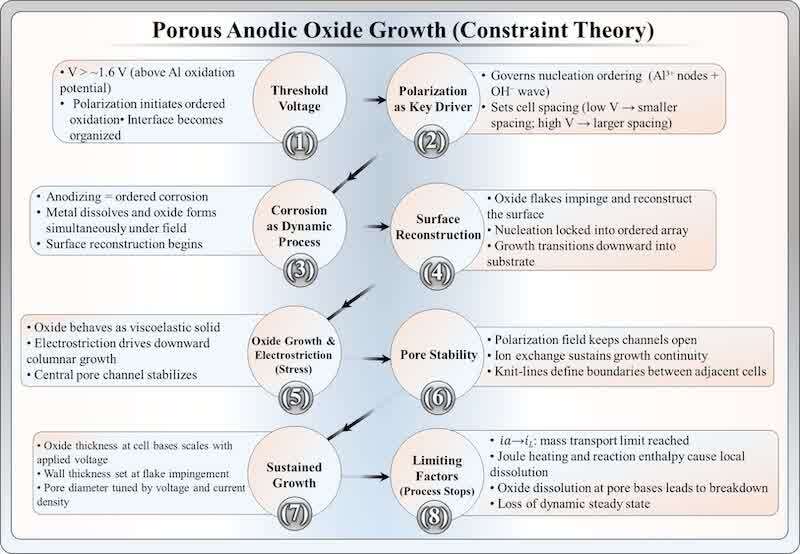
Figure 14. Schematic summary of the Constraint Theory for porous anodic oxide growth. The diagram illustrates the sequential stages of anodic oxide development: (1) onset of polarization above the threshold potential, initiating ordered oxidation; (2) polarization governing nucleation spacing and cell dimensions; (3) anodizing as a dynamic corrosion process involving simultaneous metal dissolution and oxide formation; (4) surface reconstruction through impingement of oxide flakes and ordering of growth fronts; (5) oxide growth coupled with electrostriction leading to columnar development and pore formation; (6) stabilization of pores through polarization and ion exchange within the cellular network; (7) sustained growth, in which oxide dimensions scale with applied voltage and current density; and (8) limiting conditions where mass transport constraints, heating, and oxide dissolution terminate steady growth.
The revisited mechanisms of the CT presented here can be explored in better detail in the book The Metallurgy of Anodizing Aluminium.[44] Readers interested in visualizing anodizing mechanisms from different perspectives are encouraged to consult the illustrations created by Joy Kaufman, illustrator and graphic artist.[136] Remarkably, many of the drawings were constructed to scale, sometimes down to the ionic radius observed in TEM micrographs, offering a combination of scientific rigor and didactic clarity. Importantly, this is not a manual on how to anodize, but rather a book that explains what occurs when one anodizes.
It should also be emphasized that the presentation of PAAO formation developed an ideal aluminium surface, free of precipitates and intermetallics. For readers interested in understanding how microstructural features influence anodizing behaviour, a deeper exploration is provided in the review article by Araujo et al.[19] which offers a critical, data-driven assessment of the role of alloy microstructure in anodic film growth.
5. Summary
The evolution of theories on the formation of anodic oxide films on aluminium closely parallels the development of characterization techniques that enabled their observation and interpretation. The model proposed by Keller, Hunter, and Robinson (KHR, 1953) was the first to explain the morphology of the oxide, describing the barrier layer and pores as distinct entities within a superimposed architecture. This geometric conception, grounded in pioneering electron microscopy observations, laid the structural foundations for subsequent models. A few years later, the mechanism advanced by Hoar and Mott (1959) introduced an electrochemical perspective, postulating metallic, passive, and nucleating regions (M, P, N) and emphasizing the role of the electric field in organizing the film.
In the 1970s, the Field-Assisted Dissolution (FAD) theory emerged, proposed by Graham Charles Wood and later consolidated by George Thompson at UMIST. This model attributed pore formation to localized dissolution of the barrier layer, intensified by the electric field. The designation field-assisted emphasizes the dual role of the electric field: guiding ionic migration and enhancing chemical dissolution at the pore base. The model gained prominence in the 1980s with advances in transmission electron microscopy (TEM), which provided direct images of the morphological evolution occurring at the pore base.
In the early 2000s, Sandra García-Vergara and Peter Skeldon proposed the Field-Assisted Plasticity (FAP) theory, marking a transition from a chemically based explanation to a mechanically driven one. Within this framework, the anodic oxide was interpreted as a viscoelastic solid subjected to electrostrictive stresses, which induce plastic flow along the film walls and sustain columnar growth. The term plasticity precisely conveys this conceptual shift, in which the electric field not only drives ionic transport but also generates stresses capable of deforming the oxide while maintaining its organization into columns.
More recently, Constraint Theory (CT), developed and progressively refined by Jude M. Runge, reframed anodizing as an organized corrosion process under polarization, governed by electrochemical, mechanical, and microstructural constraints. In contrast to earlier approaches, this theory rejects the classical duality between the “barrier layer” and the “porous layer” and describes the film instead as a single, integrated network. Oxide nuclei emerge at polarized sites, expand laterally until impingement occurs, and extend downward by consuming the aluminium substrate, while simultaneously organizing into upright porous columns. The resulting oxide is not composed of independent parts but constitutes a continuous architecture whose stability and morphology are defined by the constraints imposed by the applied field. The term constraint precisely conveys this set of simultaneous limitations—electrochemical, structural, and mechanical—that keep the ionic pump active and channel the natural corrosion of aluminium into a highly ordered porous morphology.
Throughout this trajectory, each theoretical model reflects not only advances in conceptual understanding but also the experimental techniques available at the time: the KHR model relied on early electron microscopy; FAD was consolidated through TEM; FAP depended on in situ mechanical analyses and stress modeling; and CT engages with an integrated approach combining spectroscopies, diffraction, and advanced structural and chemical mapping techniques. Fig. 15 summarizes this timeline, illustrating how the history of anodizing is also the history of the interplay between theory and characterization.
![Figure 15. Historical timeline of porous anodic aluminium oxide (PAAO) film theories on aluminium. Early models, such as the KHR model (1953) and the Hoar–Mott mechanism (1959), laid the foundation for subsequent developments. The field-assisted dissolution (FAD) model, advanced at UMIST in the 1970s by G. C. Wood[7] and later supported by G. Thompson,[9,84,137] attributed pore formation to field-enhanced dissolution at the pore base. Experimental validation using transmission electron microscopy (TEM) in the 1980s further consolidated FAD. In the 2000s, the field-assisted plasticity (FAP) model, developed at the University of Manchester by S. J. García-Vergara[11] and P. Skeldon,[12] proposed that pore growth through electrostrictive plastic flow of the oxide. More recently, the constraint theory,[15,17,58,62] formulated by J. M. Runge (University of Illinois Chicago, 1997), reframed anodizing as a polarization-driven corrosion process, integrating mechanical stress, surface reconstruction, and substrate microstructure.](/images/images/whitepapers/deSousaAraujoa/Figure_15.jpg)
Figure 15. Historical timeline of porous anodic aluminium oxide (PAAO) film theories on aluminium. Early models, such as the KHR model (1953) and the Hoar–Mott mechanism (1959), laid the foundation for subsequent developments. The field-assisted dissolution (FAD) model, advanced at UMIST in the 1970s by G. C. Wood[7] and later supported by G. Thompson,[9,84,137] attributed pore formation to field-enhanced dissolution at the pore base. Experimental validation using transmission electron microscopy (TEM) in the 1980s further consolidated FAD. In the 2000s, the field-assisted plasticity (FAP) model, developed at the University of Manchester by S. J. García-Vergara[11] and P. Skeldon,[12] proposed that pore growth through electrostrictive plastic flow of the oxide. More recently, the constraint theory,[15,17,58,62] formulated by J. M. Runge (University of Illinois Chicago, 1997), reframed anodizing as a polarization-driven corrosion process, integrating mechanical stress, surface reconstruction, and substrate microstructure.
This perspective indicates that the various theories should not be regarded as mutually exclusive, but rather as complementary stages in a historical construction, each aligned with the instrumentation and knowledge available at the time. It is reasonable to anticipate that as real-time and atomic-scale characterization techniques continue to advance, new interpretations will likely emerge. Up to the present, however, the Constraint Theory stands as the most comprehensive formulation, integrating the chemical, mechanical, and structural aspects of anodizing into a single model, providing an explanation without the classical duality between barrier and pore — a continuous oxide, structurally defined and controlled by polarization.
In this sense, these models should not be viewed as successive replacements but as complementary frameworks that emphasize different aspects of anodic oxide growth. FAD and FAP, which emerged from closely related research traditions, continue to provide valuable insight into dissolution and stress-driven mechanisms, while the CT introduces an alternative perspective that incorporates microstructural and process-scale constraints more explicitly. Together, these approaches illustrate how anodizing can be interpreted through multiple, partially overlapping mechanisms whose relevance depends on material composition, processing conditions, and the scale of analysis. Consequently, contemporary studies often adopt the framework most appropriate to the specific materials, experimental conditions, or technological objectives under investigation, reflecting the coexistence and continued applicability of these models in current anodizing research.
Coordinated research programs conducted at the University of Manchester (UoM) over the past decades, often supported by UK research councils[92] have played a central role in advancing the mechanistic understanding of porous anodic alumina formation. Fundamental investigations into oxide growth mechanisms carried out within these initiatives led to a broader re-evaluation of pore formation processes. By combining tracer-based methodologies, advanced electron microscopy, and electrochemical analysis, these studies provided evidence that oxide development may involve internal flow phenomena within the barrier region and that field-assisted dissolution can, under certain anodizing conditions, play a minor or even negligible role. Currently, anodizing research at UoM continues to advance through the work of researchers such as Professor Xiaorong Zhou,[93] with increasing emphasis on the role of alloy microstructure, crystallographic orientation, and local electrochemical heterogeneities in governing pore initiation, oxide ordering, and growth stability.[100,104,119,120,138–145]
In parallel, it is also important to recognize that the development of Constraint Theory did not arise solely from academic laboratory studies but was strongly influenced by investigations on industrial aluminium alloys conducted in collaboration with manufacturing partners and end users of anodized components.[63] These studies began in the late 1990s and have continued to evolve over time, reflecting long-standing efforts to understand anodizing behaviour under practical processing conditions. Within this framework, anodizing is interpreted as an organized corrosion process governed by electrochemical polarization, mechanical response, and process-scale constraints that collectively define oxide morphology, ordering, and long-term stability.
These developments illustrate how anodizing science has progressed through parallel and interconnected research traditions, each initiated in response to different technological demands yet ultimately driven by a common fundamental question: why anodically polarized aluminium develops a highly ordered porous oxide structure. In this sense, the evolution of anodizing theories reflects not only advances in characterization techniques and modelling approaches, but also the continuous reinterpretation of shared scientific challenges across generations of researchers.
Looking forward, important distinctions remain testable among FAD, FAP, and CT. FAD predicts that modifications in electrolyte chemistry and dissolution kinetics should directly modulate pore initiation and stability; FAP anticipates measurable signatures of stress-driven flow, such as tracer displacement and stress relaxation, particularly under high-field regimes; CT, in turn, predicts coupled electrochemical–mechanical responses that can be revealed through in situ polarization mapping and surface reconstruction dynamics. Critical gaps include the absence of real-time thermo-mechanical coupling analyses, direct mapping of pH and ionic gradients inside pores, and the integration of local EBSD with spatially resolved electrochemical techniques (e.g., LEIS, EIS). Future priorities involve (i) in operando imaging of ionic and stress fields at the pore scale, (ii) direct quantification of oxide viscoelasticity under field, and (iii) nanoscale correlation of microstructure and current distribution. From an engineering standpoint, resolving these questions is not merely academic: it directly affects strategies for sealing, coloring, and improving the thermal stability of anodic films in advanced applications.
Future advances will likely integrate elements of existing models, refining rather than entirely replacing the current understanding of anodic oxide growth. It should also be noted that theoretical interpretations of porous anodic alumina formation remain under active discussion.[146,147] The continuing divergences among authors are not a weakness of the field, but rather an indication of its scientific vitality, as new evidence may further refine current models or give rise to new theoretical perspectives. Readers interested in broader contemporary developments beyond the models discussed here are referred to the comprehensive review by Mikhail Pashchanka.[98]
Dr. João Victor de Sousa Araujo is a materials researcher whose work focuses on aluminum anodizing, localized corrosion, and electrochemical surface characterization. He received his Ph.D. in Nuclear Technology–Materials from the University of São Paulo, Brazil, in 2025. His doctoral research investigated the influence of alloy microstructure on anodic film formation and corrosion resistance in high-strength aluminum alloys, with relevance to aerospace applications. As part of his Ph.D., he conducted research at the Corrosion and Protection Centre at The University of Manchester, where he also served as Honorary Staff. He is currently a postdoctoral researcher at the Nuclear and Energy Research Institute (IPEN) in São Paulo (Brazil), working on corrosion and materials performance for nuclear applications. He has authored numerous scientific publications, including two review articles on aluminum anodizing, and his research combines advanced microscopy, surface characterization, and electrochemical techniques to investigate anodic film formation and corrosion mechanisms. João has a genuine passion for anodizing and is always enthusiastic about learning more and discussing its history, mechanisms, and industrial applications. For him, anodizing is more than a research topic, it is a scientific passion.
Acknowledgements: The author gratefully acknowledges PhD. Jude M. Runge for her invaluable scientific input, careful reading, and constructive suggestions, which provided important insights into the mechanisms of anodic oxide formation and greatly contributed to the theoretical framework developed in this work. The author also extends sincere thanks to Prof. Hercílio Gomes de Melo for his encouragement, critical corrections, and thoughtful guidance, as well as for sharing his passion for anodizing, which has been an enduring source of inspiration throughout the preparation of this study.
Funding: The author gratefully acknowledges the financial support provided by Fundação de Amparo à Pesquisa do Estado de São Paulo (FAPESP) under grant numbers 2019/18388–1 and 2022/06935–0.
References
- Runge, J. M. A Brief History of Anodizing Aluminum. In The Metallurgy of Anodizing Aluminum; Springer International Publishing: Cham, 2018; pp 65–148. https://doi.org/10.1007/978-3-319-72177-4_2
- Thompson, G. E. Porous Anodic Alumina: Fabrication, Characterization and Applications. Thin Solid Films 1997, 297, 192–201. https://doi.org/10.1016/S0040-6090(96)09440-0
- Thompson, G. E.; Habazaki, H.; Shimizu, K.; Sakairi, M.; Skeldon, P.; Zhou, X.; Wood, G. C. Anodizing of Aluminium Alloys. Aircr. Eng. Aerosp. Technol. 1999, 71, 228–238. https://doi.org/10.1108/00022669910270709
- Thompson, G. E.; Skeldon, P.; Zhou, X.; Shimizu, K.; Habazaki, H.; Smith, C. J. E. Improving the Performance of Aerospace Alloys. Aircr. Eng. Aerosp. Technol. 2003, 75, 372–379. https://doi.org/10.1108/00022660310484301
- Aluminum Anodizers Council. What Is Anodizing? Aluminum Anodizers Council, 2016. http://www.anodizing.org/?page=what_is_anodizing (accessed 8 September 2025)
- Edwards, F.; Keller, J. D. Formation of Anodic Coatings on Aluminum. Electrochem. Soc. 1940, 133–140.
- Wood, G. C.; O’Sullivan, J. P. The Anodizing of Aluminium in Sulphate Solutions. Electrochim. Acta 1970, 15, 1865–1876. https://doi.org/10.1016/0013-4686(70)85024-1
- Hoar, T. P.; Mott, N. F. A Mechanism for the Formation of Porous Anodic Oxide Films on Aluminium. J. Phys. Chem. Solids 1959, 9, 97–99. https://doi.org/10.1016/0022-3697(59)90199-4
- Thompson, G. E.; Wood, G. C. Porous Anodic Film Formation on Aluminium. Nature 1981, 290, 230–232. https://doi.org/10.1038/290230a0
- Thompson, G. E.; Furneaux, R. C.; Wood, G. C.; Richardson, J. A.; Goode, J. S. Nucleation and Growth of Porous Anodic Films on Aluminium. Nature 1978, 272, 433–435. https://doi.org/10.1038/272433a0
- Garcia-Vergara, S. J.; Skeldon, P.; Thompson, G. E.; Habazaki, H. A Flow Model of Porous Anodic Film Growth on Aluminium. Electrochim. Acta 2006, 52, 681–687. https://doi.org/10.1016/j.electacta.2006.05.054
- Skeldon, P.; Thompson, G. E.; Garcia-Vergara, S. J.; Iglesias-Rubianes, L.; Blanco-Pinzon, C. E. A Tracer Study of Porous Anodic Alumina. Electrochem. Solid-State Lett. 2006, 9. https://doi.org/10.1149/1.2335938
- Houser, J. E.; Hebert, K. R. The Role of Viscous Flow of Oxide in the Growth of Self-Ordered Porous Anodic Alumina Films. Nat. Mater. 2009, 8, 415–420. https://doi.org/10.1038/nmat2423
- Runge, J. M. Anodic Aluminum Oxide Growth and Structure. In The Metallurgy of Anodizing Aluminum; Springer International Publishing: Cham, 2018; pp 281–320. https://doi.org/10.1007/978-3-319-72177-4_6
- Runge, J. M. Interfacial Phenomena and Anodizing. In The Metallurgy of Anodizing Aluminum; Springer International Publishing: Cham, 2018; pp 321–372. https://doi.org/10.1007/978-3-319-72177-4_7
- Schneider, M.; Fürbeth, W. Anodizing: The Pore Makes the Difference. Mater. Corros. 2022, 73, 1752–1765. https://doi.org/10.1002/maco.202213324
- Runge, J. M. Anodizing as an Industrial Process. In The Metallurgy of Anodizing Aluminum; Springer International Publishing: Cham, 2018; pp 149–190. https://doi.org/10.1007/978-3-319-72177-4_3
- Runge, M. J.; Blum, W. The 56th William Blum Lecture Presented at NASF SUR/FIN 2022 in Rosemont, 2024.
- Araujo, J. V. de S.; Milagre, M.; Costa, I. A Historical, Statistical and Electrochemical Approach on the Effect of Microstructure in the Anodizing of Al Alloys: A Review. Crit. Rev. Solid State Mater. Sci. 2024, 49, 521–581. https://doi.org/10.1080/10408436.2023.2230250
- Diggle, J. W.; Downie, T. C.; Goulding, C. W. Anodic Oxide Films on Aluminum. Chem. Rev. 1969, 69, 365–405. https://doi.org/10.1021/cr60259a005
- Dell’Oca, C. J.; Pulfrey, D. L.; Young, L. Anodic Oxide Films. In 1971; pp 1–79. https://doi.org/10.1016/B978-0-12-533006-0.50008-6
- Tajima, S. Anodic Oxidation of Aluminum. In Advances in Corrosion Science and Technology, 1970; pp 229–362. https://doi.org/10.1007/978-1-4615-8252-6_4
- Raj, V.; Rajaram, M. P.; Balasubramanian, G.; Vincent, S.; Kanagaraj, D. Pulse Anodizing: An Overview. Trans. Inst. Met. Finish. 2003, 81, 114–121. https://doi.org/10.1080/00202967.2003.11871515
- Mathew, N. A Short Review on Aluminum Anodizing: An Eco-Friendly Metal Finishing Process. J. Res. 2016, 2, 5–9.
- Ofoegbu, S. U.; Fernandes, F. A. O.; Pereira, A. B. The Sealing Step in Aluminum Anodizing: A Focus on Sustainable Strategies for Enhancing Both Energy Efficiency and Corrosion Resistance. Coatings 2020, 10. https://doi.org/10.3390/coatings10030226
- Wielage, B.; Alisch, G.; Lampke, T.; Nickel, D. Anodizing: A Key for Surface Treatment of Aluminium. Key Eng. Mater. 2008, 384, 263–281. https://doi.org/10.4028/www.scientific.net/KEM.384.263
- Poinern, G. E. J.; Ali, N.; Fawcett, D. Progress in Nano-Engineered Anodic Aluminum Oxide Membrane Development. Materials 2011, 4, 487–526. https://doi.org/10.3390/ma4030487
- Brace, A. W.; Sheasby, P. G. The Technology of Anodizing Aluminium, 2nd ed.; Technicopy Limited: Stonehouse, Glos., 1979.
- Henley, V. F. Anodic Oxidation of Aluminium and Its Alloys, 1st ed.; Pergamon Press: Oxford, 1982.
- Runge, J. M. The Metallurgy of Anodizing Aluminum; Springer International Publishing: Cham, 2018. https://doi.org/10.1007/978-3-319-72177-4
- Wernick, S.; Pinner, R.; Sheasby, P. G. The Surface Treatment and Finishing of Aluminum and Its Alloys, 6th ed.; Middlesex, England, 2001.
- Zhou, X.; Sheasby, P. G.; Scott, B. A. Coatings Produced by Anodic Oxidation. In Shreir’s Corrosion; Elsevier, 2010; pp 2503–2518. https://doi.org/10.1016/B978-044452787-5.00193-1
- Yanagishita, T.; Moriyasu, R.; Ishii, T.; Masuda, H. Self-Ordered Anodic Porous Alumina with Inter-Hole Spacing over 1.5 μm. RSC Adv. 2021, 11, 3777–3782. https://doi.org/10.1039/D0RA10269E
- Ku, C. A.; Yu, C. Y.; Hung, C. W.; Chung, C. K. Advances in the Fabrication of Nanoporous Anodic Aluminum Oxide and Its Applications to Sensors: A Review. Nanomaterials 2023, 13. https://doi.org/10.3390/nano13212853
- Li, C.; Ni, Y.; Gong, J.; Song, Y.; Gong, T.; Zhu, X. A Review: Research Progress on the Formation Mechanism of Porous Anodic Oxides. Nanoscale Adv. 2022, 4, 322–333. https://doi.org/10.1039/D1NA00624J
- Paz Martínez-Viademonte, M.; Abrahami, S. T.; Hack, T.; Burchardt, M.; Terryn, H. A Review on Anodizing of Aerospace Aluminum Alloys for Corrosion Protection. Coatings 2020, 10, 1106. https://doi.org/10.3390/coatings10111106
- Lee, W.; Park, S. J. Porous Anodic Aluminum Oxide: Anodization and Templated Synthesis of Functional Nanostructures. Chem. Rev. 2014, 114, 7487–7556. https://doi.org/10.1021/cr500002z
- Lyon, S. Graham Wood. 6 February 1934–4 November 2016. Biogr. Mem. Fellows R. Soc. 2022, 72, 447–470. https://doi.org/10.1098/rsbm.2021.0025
- Scamans, G.; Skeldon, P.; Zhou, X. Professor George Thompson, OBE, DSc, FREng (1946–2020). Corrosion 2021, 77, 482–483. https://doi.org/10.5006/3856
- Clarivate Analytics. Web of Science. https://www.webofscience.com (accessed 8 September 2025)
- Elsevier. Scopus. https://www.scopus.com (accessed 8 September 2025)
- Scampone, G.; Timelli, G. Anodizing Al–Si Foundry Alloys: A Critical Review. Adv. Eng. Mater. 2022, 24, 2101480. https://doi.org/10.1002/adem.202101480
- Runge, J. M.; Pomis, A. J. Anodic Oxide Film Formation Relating Mechanism to Composition and Structure, AESF SUR/FIN, 2000, 266–277.
- Runge, J. M. The Metallurgy of Anodizing Aluminum; Springer International Publishing: Cham, 2018. https://doi.org/10.1007/978-3-319-72177-4
- McLoughlin, J.; Sopasakis, P.; McLoone, S. Digitalisation of UK Aluminium Anodisation, 2022. http://go.qub.ac.uk/oa-feedback (accessed 8 September 2025)
- O’Sullivan, J. P.; Wood, G. C. The Morphology and Mechanism of Formation of Porous Anodic Films on Aluminium. Proc. R. Soc. Lond. A 1970, 317, 511–543. https://doi.org/10.1098/rspa.1970.0129
- Thompson, G. E.; Furneaux, R. C.; Wood, G. C. Electron Microscopy of Anodic Films Formed on Aluminium in Sulphuric Acid. Trans. Inst. Met. Finish. 1977, 55, 117–128. https://doi.org/10.1080/00202967.1977.11870432
- Furneaux, R. C.; Thompson, G. E.; Wood, G. C. The Application of Ultramicrotomy to the Electronoptical Examination of Surface Films on Aluminium. Corros. Sci. 1978, 18, 853–881. https://doi.org/10.1016/0010-938X(78)90009-4
- Garcia-Vergara, S. J. Effects of Alloy Enrichment in the Surface Properties of Aluminium Alloys. Thesis, University of Manchester, 2004.
- Garcia-Vergara, S. J.; Skeldon, P.; Thompson, G. E.; Habazaki, H. Pore Development during Anodizing of Al–3.5 at.%W Alloy in Phosphoric Acid. Surf. Coat. Technol. 2007, 201, 9506–9511. https://doi.org/10.1016/j.surfcoat.2007.04.015
- Garcia-Vergara, S. J.; Skeldon, P.; Thompson, G. E.; Habakaki, H. Pore Development in Anodic Alumina in Sulphuric Acid and Borax Electrolytes. Corros. Sci. 2007, 49, 3696–3704. https://doi.org/10.1016/j.corsci.2007.03.033
- Garcia-Vergara, S. J.; Habazaki, H.; Skeldon, P.; Thompson, G. E. Tracer Studies Relating to Alloying Element Behaviour in Porous Anodic Alumina Formed in Phosphoric Acid. Electrochim. Acta 2010, 55, 3175–3184. https://doi.org/10.1016/j.electacta.2010.01.038
- Garcia-Vergara, S. J.; Skeldon, P.; Thompson, G. E.; Habazaki, H. Stress Generated Porosity in Anodic Alumina Formed in Sulphuric Acid Electrolyte. Corros. Sci. 2007, 49, 3772–3782. https://doi.org/10.1016/j.corsci.2007.03.036
- Arenas-Vara, M. Á.; Skeldon, P.; García-Vergara, S. J. Effect of Copper-Enriched Layers on Localized Corrosion of Aluminium-Copper Alloys. Rev. Fac. Ing. 2018, 27, 7–15. https://doi.org/10.19053/01211129.v27.n48.2018.8016
- Garcia-Vergara, S. J.; Skeldon, P.; Thompson, G. E.; Habazaki, H. A Tracer Investigation of Chromic Acid Anodizing of Aluminium. Surf. Interface Anal. 2007, 39, 860–864. https://doi.org/10.1002/sia.2601
- Garcia-Vergara, S. J.; El Khazmi, K.; Skeldon, P.; Thompson, G. E. Influence of Copper on the Morphology of Porous Anodic Alumina. Corros. Sci. 2006, 48, 2937–2946. https://doi.org/10.1016/j.corsci.2005.10.017
- Garcia-Vergara, S.; Skeldon, P.; Thompson, G. E.; Bailey, P.; Noakes, T. C. Q.; Habazaki, H.; Shimizu, K. Morphology of Enriched Alloy Layers in an Anodized Al–Cu Alloy. Appl. Surf. Sci. 2003, 205, 121–127. https://doi.org/10.1016/S0169-4332(02)01040-1
- Runge, J. M. Polarization: The Key to Anodic Oxide Formation. Mater. Today Proc. 2019, 10, 360–367. https://doi.org/10.1016/j.matpr.2018.10.418
- Runge, J. M. Trace Elements and Their Impact on Surface Finishing Characteristics of Aluminum Extrusions. In 15th Annual Anodizing Conference and Expo; Aluminum Anodisers Council, 2013; pp 1–11.
- Runge, J. M. The Science of Successfully Anodizing Die Cast Substrates. Alum. Int. Today 2010, 1–7.
- Runge, J. M. Understanding the Anodic Oxide Finish: The First Commercially Available Nanoscale Coating. SUR/FIN 2006 2020, 85, 250–262.
- Barkey, D.; McHugh, J. Pattern Formation in Anodic Aluminum Oxide Growth by Flow Instability and Dynamic Re-Stabilization. J. Electrochem. Soc. 2010, 157, C388–C391. https://doi.org/10.1149/1.3491769
- Runge, J. M. Base Metal Microstructural Considerations for Anodizing Aluminum Substrates. In The Metallurgy of Anodizing Aluminum; Springer International Publishing: Cham, 2018; pp 373–431. https://doi.org/10.1007/978-3-319-72177-4_8
- Runge, J. M. Understanding the Interface: Meeting the Challenges of Anodizing Cast Substrates. In Proceedings of the 2016 AAC Annual Technical Conference and Exposition, Montreal, Canada, 2016.
- Runge, J. M. Base Metal Microstructural Considerations for Anodizing Aluminum Extrusions. In Proceedings of Eleventh International Aluminum Extrusion Technology Seminar, Chicago, 2016.
- Runge, J. M. Anodizing Complex 7000 Series. Light Met. Age 2016, 74, 52–56.
- Runge, J. M. Trace Elements and Their Impact on Surface Finishing Characteristics of Aluminum Extrusions. In Proceedings of ET, Miami, 2012.
- Runge, J. M. Interfacial Phenomena and Anodizing: Ramifications and Process Solutions. In Proceedings of the 17th Annual AAC Conference, San Francisco, CA, 2008.
- Runge, J. M. Electrochemical Formation of a Composite Polymer-Aluminum Oxide Film, 1997.
- Runge, J. M.; Hossain, T. Interfacial Phenomena in 7000 Series Alloys and Their Impact on the Anodic Oxide. Mater. Today Proc. 2015. https://doi.org/10.1016/j.matpr.2015.10.096
- Runge, J. M.; PDC International. Understanding Aluminum Anodic Oxide Film Formation: Improving Engineering Properties Through Microstructural Modification. EBRATS Brazilian Surface Treatment Meeting, 2006.
- Runge, J. M. Process Insights: The Science of Every Day Anodizing. AAC, Minneapolis, USA, October 27.
- Brace, A. W. A New Model for the Formation of Anodic Coatings on Aluminum. Plating Surf. Finish. 2010, 97, 26–31.
- Brace, A. W. Anodic Coating Formation on Aluminum without a “Barrier Layer”. Plating Surf. Finish. 2009, 96, 22–30.
- Brace, G. Dr. Arthur William Brace FIMF: “The Father of Anodising”, 24 May 1923–5 April 2017. Trans. Inst. Met. Finish. 2017, 95, 179–179. https://doi.org/10.1080/00202967.2017.1333329
- Vargel, C. The Various Forms of Atmospheric Corrosion. In Corrosion of Aluminium, 2004; pp 269–274. https://doi.org/10.1016/B978-0-08-044495-6.50020-3
- McCafferty, E. Introduction to Corrosion Science; Springer: New York, 2010. https://doi.org/10.1007/978-1-4419-0455-3
- Vargel, C.; Jacques, M.; Schmidt, M. P. Protection against Corrosion. In Corrosion of Aluminium, 2004; pp 185–207. https://doi.org/10.1016/B978-008044495-6/50015-X
- Roeber, E. F. The Film on the Aluminium Anode. Electrochem. Ind. 1904, 11, 436.
- Vargel, C.; Jacques, M.; Schmidt, M. P. The Most Common Wrought Aluminium Alloys. In Corrosion of Aluminium, 2004; pp 61–69. https://doi.org/10.1016/B978-008044495-6/50009-4
- Vargel, C.; Jacques, M.; Schmidt, M. P. Corrosion in Water. In Corrosion of Aluminium, 2004; pp 293–296. https://doi.org/10.1016/B978-008044495-6/50022-7
- Thompson, G. E.; Furneaux, R. C.; Wood, G. C. Electron Microscopy of Ion Beam Thinned Porous Anodic Films Formed on Aluminium. Corros. Sci. 1978, 18, 481–498. https://doi.org/10.1016/S0010-938X(78)80041-9
- Thompson, G. E.; Furneaux, R. C.; Goode, J. S.; Wood, G. C. Porous Anodic Film Formation on Aluminium Substrates in Phosphoric Acid. Trans. Inst. Met. Finish. 1978, 56, 159–167. https://doi.org/10.1080/00202967.1978.11870473
- Xu, Y.; Thompson, G. E.; Wood, G. C. Mechanism of Anodic Film Growth on Aluminium. Trans. Inst. Met. Finish. 1985, 63, 98–103. https://doi.org/10.1080/00202967.1985.11870715
- Thompson, G. E.; Xu, Y.; Skeldon, P.; Shimizu, K.; Han, S. H.; Wood, G. C. Anodic Oxidation of Aluminium. Philos. Mag. B 1987, 55, 651–667. https://doi.org/10.1080/13642818708218371
- Royal Society Publishing. https://royalsocietypublishing.org/doi/10.1098/rspa.1970.0129 (accessed 8 September 2025)
- Habazaki, H.; Shahzad, K.; Hiraga, T.; Tsuji, E.; Aoki, Y. Formation of Self-Organized Porous Anodic Films on Iron and Stainless Steels. ECS Trans. 2015, 69, 211. https://doi.org/10.1149/06902.0211ecst
- Habazaki, H.; Takano, T.; Kowalski, D.; Kitano, S.; Aoki, Y. The Role of Hydrated Alumina Layer on the Incorporation of Electrolyte Species in Anodizing of Aluminum. ECS Meet. Abstr. 2020, MA2020-02, 1233. https://doi.org/10.1149/ma2020-02111233mtgabs
- Habazaki, H. Anodizing of Metals for Fabrication of Functional Nanostructured Surfaces. ECS Meet. Abstr. 2020, MA2020-02, 1202. https://doi.org/10.1149/ma2020-02101202mtgabs
- Fadillah, L.; Kowalski, D.; Kitano, S.; Zhu, C.; Aoki, Y.; Habazaki, H. Highly Enhanced Photocatalytic Activity of Nanotubular Fe2O3/Fe2WO6 Nanocomposite Film Formed by Anodizing FeW Alloy. Electrochem. Commun. 2023, 149, 107460. https://doi.org/10.1016/j.elecom.2023.107460
- Quintero, D.; Ambe, T.; Iwai, M.; Kitano, S.; Fushimi, K.; Habazaki, H. Influence of Minor Alloying Elements on γ′-Al2O3 Crystalline Anodic Formation and Its Impact on the Dielectric Properties of Solid Conductive Polymer Capacitors. J. Power Sources 2025, 660, 238462. https://doi.org/10.1016/j.jpowsour.2025.238462
- Hashimoto, H. L. T.; Thompson, G. E.; Skeldon, P. New Insights into Pore Initiation in Anodic Alumina. School of Materials, The University of Manchester, 2013.
- University of Manchester. Xiaorong Zhou Profile. https://research.manchester.ac.uk/en/persons/xiaorong.zhou (accessed 8 September 2025)
- Garcia-Vergara, S. J.; Iglesias-Rubianes, L.; Blanco-Pinzon, C. E.; Skeldon, P.; Thompson, G. E.; Campestrini, P. Mechanical Instability and Pore Generation in Anodic Alumina. Proc. R. Soc. A 2006, 462, 2345–2358. https://doi.org/10.1098/RSPA.2006.1686
- Çapraz, Ö. Ö.; Shrotriya, P.; Hebert, K. R. Measurement of Stress Changes during Growth and Dissolution of Anodic Oxide Films on Aluminum. J. Electrochem. Soc. 2014, 161, D256–D262. https://doi.org/10.1149/2.057405jes
- Çapraz, Ö. Ö.; Shrotriya, P.; Skeldon, P.; Thompson, G. E.; Hebert, K. R. Factors Controlling Stress Generation during the Initial Growth of Porous Anodic Aluminum Oxide. Electrochim. Acta 2015, 159, 16–22. https://doi.org/10.1016/j.electacta.2015.01.183
- Çapraz, Ö. Ö.; Shrotriya, P.; Skeldon, P.; Thompson, G. E.; Hebert, K. R. Role of Oxide Stress in the Initial Growth of Self-Organized Porous Aluminum Oxide. Electrochim. Acta 2015, 167, 404–411. https://doi.org/10.1016/j.electacta.2015.03.017
- Pashchanka, M. Conceptual Progress for Explaining and Predicting Self-Organization on Anodized Aluminum Surfaces. Nanomaterials 2021, 11, 2271. https://doi.org/10.3390/nano11092271
- Araujo, J. O Processo de Anodização do Alumínio e Suas Ligas: Uma Abordagem Histórica e Eletroquímica. Quim. Nova 2021, 44, 999–1011. https://doi.org/10.21577/0100-4042.20170748
- Araujo, J. V. de S. Microstructural Influence on Anodic Film Formation and Corrosion Resistance in Anodized High-Strength Aluminium Alloys. Thesis, Universidade de São Paulo, 2025. https://doi.org/10.11606/T.85.2025.tde-19022025-161436
- The Impact of Hard Anodizing Conditions on the Growth Mechanism, Electrochemical Response and Protective Properties of Porous Alumina Films. Thesis, University of Manchester, Department of Materials, 2023.
- Elebar, D. Effect of Sulphate Impurity in Chromic Acid Anodizing of Aluminium and Aluminium Alloy. Ph.D. Dissertation, University of Manchester, 2016.
- Yanlong, M. Effect of Heterogeneous Microstructure on Corrosion Resistance of AA2099-T8 Aluminum-Lithium Alloy and Its Anodic Films. Mater. China 2015, 34, 928–932. https://doi.org/10.7502/j.issn.1674-3962.2015.12.10
- Qin, J. The Impact of Hard Anodizing Conditions on the Growth Mechanism, Electrochemical Response and Protective Properties of Porous Alumina Films, n.d.
- Torrescano, M. Hard Anodic Films for Aluminium Alloys. Thesis, University of Manchester, 2018. https://www.research.manchester.ac.uk/portal/files/83388174/FULL_TEXT.PDF
- Guadagnin, H. C. Corrosion Resistance Study of AA2524 Anodized in Sulphuric-Tartaric Acid and Sealed with Hybrid Coatings. Thesis, Universidade de São Paulo, 2017. https://doi.org/10.11606/T.3.2017.tde-20072017-152947
- Fratila, L. E. Anodic Oxidation of AlSi(Cu) Casting Alloys. Thesis, Delft University of Technology, 2002.
- Zhou, F. Growth Mechanism of Porous Anodic Films on Aluminium. Thesis, University of Manchester, 2011.
- Trigoulet, N. Probing Barrier-Type Anodic Alumina Films on Nano-Patterned Substrates. Thesis, 2011.
- Csokan, P. Nucleation Mechanism in Oxide Formation during Anodic Oxidation of Aluminum. In Advances in Corrosion Science and Technology; Springer US: Boston, MA, 1980; pp 239–356. https://doi.org/10.1007/978-1-4615-9065-1_4
- Finishing and Coating. 20 Questions with Dr. Jude Mary Runge. https://finishingandcoating.com/index.php/anodizingcat/906-20-questions-with-dr-jude-mary-runge-apple?highlight=WyJqdWRlIl0= (accessed 8 September 2025)
- YouTube. Legends: Jude M. Runge, Ph.D. https://www.youtube.com/watch?v=JpNpnlH5C3c (accessed 8 September 2025)
- Pashchanka, M.; Schneider, J. J. Experimental Validation of the Novel Theory Explaining Self-Organization in Porous Anodic Alumina Films. Phys. Chem. Chem. Phys. 2013, 15, 7070. https://doi.org/10.1039/C3CP50805F
- Pashchanka, M.; Org, J.; Schneider, J. Origin of Self-Organisation in Porous Anodic Alumina Films Derived from Analogy with Rayleigh-Benard Convection Cells. J. Mater. Chem. 2011, 21, 18761–18767. https://doi.org/10.1039/C1JM13898G
- Runge, J. M. Anodizing as a Corrosion Process. In The Metallurgy of Anodizing Aluminum; Springer International Publishing: Cham, 2018; pp 249–280. https://doi.org/10.1007/978-3-319-72177-4_5
- Deal, B. E.; Grove, A. S. General Relationship for the Thermal Oxidation of Silicon. J. Appl. Phys. 1965, 36, 3770–3778. https://doi.org/10.1063/1.1713945
- Lerner, M. Is the Barrier Layer Responsible for the Cellular Structure of Aluminum Oxide Film Anodized in Sulfuric Acid? In Proceedings of AESF Surfin Conference, Chicago, 2003.
- Nogueira Pereira, B.; de Sousa Araujo, J. V.; Emil Klumpp, R.; Altobelli Antunes, R.; Costa, I. Effects of Surface Preparation on the Corrosion Resistance of TSA Anodized Aluminum Alloys. Mater. Res. 2025, 28, e20250452. https://doi.org/10.1590/1980-5373-MR-2025-0452
- Araujo, J. V. de S.; Chen, J.; Costa, I.; Zhou, X. Localized Corrosion in Anodized Aluminium Alloys: The Role of Constituent Particle-Induced Defects in Anodic Films. Corros. Sci. 2025, 252, 112961. https://doi.org/10.1016/j.corsci.2025.112961
- Araujo, J. V. de S.; Chen, J.; Qin, J.; Costa, I.; Zhou, X. Comparative Study of Anodic Film Formation on High-Strength Aluminium Alloys in Tartaric-Sulphuric Acid Electrolyte. Trans. Inst. Met. Finish. 2025. https://doi.org/10.1080/00202967.2025.2569165
- Habazaki, H.; Shimizu, K.; Skeldon, P.; Thompson, G. E.; Wood, G. C. Aluminium Surface Science and Technology. In Aluminium Surface Science and Technology (ASST II), Manchester, 2000; p 151.
- Habazaki, H.; Shimizu, K.; Skeldon, P.; Thompson, G. E.; Wood, G. C. The Co-Enrichment of Alloying Elements in the Substrate by Anodic Oxidation of Al-Cu-W Alloys. Corros. Sci. 1997, 39, 339–354. https://doi.org/10.1016/S0010-938X(97)83350-1
- Habazaki, H.; Shimizu, K.; Skeldon, P.; Thompson, G. E.; Wood, G. G. Formation of Amorphous Anodic Oxide Films of Controlled Composition on Aluminium Alloys. Thin Solid Films 1997, 300, 131–137. https://doi.org/10.1016/S0040-6090(96)09491-6
- Habazaki, H.; Shimizu, K.; Skeldon, P.; Thompson, G. E.; Wood, G. C. The Behaviour of Iron during Anodic Oxidation of Sputtering-Deposited Al-Fe Alloys. Corros. Sci. 2001, 43, 1393–1402. https://doi.org/10.1016/S0010-938X(00)00151-7
- Habazaki, H.; Shimizu, K.; Skeldon, P.; Thompson, G. E.; Woodj, G. C. The Incorporation of Metal Ions into Anodic Films on Aluminium Alloys. Philos. Mag. B 1996, 73, 445–460. https://doi.org/10.1080/13642819608239128
- Zhou, X.; Habazaki, H.; Shimizu, K.; Skeldon, P.; Thompson, G. E.; Wood, G. C. Formation and Accommodation of Gold Atom Clusters and Oxygen Bubbles during Amorphous Anodic Alumina Growth. Proc. R. Soc. Lond. A 1999, 455, 385–399. https://doi.org/10.1098/RSPA.1999.0318
- Skeldon, P.; Thompson, G. E.; Wood, G. C.; Zhou, X.; Habazaki, H.; Shimizu, K. Evidence of Oxygen Bubbles Formed within Anodic Films on Aluminium-Copper Alloys. Philos. Mag. A 1997, 76, 729–741. https://doi.org/10.1080/01418619708214206
- Habazaki, H.; Shimizu, K.; Skeldon, P.; Thompson, G. E.; Wood, G. C.; Zhou, X. Nanoscale Enrichments of Substrate Elements in the Growth of Thin Oxide Films. Corros. Sci. 1997, 39, 731–737. https://doi.org/10.1016/S0010-938X(97)89339-0
- Zhou, X.; Thompson, G. E.; Habazaki, H.; Shimizu, K.; Skeldon, P.; Wood, G. C. Copper Enrichment in Al-Cu Alloys Due to Electropolishing and Anodic Oxidation. Thin Solid Films 1997, 293, 327–332. https://doi.org/10.1016/S0040-6090(96)09117-1
- Habazaki, H.; Shimizu, K.; Skeldon, P.; Thompson, G. E.; Wood, G. C.; Zhou, X. Effects of Alloying Elements in Anodizing of Aluminium. Trans. Inst. Met. Finish. 1997, 75, 18–23. https://doi.org/10.1080/00202967.1997.11871137
- Habazaki, H.; Shimizu, K.; Skeldon, P.; Thompson, G. E.; Zhou, X.; De Laet, J.; Wood, G. C. The Incorporation and Mobility of Chromium Species in Anodic Alumina Films. Corros. Sci. 1997, 39, 719–730. https://doi.org/10.1016/S0010-938X(97)89338-9
- Habazaki, H.; Shimizu, K.; Skeldon, P.; Thompson, G. E.; Wood, G. C.; Zhou, X. Anodic Film Formation on Al-Au Alloys: Enrichment of Gold in the Alloy and Subsequent Evolution of Oxygen. J. Phys. D Appl. Phys. 1997, 30, 1833–1841. https://doi.org/10.1088/0022-3727/30/13/002
- Zhou, X.; Thompson, G. E.; Habazaki, H.; Paez, M. A.; Shimizu, K.; Skeldon, P.; Wood, G. C. Morphological Development of Oxygen Bubbles in Anodic Alumina. J. Electrochem. Soc. 2000, 147, 1747. https://doi.org/10.1149/1.1393428
- Crossland, A. C.; Habazaki, H.; Shimizu, K.; Skeldon, P.; Thompson, G. E.; Wood, G. C.; Zhou, X.; Smith, C. J. E. Residual Flaws Due to Formation of Oxygen Bubbles in Anodic Alumina. Corros. Sci. 1999, 41, 1945–1954. https://doi.org/10.1016/S0010-938X(99)00035-9
- Wikipedia. Anodic Aluminium Oxide. https://en.wikipedia.org/wiki/Anodic_aluminium_oxide (accessed 8 September 2025)
- JoyJoy Creations. The Metallurgy of Anodizing Aluminum: Connecting Science to Practice. https://joyjoycreations.com/portfolio/the-metallurgy-of-anodizing-aluminum-connecting-science-to-practice/ (accessed 8 September 2025)
- Thompson, G. E.; Wood, G. C. Anodic Films on Aluminium. In Corrosion: Aqueous Processes and Passive Films; Academic Press: London, 1983; pp 205–329. https://doi.org/10.1016/B978-0-12-633670-2.50010-3
- Costa, I.; Araujo, J.; Chen, J.; Zhou, X. Investigation of Corrosion Behaviour in Anodized New Generation Aluminium Alloys. In EFC’s Annual Conference, Brussels, 2023; p 63.
- Araujo, J. V. de S.; Chen, J.; Costa, I.; Zhou, X. Anodic Film Formation on Aluminium Alloys: Analysis of Defects Induced by Constituent Intermetallic Particles. Mater. Chem. Phys. 2026, 350, 131803. https://doi.org/10.1016/J.MATCHEMPHYS.2025.131803
- de Sousa Araujo, J. V.; Milagre, M. X.; Zhou, X.; Costa, I. An Assessment of Pitting Corrosion in Anodized Aluminum Alloys: It Might Not Be What It Seems. Mater. Corros. 2024, 75, 599–613. https://doi.org/10.1002/maco.202313977
- Ma, Y. L.; Wu, H. P.; Wang, Z. X.; Liao, Y.; Huang, W. J. Computational Simulation of Localised Corrosion in Anodised AA2099-T8 Aluminium-Lithium Alloy. Mater. Sci. Forum 2016, 877, 537–542. https://doi.org/10.4028/www.scientific.net/MSF.877.537
- Ma, Y. Effect of Microstructure on Corrosion Resistance and Anodising Behaviour of AA2099-T8 Aluminium Alloy, 2010.
- Ma, Y.; Zhou, X.; Thompson, G. E.; Curioni, M.; Hashimoto, T.; Skeldon, P.; Thomson, P.; Fowles, M. Anodic Film Formation on AA2099-T8 Aluminum Alloy in Tartaric-Sulfuric Acid. J. Electrochem. Soc. 2011, 158, C17–C22. https://doi.org/10.1149/1.3523262
- Qin, J.; Curioni, M. Transitions in Porous Oxide Morphologies on AA2024-T3 Anodized under High Currents and Low Temperatures: Impact on Corrosion Behaviour. Electrochim. Acta 2022, 428, 140927. https://doi.org/10.1016/j.electacta.2022.140927
- Qin, J.; Curioni, M. The Mechanism Regulating Film Thickness during Porous Anodic Oxide Growth on Aluminium: Transition from Homogeneously Thick Films during Soft Anodizing to Nodule Formation during Hard Anodizing. J. Electrochem. Soc. 2022, 169, 111507. https://doi.org/10.1149/1945-7111/aca434
- Heinschke, S.; Schneider, J. J. Comment on Pashchanka, M. Conceptual Progress for Explaining and Predicting Self-Organization on Anodized Aluminum Surfaces. Nanomaterials 2021, 11, 2271. Nanomaterials 2023, 13, 2876. https://doi.org/10.3390/nano13212876
- Pashchanka, M. Reply to Heinschke, S.; Schneider, J. J. Comment on “Pashchanka, M. Conceptual Progress for Explaining and Predicting Self-Organization on Anodized Aluminum Surfaces. Nanomaterials 2021, 11, 2271”. Nanomaterials 2023, 13, 2877. https://doi.org/10.3390/nano13212877