

Parts cleaning can be one of the most critical stages in the finishing process.
 Dave GovoniA poorly chosen cleaner, an improper rinse system, or a neglected bath can create defects that ripple through an entire production line, causing staining, adhesion failures, discoloration, and costly rework.
For decades, Dave Govoni, a senior chemist at Hubbard-Hall, has helped manufacturers troubleshoot those challenges and optimize their cleaning and mass-finishing processes. With years of experience in metal finishing chemistry, Govoni has seen firsthand how the right cleaner formulation and process controls can dramatically improve production quality, reduce waste, and extend bath life.
“The first consideration would be the type of metal that you’re going to be cleaning,” Govoni explained. “Another consideration is the type of equipment you’ll use to clean the part. Is it an immersion-type cleaning? Is it a pressure spray type of cleaning? All of those would have some bearing on what type of cleaner we would reach for.”
That deceptively simple assessment highlights the complexity behind selecting an aqueous cleaning method. Every cleaning application involves a balancing act among chemistry, equipment, temperature, soils, rinsing, waste treatment, and production requirements.
“What is it I’m trying to do to the part?” Govoni said. “Am I trying to degrease the part? Am I trying to remove oxides, scale, or basic shop dirt? All of those would come into play when choosing a cleaner.”
Understanding the Role of pH
One of the most important variables in cleaner selection is pH. Govoni says that the chemistry required for degreasing is often dramatically different from the chemistry needed to remove scale or oxides.
He says that, as a rule, if a shop is trying to degrease a part, they would use a neutral, slightly alkaline, or highly alkaline cleaner. If they are trying to descale or remove oxides, the best bet is to move into the acidic range.
While alkaline cleaners are effective at removing oils and grease, they can also cause unintended consequences when paired with sensitive metals such as aluminum, copper, or brass.
“In the case of aluminum, if you run it with a high-alkaline cleaner, it doesn’t even necessarily have to be a high-alkaline cleaner; you can actually cause an etch on the aluminum,” Govoni said. “And if that’s not the desired effect, then it’s not good.”
Interestingly, controlled etching can sometimes be advantageous. He says there are instances where they have developed a cleaner that can lightly etch the aluminum surface in a controlled way, so there are situations where a shop would want that to happen.
“If we’re trying to do a degreasing application, we have a whole array of different types of surfactants that we would use as components,” Govoni explained. “There are also inorganic chemistry components that we can use to help improve the cleaning application.”
Copper and brass present another set of challenges.
“With copper and even brass, running them in a high-alkaline cleaner, if it’s not silicated, can cause discoloration or even oxidation,” he explained.
Silicated cleaners can protect aluminum and other sensitive substrates, helping manufacturers avoid damage while still achieving effective cleaning performance.
Temperature Matters
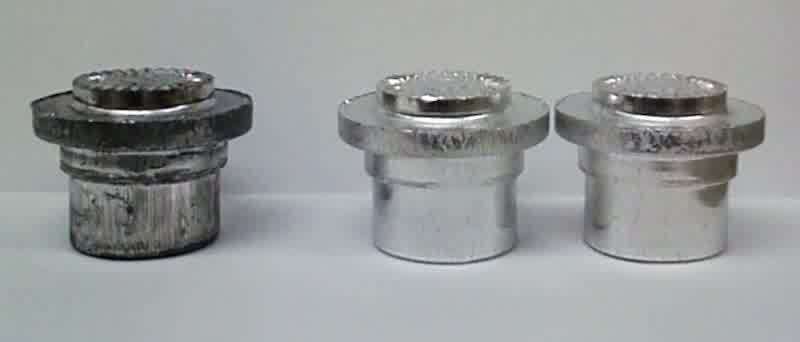 Cleaned aluminum parts.Temperature is another critical variable that directly affects cleaning efficiency and cleaner stability. Govoni says in most cases, they are running at elevated temperatures.”
But higher temperatures are not always better.
“There is a limiting factor in temperature,” he explained. “Sometimes, for example, in a pressure spray wash, if you get the temperature up too high, I’ve actually seen cases where you can oil out some of the components that are giving you the low foam characteristic. So you actually can end up destroying the cleaner if the temperature is much too high.”
Those real-world observations highlight why process chemistry requires more than simply adding heat and increasing concentration. Effective cleaning demands a carefully balanced system designed around the specific application.
Cleaning chemistry must also account for the wide variety of soils encountered in manufacturing environments. Oils, greases, shop dirt, oxides, polishing compounds, and flux residues each require different approaches.
“If we’re trying to do a degreasing application, we have a whole array of different types of surfactants that we would use as components,” Govoni explained. “There are also inorganic chemistry components that we can use to help improve the cleaning application.”
In many cases, cleaner formulations are designed not only to remove contaminants but also to keep those contaminants suspended and prevent redeposition.
“There are components, for example, that can also help keep solids in suspension so they don’t redeposit on the parts,” Govoni said.
That level of formulation detail becomes especially important in high-volume finishing environments where contaminants can quickly build up and compromise downstream quality.
The Importance of Proper Rinsing
Even the best cleaner can create problems if rinsing is not properly managed. Govoni says otherwise, an operation is just going to take contamination down the line.
He pointed to several process strategies that help maintain rinse quality and reduce carryover contamination.
“If you’ve got a multi-tank application, you want to make sure that if you’re using, for example, a tunneling barrel, you give adequate time for drainage of the solution from the parts,” he explained.
“Having an operator who’s paying attention, who sees oils floating on a tank that he normally wouldn’t see, a color change, all of those observations can also help in keeping a cleaner tank operating at its best efficiency.”
Counterflow rinsing can also significantly improve rinse efficiency while reducing water consumption.
“Just like in many plating applications, you can use a counterflow rinse to keep the final rinse that the part sees as clean as possible,” Govoni said.
For certain applications, especially those involving heated drying systems, water quality itself becomes critical.
“Use of deionized water, in some cases, especially when you’re drying parts in a heated dry type application, you may have to go to a deionized water situation,” he said.
Monitoring and Bath Health
One of Govoni’s recurring themes is that process monitoring is essential for maintaining cleaner performance. Too often, manufacturers rely on cleaner additions without fully understanding what is happening inside the bath.
“I’ve always emphasized to a customer that when we talk about doing some type of testing, the testing that we’re doing really is not looking at the entire compound or all of the elements in the product,” Govoni explained. “In the case of the titration, we’re looking at either an acid or an alkaline component, measuring the level of one, and then correlating that to the concentration of the cleaner,” he said.
However, contaminants can distort those measurements.
“That works unless you have something that may artificially increase or decrease those concentrations,” Govoni said. “And now the correlation doesn’t really work. You’ve got to make sure that whatever you’re dragging into the cleaner won’t artificially increase or decrease the solution’s conductivity,” he explained.
Yet despite advances in instrumentation, Govoni still believes operators themselves are one of the most valuable process-monitoring tools.
“Having an operator who’s paying attention, who sees oils floating on a tank that he normally wouldn’t see, a color change, all of those observations can also help in keeping a cleaner tank operating at its best efficiency,” he says.
Extending Bath Life
With increasing pressure to reduce costs and minimize waste generation, manufacturers are constantly looking for ways to extend cleaner bath life.
Govoni advocates a proactive approach that avoids large-scale bath dumps whenever possible. Instead, his advice to customers is to take part of the bath away rather than dump the entire bath at once.”
By removing smaller portions of the bath and replenishing regularly, manufacturers can stabilize contamination levels and reduce strain on waste treatment systems.
“You dump a small portion of it, you replenish it, and you try to keep the concentration of the contaminants that you’re bringing into the bath kind of at a stable place,” Govoni said. “It can also help in the waste treatment end of it, where you’re not getting an entire 500-gallon bath coming down to waste treatment,” he said.
Understanding Surfactants and Emulsifiers
Surfactants and emulsifiers are among the most important ingredients in modern aqueous cleaners, yet many manufacturers do not fully understand how they function. Govoni says the surfactant is a chemical that reduces the surface tension between two liquids, a liquid and a solid, or even a liquid and air.
To illustrate the concept, Govoni uses a simple analogy.
“I use the example of a drop of water on a surface, and then next to that, you put a drop of alcohol,” he said. “The alcohol will actually flatten out almost completely, whereas the water forms a droplet.”
Adding a surfactant changes the behavior of the water.
“If we were to add a small amount of surfactant to that drop of water, it would actually mimic what we see the alcohol doing,” Govoni explained. “They have what we call a hydrophobic, or oil-loving, portion, and a hydrophilic, or water-loving, portion.”
That chemistry enables emulsification, keeping oils suspended in solution rather than redepositing on parts.
“The hydrophobic portion of the surfactant orients itself toward the oil, and the water-loving portion toward the water,” he explained. “Therefore, you can allow oil and water to mix where they normally wouldn’t mix. When you’re making a salad dressing, oil and vinegar don’t mix, but if you add a little mustard, you can actually form an emulsion and keep it pretty stable,” he said.
“As we walked into the room, there were probably 30 vibratory machines running at the same time,” he said. “And the foam on the floor was at least a foot high. We just kind of waded through this fluff. It was kind of like a shaving cream type fluff. I was still very early in my career, I didn’t have a lot of experience putting cleaners together, but that image always stuck with me.”
Corrosion inhibition is another key aspect of cleaning chemistry, particularly for ferrous metals. Very often, the inhibitors used for ferrous parts tend to go on the alkaline side, Govoni says, and they work at the metal surface to minimize oxidation and flash rusting during and after cleaning.
“They can be amine-type inhibitors, nitrite-type inhibitors, and act at the surface to prevent corrosion,” he said. “We also use inhibitors in acid cleaners to minimize the impact on the base metal. As we’re removing oxides and we get to the base metal, we want to minimize how much attack we get on the base metal.”
Common Defects and Troubleshooting
Over the years, Govoni has helped countless manufacturers troubleshoot cleaning-related defects. Many of the most common problems occur in mass finishing operations.
Most of what he has seen relates to the mass finishing area, where shops are running parts and either don’t have the right mix or concentration of cleaner, or aren’t running any cleaner at all. Those process issues can create residues and staining that become apparent after drying.
“They end up with a residue on the part at the end after drying, and they want to know how to solve that,” Govoni says. “If you’re doing a hot air dry, depending upon whether you’re using deionized water, we can get spots on the parts from coming out of the drying end,” he said.
In many cases, manufacturers do not initially realize that the cleaner itself is the root cause.
One of Govoni’s most memorable troubleshooting experiences occurred early in his career while working with Waterbury Buckle Company.
“We were brought into the vibe finishing area, and they literally gave us a pair of boots to put on,” Govoni recalled.
The company operated dozens of vibratory finishing machines using polyester resin media.
“As we walked into the room, there were probably 30 vibratory machines running at the same time,” he said. “And the foam on the floor was at least a foot high. We just kind of waded through this fluff. It was kind of like a shaving cream type fluff. I was still very early in my career, I didn’t have a lot of experience putting cleaners together, but that image always stuck with me.”
Later, while working with another customer using centrifugal disc finishing and polyester resin media, Govoni encountered the same issue.
“When I went back to the lab, I came up with a cleaner — or a compound, if you will — to run in the process that stopped the foam from forming,” he says. “It’s still being used today for that purpose.”
Interestingly, the foam problem was not caused by the cleaner itself.
“The media by itself, if you ran polyester media with just plain water, it would actually form this shaving cream type foam,” Govoni says, adding that the chemistry of the polyester resin created a long-lasting foam matrix that interfered with processing and drying.
“We created a product that prevents that from happening,” he said. “It keeps everything flowing and keeps the parts clean.”
The Lasting Importance of Process Expertise
As manufacturing processes become more sophisticated and quality requirements more demanding, cleaning and mass-finishing chemistry continues to play a critical role in production success.
Govoni’s decades of experience illustrate that effective cleaning is far more than simply removing oil or dirt from a part. It requires understanding metallurgy, chemistry, equipment design, water quality, rinsing dynamics, operator practices, and production goals.
At Hubbard-Hall, that combination of chemistry expertise and real-world troubleshooting continues to help manufacturers fine-tune their operations, solve persistent defects, and improve finishing performance.
For Govoni, the process remains rooted in observation, chemistry, and practical problem-solving.
“To me, one of the most important elements is the operator who’s paying attention,” he said.