

Logistics and operations, data-driven decision making, transformation and modernization, maintenance and readiness, and advanced manufacturing — these are the key themes Army senior leaders are discussing for the future of Army sustainment.
 Courtney Guasti, Noah Lieb, and Kari Thompson.These can also describe the future of the organic industrial base (OIB) and its capability for forward repair. The Army’s OIB is at the forefront of modernization, leveraging advanced manufacturing technologies to enhance sustainment capabilities and reduce the logistical footprint. Among these innovations, cold spray technology is revolutionizing how the Army repairs and maintains critical assets, enabling rapid, cost-effective solutions that improve readiness and reduce the logistical footprint required in multi-domain operations (MDO). Letterkenny Army Depot (LEAD) is exploring the transformative impact of cold-spray technology and its integration into forward-repair operations.
Issues such as corrosion pose significant operational and financial challenges, costing billions of dollars annually in maintenance and affecting equipment readiness throughout the Army. Every day, the wear and tear of Army weapon systems requires a suite of technologies to clean, inspect, repair, and ultimately protect them from myriad environmental conditions. Over a system’s lifecycle, metal substrates corrode due to physical damage or degradation from harsh environmental conditions (such as temperature, humidity, and salinity), leading to cracking, pitting, and reduced structural integrity. Current maintenance practices require surface preparation (such as sanding, grinding, and cleaning) to remove the corrosion down to base metal before repair/rebuild, at best, or, in the worst-case scenario, replacement of the entire component or assembly. The time spent waiting for a replacement part to arrive from the original engineering manufacturer, warehouse, or depot is a liability the Army can no longer afford. Cold spray technology collapses this timeline, enabling skilled artisans to restore critical components in a matter of hours.
To improve Army sustainment and reduce costs, the Army’s Corrosion Control and Prevention Executive (CCPE) office is partnering with LEAD to facilitate a field-capable, deployable cold-spray program for forward-support operations and repair, replacing and building back base metal. LEAD’s cold spray program has proven its value by restoring high-value military components, resulting in significant cost savings, reduced repair times, and a direct increase in materiel readiness.
Cold Spray in a Nutshell
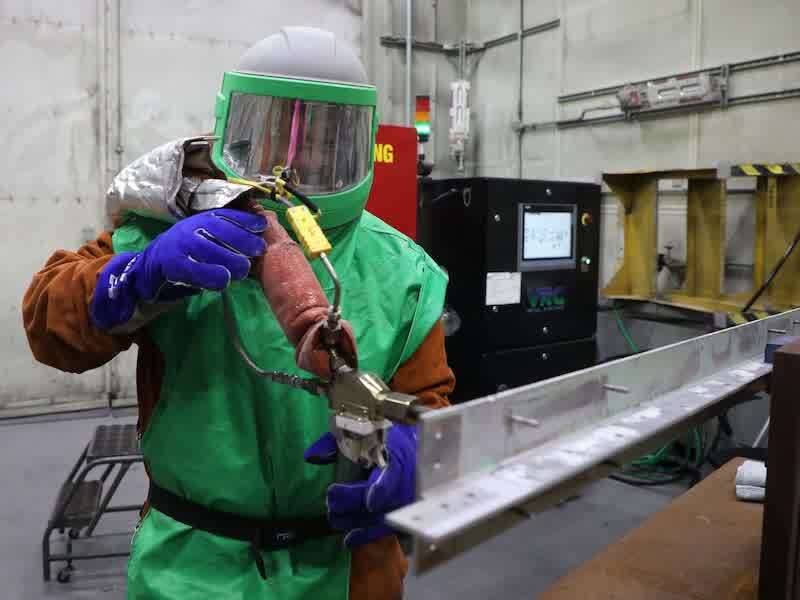
 Cold spray is a material deposition process that uses a carrier gas, such as nitrogen or helium, to propel metal powders at supersonic speeds through a specialized rocket nozzle. When these particles impact a component’s surface, the immense kinetic energy causes them to bond instantly, building up a solid metal layer. Think of cold spray as a high-speed paint sprayer for rebuilding metal surfaces.
What makes this process unique is that it is fundamentally cold. Unlike welding or other thermal spray processes that melt materials, cold spray deposits particles in the solid state. This avoids creating heat-affected zones, which can warp a part or alter its microstructural properties. Because of this, cold spray makes it possible to repair components made from heat-sensitive alloys such as aluminum, magnesium, and titanium, which would be impossible to repair with higher-temperature methods.
This technology provides a rapid and efficient way to build up material, allowing maintainers to quickly repair deficiencies like pitting, dents, or cracks. Similar to repairing potholes in a road by pouring new asphalt into the hole without removing the entire road, cold spray can do the same with metal parts: it fills pits, dents, and cracks with new metal and restores the part so it can be used again. With deposition rates of up to 45 kilograms per hour, the process can restore a part that would otherwise be scrapped, saving significant time and money. This is especially valuable for legacy systems where replacement parts are rare, expensive, or no longer in production.
To ensure consistency and reliability, the U.S. Army Research Laboratory (ARL) has developed military specifications that standardize both the cold spray process and the metal powders used. This has allowed the technology to be successfully demonstrated across numerous depots, shipyards, and maintenance facilities on a wide array of systems, including aircraft, ground vehicles, and ships.
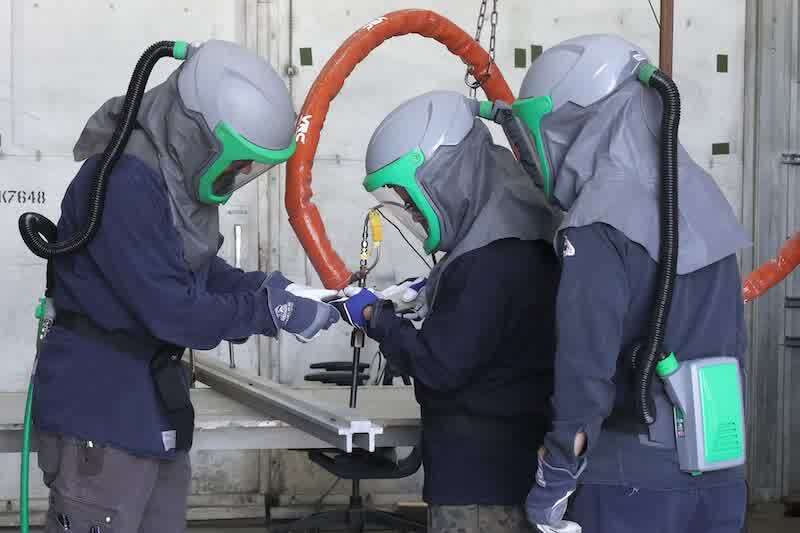
The adaptability of cold spray systems is a key advantage. They can be mounted on large robotic gantries for depot-level work or configured as portable systems with handheld nozzles. This portability enables in-situ repairs, allowing maintainers to fix a component directly on a large aircraft or ship without the costly, time-consuming process of removal.
The Return on Investment
LEAD, located in Chambersburg, Pennsylvania, repairs and modernizes air and missile defense and long-range precision fires systems to enable MDO for U.S. and allied forces. Key weapon systems such as the Phased Array Tracking Radar to Intercept on Target missile system, the High-Mobility Artillery Rocket System (HIMARS), the Terminal High-Altitude Area Defense system, and a wide range of tactical wheeled vehicles and power generation equipment are serviced by LEAD’s engineers, technicians, and artisans.
LEAD began its cold spray program in August 2024 as part of its modernization efforts, through a partnership with ARL, the CCPE office, the Missile Defense Agency, and Pennsylvania State University, to further advance its cold spray capabilities and expand its locations. LEAD uses current commercial-off-the-shelf systems for both in-depot and on-site repair. To overcome logistical challenges and operate in contested environments, the CCPE invested in a nitrogen generator to enable the forward repair team to be self-sufficient and eliminate the need to outsource nitrogen as the carrier gas. The capability to perform repairs via cold spray can reduce system downtime, the labor required to disassemble assets due to the configuration and accessibility of components needing repair, and overall repair time by enabling on-site, in-situ repair.
The cold spray program has already demonstrated a remarkable return, with an initial investment of $82,000 generating direct cost savings of $6 million in repairing 13 parts. These savings stem from avoiding the full replacement cost of complex and expensive military assets and extending the continued operation until a replacement can be acquired. The calculated cost savings are based solely on asset value and do not include transportation and labor costs incurred when assets are shipped back to the depot.
The highest cost savings were in the repair of a HIMARS, where artisans successfully restored the cabin floor. This single repair application avoided a full component replacement, saving $750 thousand and reducing downtime by 18 months. Similarly, the technology is routinely used to refurbish equipment and machinery used at LEAD, targeting equipment longevity and extending the life of repair systems to reduce depot lead times.
Operational Impact
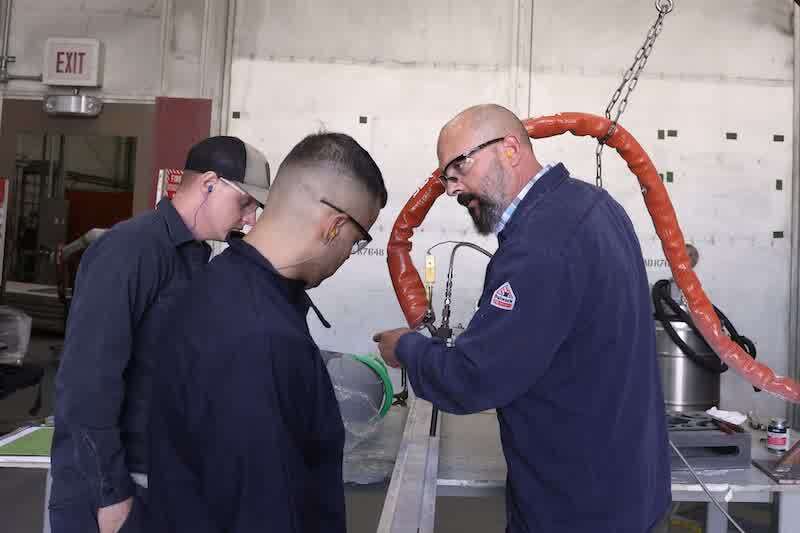 Operationally, the impact is even more significant. This technology reduces the repair turnaround times, with documented time savings ranging from a week to a year and a half for a single major component. By using mobile units to perform on-site repairs, the program minimizes the logistical burden of returning deployed assets to depots. Currently used for non-structural parts, cold spray is being expanded to structural components through enhanced standardization.
Along with the reductions in cost and repair times, perhaps most critically, this technology fundamentally reduces the logistical footprint required to sustain a formation. Every component repaired forward is one less replacement part that must be ordered, packaged, and shipped across vulnerable air, land, and sea routes. In an MDO environment where adversaries actively target supply chains, shrinking this logistical tail is a matter of survival, not just efficiency. Furthermore, cold spray provides a powerful solution to the long-standing problem of parts obsolescence. By restoring legacy components that are no longer in production, the Army can extend the service life of critical weapon systems and reduce its dependence on fragile, often non-existent, supply chains.
LEAD is planning on-site visits for cold-spray repairs to weapon systems within the U.S. Indo-Pacific Command area of responsibility, given the region's highly corrosive environment. The CCPE is actively working to transition this capability from specialized artisans at the depots to forward repair maintenance teams, ensuring its benefits are realized across the entire enterprise.
Conclusion
Looking ahead, cold spray offers leaders unparalleled operational flexibility. The move toward portable, expeditionary systems means this capability can be deployed alongside combat units, providing a degree of self-sufficiency previously unimaginable. Its significant return on investment, in which modest repair expenditures can prevent the multi-million-dollar replacement of an entire system, frees up vital sustainment funds for other operational priorities. As the technology matures, it paves the way for a future of on-demand additive manufacturing on the battlefield.
Ultimately, cold spray is more than just a better repair method; it represents a philosophical shift in Army sustainment. It empowers the Army to move from a replace-and-return model to a repair-and-reinforce mindset. Instead of relying on slow and often costly traditional methods, the Army can now proactively address corrosion and minor damage, extending the service life of critical assets.
Cold spray technology is just one piece of the puzzle in a future maintenance concept. Its continued development will lead the modernization effort, turning science fiction into realized, in-field applications. This is the future of Army sustainment.
Courtney Guasti serves as the deputy Corrosion Control and Prevention Executive in support of the office of the Deputy Assistant Secretary of the Army for Sustainment. He is responsible for managing and overseeing the Army’s corrosion prevention and control (CPC) program. His duties include ensuring CPC is incorporated into Department of the Army policy and guidance across all appropriate functional areas throughout equipment and infrastructure life cycles; executing an effective Army CPC program; advocating for CPC resources; and evaluating program effectiveness. He holds a Master of Science degree in materials engineering from Auburn University.
Noah Lieb is a senior engineer at Jensen Hughes with 21 years of experience specializing in environmental issues related to energetic materials, surface finishing, and firefighting foams. He serves on the advisory board for the Cold Spray Action Team. He provides technical support to multiple Department of War safer-alternative programs, including the U.S. Army Safer Alternatives for Readiness program and the Strategic Environmental Research and Development Program. He is a licensed professional engineer in Maryland and a certified safety professional. He holds a Bachelor of Science degree in chemical engineering from the University of Maryland.
Kari Thompson is a staff engineer at Jensen Hughes with seven years of experience. She currently supports the Army Corrosion Control and Prevention Executive Office with a focus on cold spray and corrosion policy. She is an active member of the Association for Materials Protection and Performance and holds certifications, including Naval Sea Systems Command Basic Paint Inspector, Fundamentals of Protective Coatings (C1), and Planning and Specifying Industrial Coatings Projects (C2). Her technical expertise spans external hull coating restoration, paint inspection, quality assurance, and corrosion prevention systems for submarine fleet support at Newport News Shipbuilding. She holds a Bachelor of Science degree in corrosion engineering from the University of Akron.
This article was published in the winter 2026 issue of Army Sustainment.