

Conversion coatings are applied to aluminum substrates for various aerospace and defense products to provide corrosion protection and improve adhesion for the subsequent primer coating.
 From top left, Gregory Morose, David Dukeman, Mark Kolody, Kent DeFranco, and Michelina Molongoski.Hexavalent chromium is typically incorporated into the conversion coating to enhance corrosion protection properties for the underlying aluminum substrate. However, hexavalent chromium is toxic to humans, with health effects resulting from both acute and chronic exposure. For example, chronic exposure to hexavalent chromium is associated with lung cancer, nasal, and sinus cancers. (IARC 2012)
Various regulatory initiatives on a global basis have increased efforts to replace hexavalent chromium-containing materials because of their toxicity. The Defense Federal Acquisition Regulation Supplement mandated that applicable U.S. Department of Defense contracts do not include specifications that result in a deliverable or required maintenance material containing more than 0.1% hexavalent chromium in any homogeneous material for which acceptable substitutes are available. (Federal Acquisition Regulations System 2016).
The resources required for investigating and evaluating the various hexavalent chromium-free materials can be prohibitive for an individual company to undertake alone. Therefore, the Toxics Use Reduction Institute (TURI) at the University of Massachusetts Lowell reached out to companies in the aerospace and defense industry that were interested in collaborating to address the challenges of evaluating and adopting hexavalent chromium-free alternatives. In 2018, a Hexavalent Chromium Free Conversion Coating Team was established with representatives from TURI, Boeing, Lockheed Martin, RTX-Raytheon, Blue Origin, NASA, and Textron Aviation.
The consortium members developed a test plan to evaluate various alternative conversion coatings without hexavalent chromium. The conversion coating materials listed in Table 1 below were selected for inclusion in the evaluation.
Table 1. Conversion coating materials and corrosion inhibitors.
| Supplier | Product | Corrosion inhibitor |
| Confidential Supplier A | Confidential Product A | Hexavalent chromium (baseline for comparison) |
| Chemeon | eTCP | Trivalent chromium |
| Confidential Supplier B | Confidential Product B | Not hexavalent chromium |
| Confidential Supplier C | Confidential Product C | Not hexavalent chromium |
| Socomore | Socosurf TCS/PACS | Trivalent chromium |
The aluminum alloys used for the test panels were 2024, 6061, 2219, and 7075, and their copper content is shown in Table 2. In general, the higher the copper content, the more challenging it is to meet corrosion requirements.
Table 2. Copper content of aluminum alloys.
| Alloy | Minimum copper concentration (%) | Maximum copper concentration (%) |
| 6061 | 0.15 | 0.4 |
| 7075 | 1.2 | 1.6 |
| 2024 | 3.8 | 4.9 |
| 2219 | 5.8 | 6.8 |
Conversion Coating Application
The Chemeon, Socomore, and hexavalent chromium-based conversion coatings were applied in a production environment at a contracted metal finishing facility. The hexavalent chromium-based conversion coating and the Chemeon eTCP conversion coatings were applied at Poly-Metal Finishing, located in Springfield, Massachusetts. The Socomore conversion coating was applied to test panels at International Hardcoat, located in Detroit, Michigan. The chemical tanks were prepared as recommended by the Technical Data Sheet provided by the conversion coating manufacturer, and the MIL-DTL-5541 standard for chemical conversion coatings on aluminum.
Table 3 provides the processing steps used by Poly-Metal Finishing to apply the Chemeon eTCP conversion coating to the aluminum test panels.
Table 3. Chemeon eTCP processing steps.
| Description | Temperature (F) | Time |
| Aluminum cleaner 164 (6-8 ounces per gallon) | 120-160 | 10-12 minutes |
| Deionized (DI) water rinse | Ambient | 1-2 minutes |
| Acid activated nitric acid (48-52% volume) | Ambient | 60-70 seconds |
| DI water rinse | Ambient | 1-2 minutes |
| Chemeon eTCP RTU (pH 3.6-4) | 68-78 | 5-6 minutes |
| DI water rinse | Ambient | 20-30 seconds |
The Socomore SocoSurf TCS/PACS conversion coating was applied to test panels at International Hardcoat, located in Detroit, Michigan, United States of America, using the processing steps listed in Table 4.
Table 4. SocoSurf TCS/PACS processing steps.
| Description | Temperature (F) | Time |
| Sococlean A3432 (8- 12%) | 95-131 | 20 minutes |
| Reverse osmosis (RO) water rinse | Ambient | 15-30 seconds |
| RO water rinse | Ambient | 15-30 seconds |
| Socosurf A1858 (30-50%); Socosurf A1806 (6-15%) | 104-140 | 10 minutes |
| RO water rinse | Ambient | 15-30 seconds |
| RO water rinse | Ambient | 15-30 seconds |
| Socosurf TCS (31-41%) | 95-113 | 10 minutes |
| RO water rinse | Ambient | 15-30 seconds |
| RO water rinse | Ambient | 15-30 seconds |
| Socosurf PACS (8-12%); 35% hydrogen peroxide (5-7%) | 68-86 | 5 minutes |
| RO water rinse | Ambient | 15-30 seconds |
| RO water rinse | Ambient | 15-30 seconds |
The conversion coatings for Confidential Supplier B and Confidential Supplier C were applied in a laboratory environment. The details of the conversion coating application process are confidential and are not available for publication.
The same non-hexavalent chromium primer and topcoat were applied to all the panels included in the evaluation. The non-hexavalent chromium primer used was PPG 02GN097, which was qualified to MIL-PRF-23377 Type 1 Class N during 2024. The non-hexavalent chromium topcoat used was PPG 03W127BF urethane color 17925 White that meets MIL-PRF-85285 Type 1 Class H. The primer was spray applied per MIL-PRF-23377 Version K 2012 Section 4.4.1, and the topcoat was spray applied per MIL-PRF-23377 Version K 2012 Section 4.4.2 to one side of the panel. The topcoat was applied on the same day as primer application and within 5 hours of the primer application.
Paint adhesion, electrical contact resistance, neutral salt fog corrosion resistance, SO2 salt fog corrosion resistance, and long-term beachfront corrosion testing were included in the evaluation. This article will focus on the results of the long-term beachfront corrosion testing. An article was published in the Journal of Aerospace Technology and Management containing the results for all the other tests included in the evaluation (JATM 2022).
Beachfront Corrosion Testing
The beachfront long-term corrosion testing was conducted at the NASA Beachside Atmospheric Corrosion Test Site, at Kennedy Space Center, in Florida. Visual inspections were conducted by NASA personnel at periodic intervals, and the rate of the maximum creep from the scribe was determined nondestructively as outlined in ASTM D1654 Procedure A. These inspections occurred at the following time durations: 6 months, 9 months, 12 months, 18 months, 24 months, 30 months, 36 months, 42 months, and 60 months.

Figure 1. Test panels at NASA Beachside Atmospheric Corrosion Test Site.
The ratings used for the maximum creep distance from the scribe are based on ASTM D1654 Procedure A and are shown in Table 5.
Table 5. Rating of failure from scribe for Procedure A.
| Millimeters | Rating number |
| Zero | 10 |
| Over 0 to 0.5 | 9 |
| Over 0.5 to 1 | 8 |
| Over 1 to 2 | 7 |
| Over 2 to 3 | 6 |
| Over 3 to 5 | 5 |
| Over 5 to 7 | 4 |
| Over 7 to 10 | 3 |
| Over 10 to 13 | 2 |
| Over 13 to 16 | 1 |
| Over 16 to more | 0 |
The beachfront corrosion testing included 120 panels in total, with six panels for each aluminum alloy and conversion coating combination. All six panels for Product B, Product C, and Socomore TCS/PACS had both primer and topcoat. For the hexavalent chromium-based and Chemeon eTCP coatings, three panels had primer only, and three panels had primer and topcoat. The results presented in this article are focused on just the test panels with both a primer and a topcoat.
A representative photograph of the beachfront corrosion test after 60 months is provided in Figure 2. The photograph is of the eTCP conversion coating with primer and topcoat on 2024 alloy test panel #1, which received a rating of “7”, indicating that corrosion had creeped between 1 to 2 mm from the scribe area.
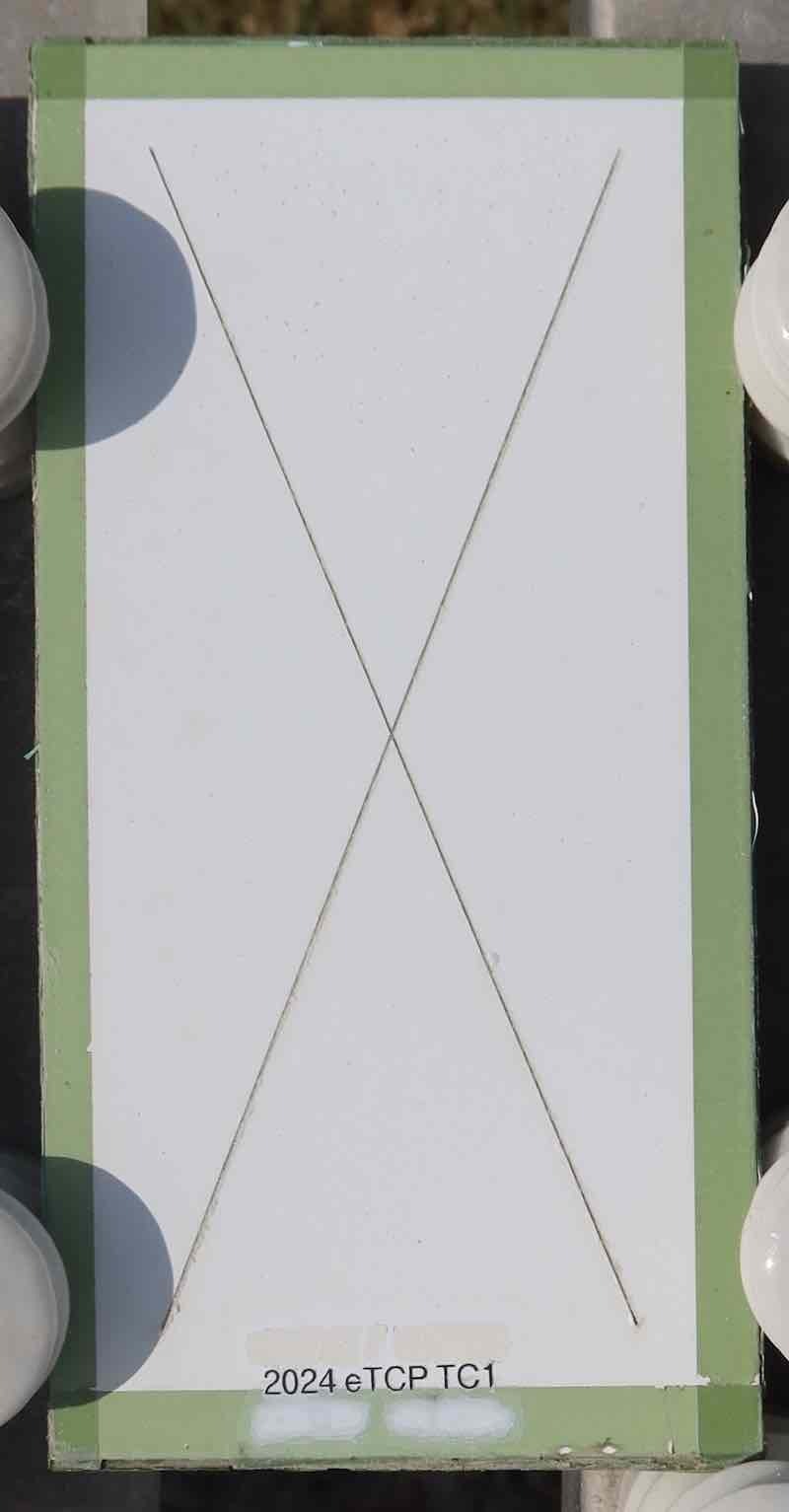
Figure 2. eTCP with topcoat on 2024 alloy test panel #1 after 60 months of beachfront exposure.
Table 6 provides the visual ratings for each of the test panels at the 60-month visual inspection. Yellow shading indicates that some level of corrosion was observed on the test panel, resulting in a rating less than “10”. Green shading indicates that no corrosion was observed to creep from the scribe area, resulting in a rating of “10”.
Table 6. Beachfront visual inspection after 60 months of exposure.
| Conversion coating | 2219 | 2024 | 7075 | 6061 |
| Hex chrome - 1 | 5 | 7 | 6 | 10 |
| Hex chrome - 2 | 0 | 5 | 7 | 10 |
| Hex chrome - 3 | 3 | 7 | 7 | 10 |
| eTCP TC-1 | 4 | 7 | 3 | 9 |
| eTCP TC-2 | 4 | 7 | 5 | 9 |
| eTCP TC-3 | 3 | 7 | 7 | 8 |
| Product C - 1 | 2 | 7 | 8 | 9 |
| Product C - 2 | 3 | 6 | 8 | 7 |
| Product C - 3 | 3 | 7 | 7 | 8 |
| Product C - 4 | 3 | 7 | 7 | 9 |
| Product C - 5 | 2 | 7 | 6 | 8 |
| Product C - 6 | 4 | 7 | 8 | 8 |
| Product B - 1 | 0 | 0 | 0 | 2 |
| Product B - 2 | 0 | 0 | 0 | 0 |
| Product B - 3 | 0 | 0 | 0 | 6 |
| Product B - 4 | 0 | 0 | 0 | 0 |
| Product B - 5 | 0 | 0 | 0 | 0 |
| Product B - 6 | 0 | 0 | 0 | 5 |
| Socosurf TCS/PACS-1 | 4 | 7 | 8 | 6 |
| Socosurf TCS/PACS-2 | 3 | 7 | 6 | 10 |
| Socosurf TCS/PACS-3 | 5 | 1 | 7 | 4 |
| Socosurf TCS/PACS-4 | 0 | 8 | 8 | 3 |
| Socosurf TCS/PACS-5 | 0 | 5 | 7 | 10 |
| Socosurf TCS/PACS-6 | 3 | 3 | 6 | 10 |
Table 7 provides the average rating values for each of the conversion coating products and aluminum alloy combinations. It also provides average rating values for each of the aluminum alloys and each conversion coating product.
Table 7. Average rating values for different conversion coating products and alloy types
| Conversion Coating | 6061 alloy | 7075 alloy | 2024 alloy | 2219 alloy | Average Rating |
| Product A (hexavalent chromium) | 10.0 | 6.7 | 6.3 | 2.7 | 6.4 |
| Product C | 8.5 | 7.3 | 6.8 | 2.8 | 6.4 |
| eTCP | 8.7 | 5.0 | 7.0 | 3.7 | 6.1 |
| TCS PACS | 7.2 | 7.2 | 5.2 | 2.5 | 5.5 |
| Product B | 3.7 | 0 | 0 | 0 | 0.9 |
| Total Average | 7.6 | 5.2 | 5.1 | 2.3 | 4.6 |
Testing Duration Impact
The average rating of the panels decreased as the duration of testing time increased for both the conversion coatings with and without hexavalent chromium. For test panels with both primer and topcoat, the average test panel rating was “8.6” after 6 months, the average test panel rating was “5.5” after 42 months, and the average test panel rating was “4.6” after 60 months.
Conversion Coating Impact
For test panels with both primer and topcoat for all test durations, the hexavalent chromium-based conversion coating, Chemeon eTCP, Product C, and Socomore TCS/PACS conversion coatings all had average ratings between “5.5” and “6.4”. However, the Product B conversion coating had an average rating of “0.9,” which was much lower than the other four conversion coatings.
 Some of the authors inspecting the test panels in 2025 at the NASA Beachside Atmospheric Corrosion Test Sit, at Kennedy Space Center in Florida. David Dukeman (NASA), Mark Kolody (NASA) and Greg Morose (University of Massachusetts Lowell).
Aluminum Alloy Impact
The four aluminum alloys used for this evaluation have varying levels of copper content. In general, the higher the copper content, the more challenging it was anticipated to meet corrosion requirements. The results for this section are based only on the test panels with both primer and topcoat for all test durations. The 6061 panels have the lowest copper concentration, and the lowest level of corrosion was observed for these panels. Consequently, the 6061 panels had the highest average rating of “7.6”. The 2219 panels have the highest copper concentration and had the highest levels of observable corrosion with the lowest average rating of “2.3” as shown in Table 7. These results are consistent with the anticipated greater difficulty of corrosion protection resulting from increasing amounts of copper within the aluminum alloy.
For the 6061 aluminum alloy, the hexavalent chromium conversion coating had the highest rating of “10.0”. For the 2024 and 2219 alloys, the eTCP conversion coating had the highest ratings of “7.0” and “3.7”, respectively. For the 7075 alloy, Product C conversion coating had the highest rating of “7.3”.
Conclusions
The long-term corrosion test results for the conversion coatings without hexavalent chromium were encouraging. Overall, for the test panels with both primer and topcoat, the Socosurf TCS/PACS, Product C, and Chemeon eTCP conversion coatings were the best-performing hexavalent chromium-free conversion coatings across all four types of aluminum alloys, with results comparable to the hexavalent chromium-based conversion coating.
No single study will completely resolve the long-standing issue of replacing hexavalent chromium in conversion coatings with a safer alternative. Given the number of hexavalent chromium-free conversion coatings that provided long-term corrosion testing after 60 months for various aluminum alloys, the results of this evaluation provide significant progress toward achieving the goal of identifying a replacement conversion coating for a traditionally hexavalent chromium conversion coating application on aluminum alloys.
Gregory Morose is with the University of Massachusetts Lowell’s Toxics Use Reduction Institute in Lowell, MA. David Dukeman and Mark Kolody are with the NASA Corrosion Engineering Laboratory at the Kennedy Space Center in Florida. Kent DeFranco is with Lockheed Martin Aeronautics in Fort Worth, Texas. Michelina Molongoski is with RTX - Raytheon in Arlington, Virginia.
Funding: Raytheon provided funding for conversion coatings applied at International Hardcoat. The Toxics Use Reduction Institute provided funding for conversion coatings applied at Poly-Metal Finishing and panel painting at CIL, located in Lawrence, Massachusetts.
Acknowledgments: The authors thank NASA for providing the beachfront testing services, and Textron Aviation and Blue Origin for providing aluminum test panels.
References
- Federal Acquisition Regulations System (2016) Title 48. United States of America: Defense Acquisition Regulations System, Department of Defense. Part 222, p. 159-160.
- International Agency for Research on Cancer (IARC) (2012) Monographs on the evaluation of carcinogenic risks to humans. United States of America: IARC. v. 100C.
- Morose, Gregory, Humphrey, Chandler, DeFranco, Kent (Lockheed Martin), David Pinsky (Raytheon), “Safer Coatings without Hexavalent Chromium for Aerospace and Defense Industry Applications”, Journal of Aerospace Technology and Management (JATM), January, 2022.