

Many companies struggle to find the right balance between reducing costs and growing their business.
 Petruta BlagaIt seems like an impossible equation for some, while for others it is a great challenge. The main purpose of a business is to make a profit, that is, to earn money from the investment and the work done. One way of reducing costs while increasing productivity is to implement improvements based on new ideas. Companies tend to overlook one very important aspect of their daily activities when thinking about cost savings: continuing to use old processes and avoiding exploration and investment in a new, more practical solution. Based on this, we offer a tested and implemented solution to increase profits by reducing the costs of the technological process in the field of electrostatic powder painting, which we employ to give a brief introduction to your work.
1. Introduction
Electrostatic field painting with powder paint is a process technique in which a layer of decorative powder paint is applied to a metallic surface to color it and protect it against external factors. This process takes place in three main stages:
- Chemical pretreatment—removes all unwanted factors and agents, foreign bodies, and solutions from the product's surface, preparing it for painting.
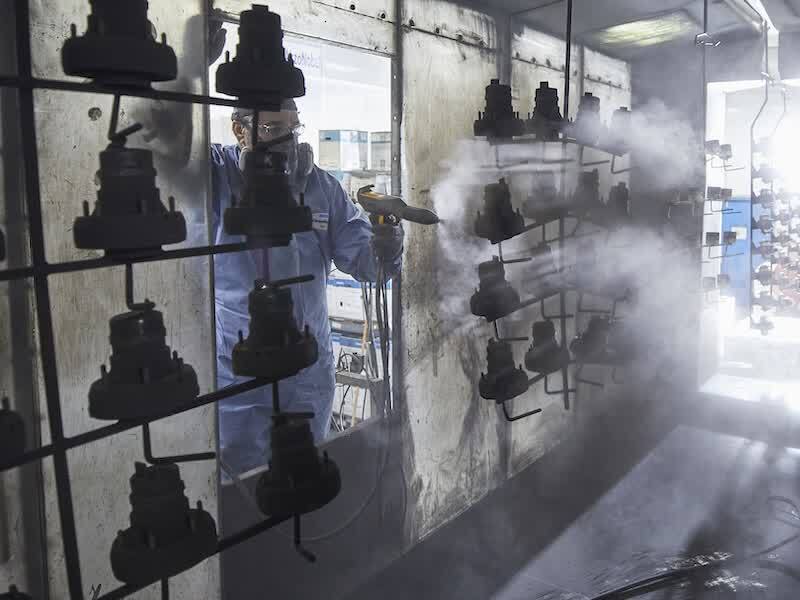
- Painting—the process by which the powder paint is transferred to the product using the electrostatic field created by a special installation.
- Treatment—the process by which the powder paint is polymerized and stabilized on the surface of the product.
For these reasons, electrostatic powder coating is the most advanced surface treatment available, as it offers the following advantages:
- High adherence [1];
- High hiding power [2];
- High abrasion resistance;
- High wear resistance;
- High resistance to corrosive agents;
- Uniform fine coat of paint [3].
The paper presents the third stage of the electrostatic powder coating process—polymerization. The parts are sprayed with powder paint during the painting phase, hung on the conveyor chain, then transported and suspended in the polymerization furnace. The polymerization time and temperature are set based on the powder type, the paint manufacturer's recommended temperature, and the customer’s requirements. We work with the following parameters: temperatures between 160 °C and 200 °C, and working times between 7 and 30 min.
Correct polymerization involves setting appropriate parameters, taking into account the material the product is made of, the thickness of the material walls, its mass and volume, conveyor speed, polymerization oven capacity, powder paint polymerization performance, and storage space for cooling products after they leave the polymerization furnace.
2. Materials and Methods
By using a combined research methodology, we aimed to obtain results that improve decision accuracy and reduce polymerization time, thereby providing a decision-making basis for determining the necessary settings for painting projects following the implementation of polymerization reduction.
We started with thematic qualitative empirical research by observing results from tests measuring temperature at different conveyor speeds and respective polymerization times. Empirical research was followed by applied research aimed at finding a method or tool to reduce production costs.
Reducing production costs is one of the tools by which management can be made more effective [4], and it enables offering lower prices for products or services than the competition.
In this case, the polymerization time for the paint powder is reduced by 2 min compared to the usual process, without affecting product quality. As such, the savings achieved by reducing processing times make it possible to produce a larger quantity of products [5]. Consequently, more orders can be accepted, generating higher profits.
Schematically, the polymerization process in the furnace dedicated to this phase looks as follows (Figure 1).
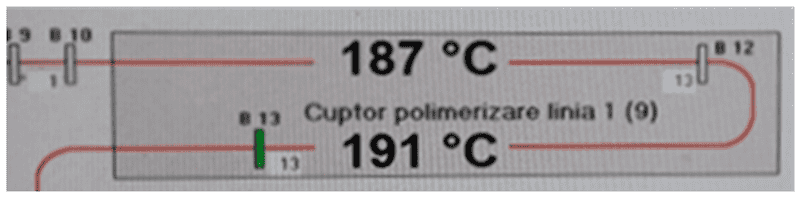
Figure 1. The polymerization process before implementation.
After quality control at the workshop upon receipt of raw products, they are placed on the painting line by hanging them on the conveyor at point A; the hanging systems are specifically prepared for each type. They pass through the pre-treatment tunnel B, where their surface, and then their inside if they have openings or open spaces, undergo a chemical attack by sprayers performed in several steps (Figure 2):
- Coarse washing with water;
- Degreasing using a strongly alkaline solution;
- Rinse with water;
- Rinse with demineralized water;
- Passivation with a nanoceramic multimetal solution;
- Rinse with recirculated demineralized water;
- Rinse with fresh demineralized water.
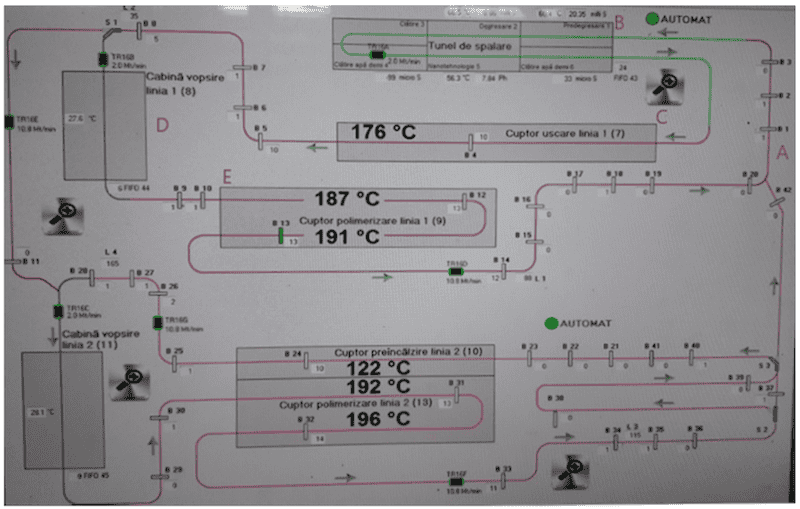
Figure 2. Painting line.
After the chemical pre-treatment [6], the products enter drying oven C to dry and completely remove residual water from the surfaces and interiors of the products.
The painting step is next. This is done in a special booth D, where powder paint is applied to the surfaces of the products using automatic guns and, if necessary, manual guns. Everything is done in the electrostatic field created between the ends of the guns and the paint product body. Through the gun, the powder is deposited onto the product surface and adheres to it thanks to the electronic loading of the paint powder, specific to the product in question.
The next stage is polymerization, during which the paint layer on the product's surface polymerizes. It takes place in the polymerization furnace E under the temperature conditions set according to the working procedures and instructions developed on the basis of the customer’s requirements, the paint manufacturer’s recommendations, and the standards in force.
This stage has been studied to reduce the remaining times of the products in the polymerization furnace, thereby reducing working times and implicitly lowering production costs [7].
After polymerization, the products are cooled, then undergo quality control, and are packaged and delivered to the customer.
The essence of the implementation is to reduce the polymerization time from 27 min to 25 min, which differs from the time recommended by the paint powder manufacturer, without causing issues or compromising the quality of the painted product.
In this case, we refer to the products on the hanging system no 14 (Figure 3). Four to six or eight products can be suspended on this support, depending on their size, with a range of 0.3 to 0.7 m2/piece.
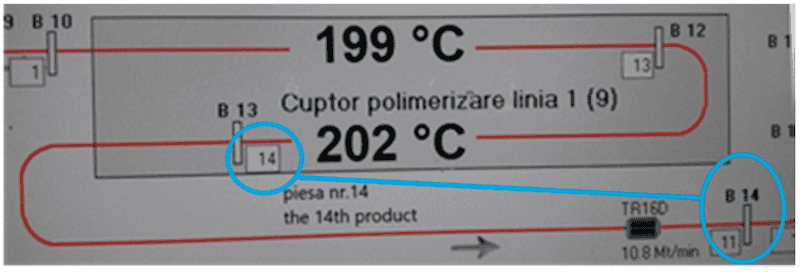
Figure 3. The polymerization process after implementation.
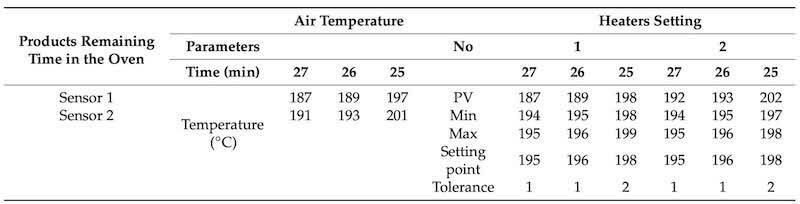
In the initial settings, support no. 14 remains in the oven for 27 min for curing. After implementing the settings, the remaining time decreased to 26 min, ultimately reaching 25 min in the oven (Table 1). Thus, for every 27 min of polymerization, we gain 2 min in the working process. Calculated at the actual working time of 7 h and 30 min (excluding breaks), a set of 18 cycles of 25 min is obtained, compared to the initial set of 16.66 cycles of 27 min. Therefore, the difference of 1.34 cycles × 25 min generates a saving of 33.5 min on an 8-h shift.
Table 1. Polymerization oven parameters.
3. Results
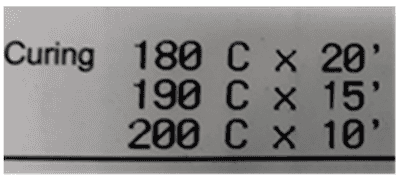 Figure 4. The requirements of the paint manufacturer.As a result of implementing the optimization measures, the polymerization time was reduced from 27 min to 25 min. With this time reduction calculated for a working day with two 8-h shifts, you get twice the time, that is, 67 min, so a time saving of over an hour every 24 h will be achieved. Following an analysis of the 220 effective working days for 1 year, the time saving is 220 × 67 min, which is 14,740 min or 245.66 h of actual work.
Expressed in costs, this looks like: the customer pays EUR 10,176 for one system with four products per 1 h, given that the value of a painted product is EUR 2544. Multiplied by 15 effective working hours per day for 220 days per year, you get 10,176 × 15 effective hours/day × 220 days/year = EUR 33,580.8/year cost reduction or gain for the company.
If the calculation is made for a hanging system with six or eight products instead of four, the gain can be calculated very easily, with the economy achieved per year obviously much higher.
The decision to reduce polymerization time was not taken without a very meticulous study and analysis from all points of view of all the data obtained.
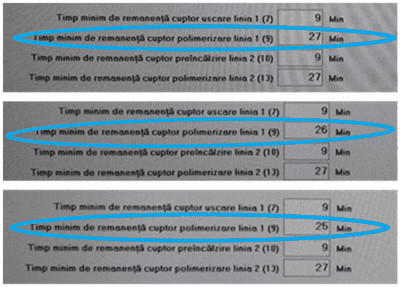 Figure 5. Reduction of polymerization time.The main idea behind the implementation was to reduce procedural time without affecting product quality. The aim was to reduce the polymerization time to a minimum, ensuring polymerization of the required quality under conditions that satisfy the customer’s requirements, while observing the implemented standards and the paint manufacturer's recommendations [8]. The paint manufacturer's requirements are presented in Figure 4.
Based on these criteria, the curing oven parameters must be set to reach the minimum temperature threshold for the paint to polymerize, ensuring maximum adhesion of the paint to the product surface [9].
Starting from the possibility of increasing the polymerization temperature and thus reducing the polymerization time, the remaining time in the staggered polymerization furnace was reduced from 27 min to 26 min and then to 25 min, increasing the polymerization temperature in increments of ±1 min every 2 min (Figure 5).
The result was not considered sufficient to justify a 100% safe decision, as the temperature was monitored step by step for each time reduction step using the temperature measuring device (Datapack from TQC) directly on the product surface (Figure 6).
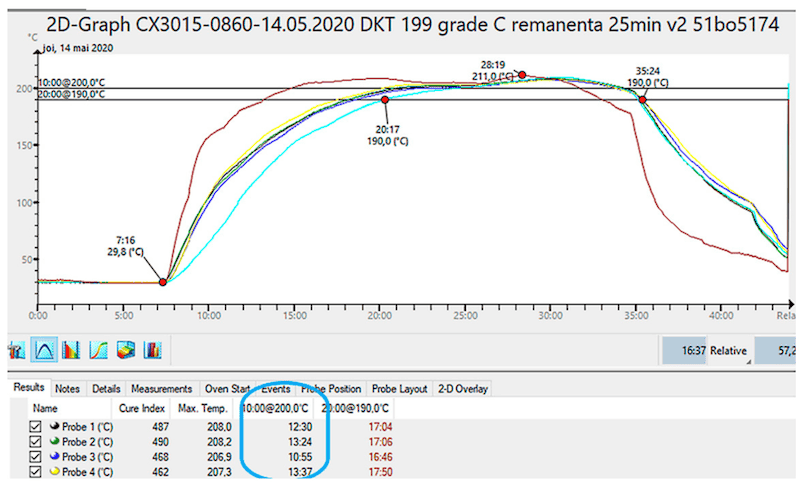
Figure 6. Temperature monitoring.
4. Discussion
By using a combined research methodology, it was intended to obtain results that would strengthen the fairness of the decision to reduce the polymerization time, thereby providing a basis for establishing a table of necessary settings for painting projects after the implementation of polymerization reduction.
We started with a thematic qualitative empirical study, observing results from temperature measurements at different conveyor speeds and polymerization times. The empirical research was followed by applied research aimed at finding a method or tool to reduce the production costs [10].
After data collection and information processing, the conclusion was that a 2 °C decrease in polymerization time does not result in quality and performance non-conformities in the painted product.
The polymerization time reduction tests have gone from qualitative to exploratory research to experimental research, which is still one of the research methods used.
Following the use of these tools, it was possible to implement a new polymerization time setting grid, reducing the temperature from 27 °C to 25 °C, which, in the long run, leads to a EUR 33,580.8/year reduction in production costs [11,12], a real gain for the company.
5. Conclusions
The monitoring reported in the paper is carried out throughout the entire painting process, from hanging the products on the pre-treatment line to packing and final control after painting and polymerization of the powder paint on the products' surfaces.
Every step was monitored individually; these are parts of the whole painting process, so the values obtained after 3 months of monitoring are more significant for reducing costs over the entire process.
Even if using a developed and technologically advanced system of painting in an electrostatic field is not sufficient for purchase and for connecting the performant devices to the painting and pre-treatment system, the surveillance and monitoring must be carried out, namely to achieve continuous implementations to reduce the costs of production and to cope with the increasing competition in the market in the field, without forgetting the other important elements that make up the final price of the transaction cost of painting in an electrostatic field.
Jozsef Boer is with SC Allcolors Serv SRL, Parcul Industrial Târgu-Mureş, Platforma Industrială Nr. 1/G/5, 547612 Vidrasău, România. Petruta Blaga is with the Department of Management, “George Emil Palade” University of Medicine, Pharmacy, Science and Technology of Târgu Mureș, 540139 Târgu Mureș, Romania. Presented at the 14th International Conference on Interdisciplinarity in Engineering—INTER-ENG 2020, Târgu Mureș, Romania, 8–9 October 2020.
Funding: This research received no external funding.
References
- Banerjee, S.; Mazumder, M.K. Surface microstructure of powder layers influenced by the forces of deposition and adhesion in electrostatic coating process. IEEE Trans. Ind. Appl. 2000, 36, 46–52.
- Barmuta, P.; Cywinski, K. Electroseparation and efficiency of deposition during electrostatic powder coating. J. Electrostat. 2001, 51, 239–244.
- Cazaux, J. Critical thicknesses of electrostatic powder coatings from inside. J. Electrostat. 2007, 65, 764–774.
- Boer, J.; Blaga, P. Production cost optimization in industrial wastewater treatment. Proc. Econ. Financ. 2014, 15, 1463–1469.
- Pop, L.D.; Nagy, E. Measuring System Optimization to Increase Productivity. Procedia Eng. 2017, 181, 1036–1042.
- Boer, J.; Blaga, P. The influence of the specific indicators of the chemical treatment on the production costs of painting in the electrostatic field. Proc. Econ. Financ. 2015, 32, 514–519.
- Boer, J.; Blaga, P. Reducing production costs by monitoring the roughness of raw product surfaces. Procedia Manuf. 2018, 22, 202–208.
- Pop, L.D. Study on Creating a Simplified Model of Quality Management System in an SME from the Central Region of Romania. Procedia Technol. 2016, 22, 1084–1091.
- Glick, N.; Shareef, I. Optimization of electrostatic powder coat cure oven process: A capstone senior design research project. Procedia Manuf. 2019, 34, 1018–1029.
- Gabor, M.R.; Cîmpian, L.; Oltean, F.D. Comparative Study concerning the Impact of IT&C Indicators on Performances of Organizations in the Industry. Procedia Manuf. 2019, 32, 627–633.
- Boer, J.; Blaga, P. Optimizing production costs by redesigning the treatment process of the industrial wastewater. Procedia Technol. 2016, 22, 419–424.
- Boer, J.; Blaga, P. Optimizing Production Costs with the Correct Setting of the Paint Thickness Parameters. Procedia Eng. 2017, 181, 1021–1027.
© 2021 by the authors. Licensee MDPI, Basel, Switzerland. This article is an open-access article distributed under the terms and conditions of the Creative Commons Attribution (CC BY) license.