



Paint and coating costs continue to climb while manufacturers face increasing pressure to improve quality, reduce waste, and boost throughput.
As a result, some finishing operations are using electrostatic spray technology as a practical way to improve productivity without sacrificing finish quality. Although the technology has existed for decades, today's equipment combines higher transfer efficiency, improved ergonomics, smart diagnostics, and process controls that make it more attractive than ever.
Wendy Hartley, Global Product Manager for the Industrial Division at Graco, says the biggest advantage begins with where the coating ends up.
“Electrostatics are very important to customers because they allow them to put more paint onto the part and increase the amount of transfer efficiency that they get,” she says. “Not only do they save material by putting more paint on the part, but they're also saving money by not having so much waste through filters or VOCs out of the stack.”
Improving Transfer Efficiency
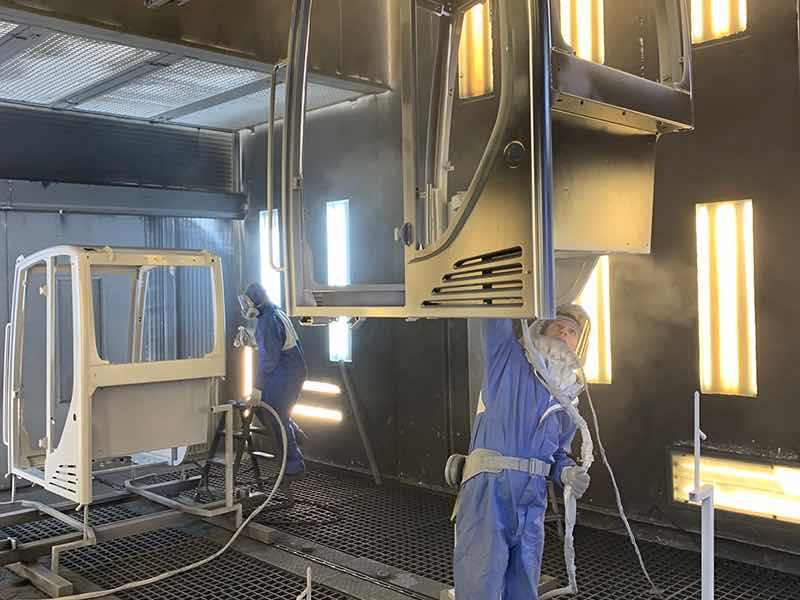 Transfer efficiency has become one of the industry's most important performance metrics. Every gallon of coating that misses the target becomes wasted material, additional filter loading, disposal costs, and unnecessary emissions. Electrostatic spraying addresses all of these issues simultaneously.
Hartley explains the science in simple terms.
“We're adding a charge to the paint so it's attracted to the part being sprayed,” she says. “If you think about it like a magnet, the paint is being attracted to the part.”
That attraction creates the wraparound effect that allows coating to reach the sides and back of components far more effectively than conventional spraying.
The wraparound effect is especially valuable when coating complex fabricated parts, welded assemblies, agricultural equipment, aerospace components, and fabricated metal products where difficult geometries often require multiple spray passes.
Beyond material savings, electrostatics improve film-build consistency. Painters only have to cover a part once because they get enough mil thickness on their part instead of having to go over it two or three times. Reducing passes not only saves labor but improves consistency from the first component to the hundredth.
Reduce Rework and Improve First-Pass Yield
For industries with tight specifications, that consistency can reduce rework and improve first-pass yield. Uniform coating thickness contributes to corrosion protection, appearance, and long-term performance.
Operator fatigue has also become an important design consideration. Hartley says that manufacturers have worked to make electrostatic guns smaller and more comfortable because operators often compare them to familiar HVLP guns. She added that Graco engineers designed a 40 kV model that is nearly the same size as a conventional spray gun, significantly reducing muscle strain.
Smart technology now provides real-time feedback. Hartley said the Pro Xp Smart gun warns operators when they are spraying too close to the part, helping maintain optimum transfer efficiency. Adjustable kV settings also allow painters to reduce electrostatic attraction temporarily when coating inside corners rather than turning the system completely off.
“A lot of times operators will turn off the electrostatics,” Hartley says. “That's a disadvantage because they may forget to turn it back on.”
The adjustable settings maintain many of the efficiency benefits while improving coverage in difficult areas.
Maintenance departments also benefit from built-in diagnostics. Hartley noted that technicians can quickly identify operating issues before they become production problems, reducing downtime and simplifying troubleshooting.
Easier to Install Than You Think
One misconception is that electrostatic equipment is difficult to install. Hartley disagrees. She said facilities primarily need proper grounding and the appropriate air hose, making conversion relatively straightforward for many finishing operations.
Durability remains another strength.
“The gun itself is very durable. The components are very durable. It's built to last a long time,” Hartley says, recalling seeing painters routinely handling the equipment roughly without affecting performance.
Hartley sees electrification becoming another major trend. Electric pumps reduce dependence on compressed air while providing greater process stability and improved control. Manufacturers looking to reduce energy consumption are increasingly evaluating electric pumping technologies alongside electrostatic application systems.
As Much as 60% Material Reduction
Facilities considering electrostatic spraying should evaluate their coating materials, production volumes, part geometry, and quality requirements before selecting equipment. Matching the correct applicator to the application remains critical for maximizing return on investment.
For many finishers, Hartley says the business case is compelling. Material savings, reduced VOC emissions, improved productivity, better finish consistency, lower operator fatigue, and fewer maintenance issues can together provide a rapid payback. Hartley noted that some operations can reduce coating consumption by up to 60%, depending on the starting process.
As manufacturers continue pursuing lean manufacturing and sustainability initiatives, she says electrostatic spray technology is positioned to play an increasingly important role.
Visit www.graco.com.