

The area of Long Beach, California, has long been a hub for aerospace activity.
 Jim MeyerBut tucked within this historic aviation corridor is a highly specialized finishing and repair operation that plays a quiet yet critical role in keeping aircraft in operation.
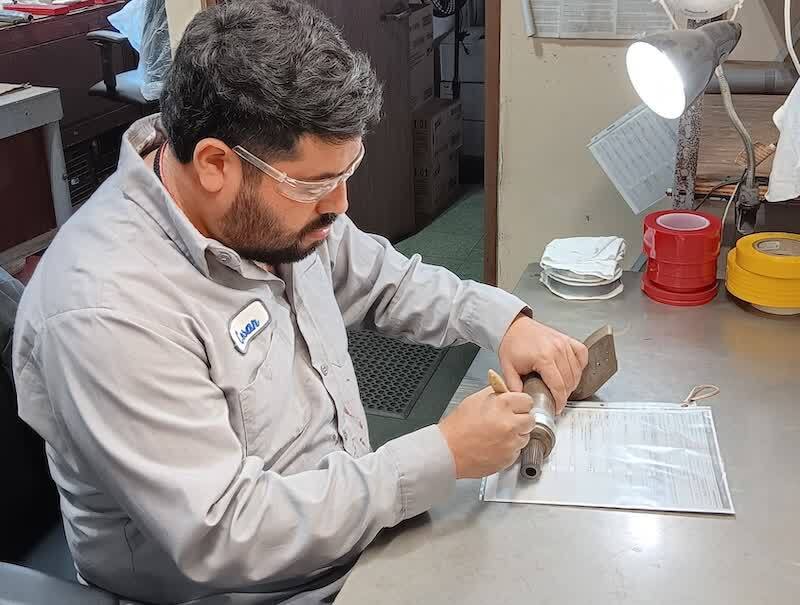
Aviation Repair Solutions (ARS), led by President Jim Meyer, is not your typical metal finishing shop. Instead, it is a focused Maintenance, Repair, and Overhaul (MRO) facility that blends hard chrome plating, precision grinding, and non-destructive testing (NDT) into a seamless, FAA-certified repair process for high-value aircraft components.
A Specialized Niche in Aircraft Repair
Meyer says ARS is dedicated to only aircraft parts. Unlike many job shops that serve a broad range of industries, ARS operates exclusively in aerospace.
“Just like the name of the company, Aviation Repair Solutions, our focus is 100% on aircraft parts,” Meyer said. “We do hard chrome plating, grinding, and non-destructive testing as part of a complete repair process.”
That process typically involves stripping or grinding off worn coatings, inspecting the part using various NDT methods, applying new chrome plating, and then finishing grinding the component back to original equipment manufacturer (OEM) specifications. The ability to control this entire process under one roof is what sets ARS apart from many competitors.
“The manuals define the string of processes needed to repair a part, and we try to do all of that in-house,” Meyer said. “That allows us to control turn times, which are critical to our customers.”
“There aren’t a lot of operations like us,” Meyer noted. “There are a few around the country—in Alabama, Phoenix, and Oklahoma—but it’s a pretty specialty field. You really have to know what you’re doing in each of these areas.”
Serving Airlines, Repair Stations, and OEMs
 Aviation Repair Solutions offers hard chrome plating, precision grinding, and non-destructive testing.ARS serves three primary customer categories: commercial airlines, independent component repair stations, and original equipment manufacturers (OEMs).
Major airlines such as American Airlines and Lufthansa rely on ARS to support their hydraulic and Pneumatic component backshops. A larger portion of ARS’s work, however, comes from third-party component repair facilities that service airlines across the U.S. and worldwide. In fact, over 30% of ARS’s work is international. Additionally, major OEMs send parts to ARS for warranty support and ongoing maintenance of their aircraft systems.
The company supports a wide range of aircraft platforms, from large commercial jets like the Boeing and Airbus families to turboprops such as the ATR 42/72 and Bombardier Q400, as well as components of certain helicopters used by oil service and firefighting operators.
In aviation, downtime is costly. With aircraft valued at upwards of $150 million, every day on the ground represents a significant financial loss. That’s why ARS’s in-house capabilities are so valuable.
“We uniquely can do aluminum and titanium. We have a proprietary process to plate chrome directly onto titanium, which is a real differentiator for us.”
“The manuals define the string of processes needed to repair a part, and we try to do all of that in-house,” Meyer said. “That allows us to control turn times, which are critical to our customers.”
Typical turnaround times range from 15 working days to 6 weeks, depending on the complexity of the repair, masking requirements, baking cycles, and additional finishing steps, such as cadmium plating, which is often performed by partner metal finishers.
To further reduce aircraft downtime, airlines and repair facilities maintain “rotable pools”—ready-to-install components that can immediately replace removed parts while the originals are refurbished.
 Airplane parts ready to be repaired and finished at Aviation Repair Solutions.
Proprietary Capabilities in Chrome Plating
 One of ARS’s standout technical strengths is its ability to plate chrome on challenging aerospace metals.
“We do all aerospace metals, including stainless steels,” Meyer explained. “But we uniquely can do aluminum and titanium. We have a proprietary process to plate chrome directly onto titanium, which is a real differentiator for us.”
This capability is particularly important because many flight-critical components—such as actuators, landing gear parts, and thrust reverser assemblies—require durable, high-performance chrome finishes that meet stringent aerospace standards.
Much of ARS’s work stems from scheduled maintenance intervals. Aircraft components are periodically removed, disassembled, inspected, and parts are sent out for repair if wear or damage is detected.
However, unplanned maintenance—such as leaks or unexpected failures—also drives business. In those cases, parts are removed immediately and routed through the repair chain, often landing at ARS for final restoration.
A 20-Year Journey Rooted in Aerospace
 “Our people take pride in knowing their work directly contributes to the safety of the flying public,” Meyer says.Meyer acquired Aviation Repair Solutions in 2006, though the facility had long been U.S. Chrome’s western, aviation-focused operation. His background in aerospace, particularly his two-decade career at McDonnell Douglas and Boeing, positioned him well to lead the company.
Originally trained as an accountant, Meyer worked throughout McDonnell Douglas/Boeing in industrial engineering, manufacturing, purchasing, finance, and product support, giving him a deep understanding of aircraft manufacturing processes and cost structures. He remembers being intrigued by the high value of actuation components used to build the MD-80 and DC/KC-10 aircraft when he was in purchasing, and now he repairs them.
“I knew nothing about plating when I bought the company,” he says. “But I had a great team who knew that side of the business. My role has been managing the processes, the people, and making sure the work keeps coming in the door.” Now, after 20 years, he thinks he knows a few things about plating and a lot more about people.
“If California eliminates hexavalent chrome with no viable replacement, customers will simply have to go to other states—or even Mexico—to get this work done. That’s bad for California, bad for jobs, and potentially bad for the supply chain.”
Today, ARS employs 18 skilled workers, many of whom have been with the company for years. Several have previously worked at McDonnell Douglas, Continental Airlines, Crane, Garrett, Allied Signal, and Moog, among others.
Demand for ARS’s services is currently strong, fueled by a combination of industry factors.
As the COVID-19 pandemic ended, many airlines deferred maintenance, creating a backlog of repairs. At the same time, production slowdowns at Boeing and engine issues affecting some Airbus aircraft have kept older planes flying longer than expected.
“That’s good for our business,” Meyer says. “Older aircraft need more repairs, and that’s where we come in.”
The Regulatory Challenge: CARB and Hexavalent Chrome
 Despite strong business conditions, ARS faces an uncertain future due to regulatory pressure from the California Air Resources Board (CARB).
A few years ago, CARB moved to standardize air quality regulations across the state, effectively extending the strict South Coast Air Quality Management District’s Rule 1469 statewide. In doing so, CARB increased source testing requirements by 250%—a costly burden for chrome platers.
More controversially, CARB mandated a transition from hexavalent chrome to trivalent chrome plating, with a full phaseout of hexavalent chrome by 2039.
For Meyer and many in the aerospace finishing industry, this is deeply problematic.
“Hexavalent chrome plating is the FAA-approved, OEM-specified method for repairing these aircraft parts,” he said. “Trivalent chrome cannot build up material to the same thickness, which means it can’t properly repair worn or damaged surfaces.” It isn’t thick enough to fill the damage and be machined.
Because aircraft are designed around existing materials and processes and remain in service for 20–30 years, Meyer argues that even if a suitable alternative were to emerge today, a rapid phaseout would be unrealistic.
“If California eliminates hexavalent chrome with no viable replacement, customers will simply have to go to other states—or even Mexico—to get this work done,” he said. “That’s bad for California, bad for jobs, and potentially bad for the supply chain. It’s not just us; there are scores of talented aerospace companies in Southern California.”
“These are flight-critical components—landing gear, flight controls, thrust reversers. Our people take pride in knowing their work directly contributes to the safety of the flying public.”
Meyer remains hopeful that other states will take a more science-based approach rather than simply following California’s lead. After all, California firms already in compliance with South Coast AQMD Rule 1469 have shown they are among the cleanest chrome-plating firms in the world. Meyer states, “Science tells us that it makes sense to use environmentally compliant firms to perform work that is necessary to support modern societies and shifting that work to less stringent regulatory regimes is irresponsible”.
Adapting to Change
 Jim Meyer and Scott Kline, ARS's operations manager who has worked in the facility for 47 years.Over the past two decades, ARS has evolved along with the industry. The company added in-house NDT capabilities, significantly improving efficiency and turnaround times. It has also shifted its focus as aircraft fleets have changed.
When Meyer first took over, American Airlines’ MD-80 fleet was a major source of work. As those planes were retired, ARS transitioned to supporting newer aircraft, including the Airbus family and Boeing 737, 777, and 787 Dreamliners.
“We’ve kept moving with the aviation industry,” Meyer says. “Same core business, but newer parts and newer platforms.”
One of Meyer’s biggest concerns is workforce sustainability amid regulatory uncertainty. While many of his current employees are nearing retirement, he wants to offer younger workers entering the trade meaningful careers.
“Our long-term employees have been able to buy homes, put kids through college, and live good middle-class lives here in Southern California,” he says. “That’s something I want to be able to continue offering.”
Despite the challenges, he believes the work itself is deeply rewarding.
“These are flight-critical components—landing gear, flight controls, thrust reversers,” Meyer says. “Our people take pride in knowing their work directly contributes to the safety of the flying public. I am honored to be able to provide a stable and long-term work environment for this group of precision craftsmen.”
Looking Ahead in Turbulent Times
 For now, Aviation Repair Solutions remains busy, capable, and essential to the aviation ecosystem. While political and regulatory headwinds loom, Meyer and his team continue to deliver the high-quality finishing and repair work that airlines and OEMs depend on.
As the industry navigates technological, economic, and environmental shifts, one thing is clear: specialized shops like ARS will remain a vital link in the aerospace supply chain—for as long as they are allowed to operate.
Visit https://aviation-repair.com.