


For decades, the finishing industry has sought something many believed would be nearly impossible to achieve: a practical, cost-effective replacement for hard chromium plating that meets the performance requirements of demanding industrial applications.
The challenge has never been simply creating a coating that works in a laboratory. The real test has been developing a technology that can survive in the field, scale to production-sized tanks, satisfy environmental requirements, and make economic sense for shops and their customers.
One company that believes it may have solved that puzzle is Maxterial, a Michigan-based technology company focused on advanced coatings and chemical technologies. Co-Founded in 2015 by Mehdi Kargar, the company has spent more than a decade developing MaxShield, a nickel-based alloy coating designed to provide wear and corrosion protection while eliminating the use of hexavalent chromium.
Today, Maxterial's technology is attracting attention from commercial customers around the world, as well as from the U.S. Department of Defense, which recently selected MaxShield for evaluation through the Environmental Security Technology Certification Program (ESTCP), an initiative aimed at validating environmentally sustainable technologies for military applications. The program is evaluating MaxShield as a potential next-generation alternative to hard chrome coatings in defense-related applications.
A Different Kind of Coatings Company
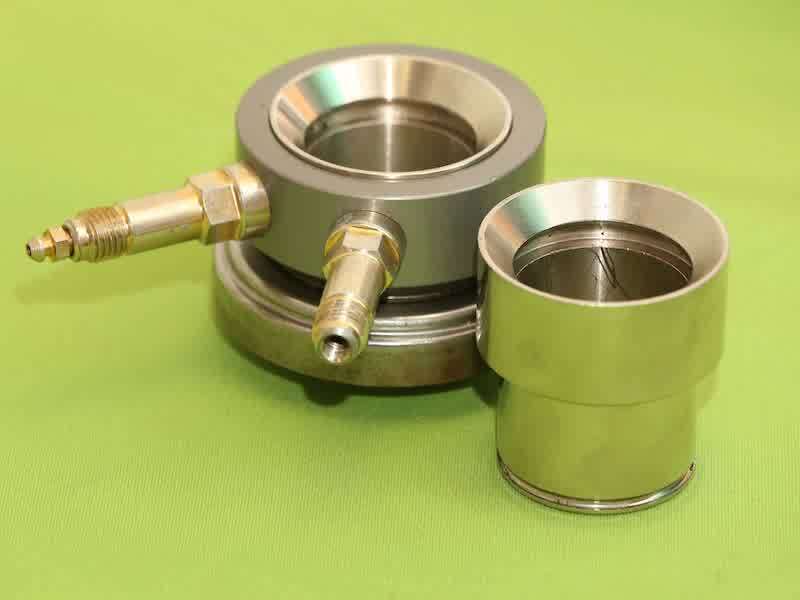 Kargar describes Maxterial as more than a traditional coatings company.
“Maxterial is basically a chemical coating and also a data technology company,” he says. “Since 2015, we have been focused on replacing hard chromium and, overall, on wear and corrosion in industrial parts.”
The company's path, however, was not originally aimed at chromium replacement. The technology traces its roots back to research conducted by Maxterial’s co-founders while they were at Virginia Tech, where work on specialized electroplated copper surfaces led to the publication of a scientific paper. That paper eventually attracted the attention of investors affiliated with Breakout Labs, a fund backed by entrepreneur and investor Peter Thiel.
“After publishing the paper, we received interest from one of the early-stage funds backed by the Peter Thiel Foundation,” Kargar explains. “That ultimately led to the founding of the company and the journey we're on today.”
What began as research into specialized surface technologies eventually evolved into something entirely different.
“We found that the market was moving toward replacing chrome in high-wear and high-corrosion environments,” he says. “The company went through multiple pivots before we found the right product and the right market.”
Eleven Years of Development
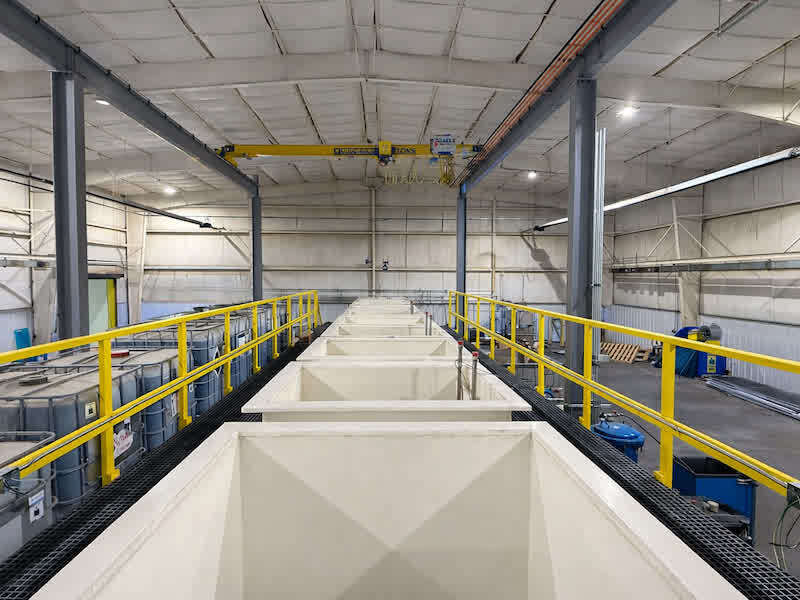 A large finishing line in the Maxterial research facility.While many startups focus on rapid commercialization, Kargar says MaxShield required a far longer development cycle than most technologies.
“Starting in 2015, we developed the prototype of our alloy coating in late 2018,” he says. “Then we spent five to six years making it work in real-world environments. It's not enough for a coating to work in a laboratory. It has to work in the field, meet cost targets, provide the right appearance, meet thickness requirements, and deliver consistent performance.”
The company adopted what Kargar calls a methodical scaling approach.
“We went from a small beaker to a 12-gallon tank, then a 60-gallon tank, then a test in a 3,000-gallon tank,” he says. “Every stage had to prove itself before moving to the next one.” We are now building our in-house 600-gallon tank for further development, trial support, and early production
According to Kargar, developing a replacement for hard chrome involves balancing several competing factors simultaneously.
“Performance matters. Cost matters. Environmental factors matter,” he says. “You don't want to replace chrome with something that becomes another source of trouble five years later.”
That balancing act has been one of the primary reasons hard chrome replacement efforts throughout the industry have struggled.
“Many people have tried to replace hard chrome, but the criteria are extremely difficult,” Kargar says. “Performance, capital costs, ESG considerations, process compatibility, adoption hurdles, everything has to come together.”
Why Hard Chrome Replacement Matters
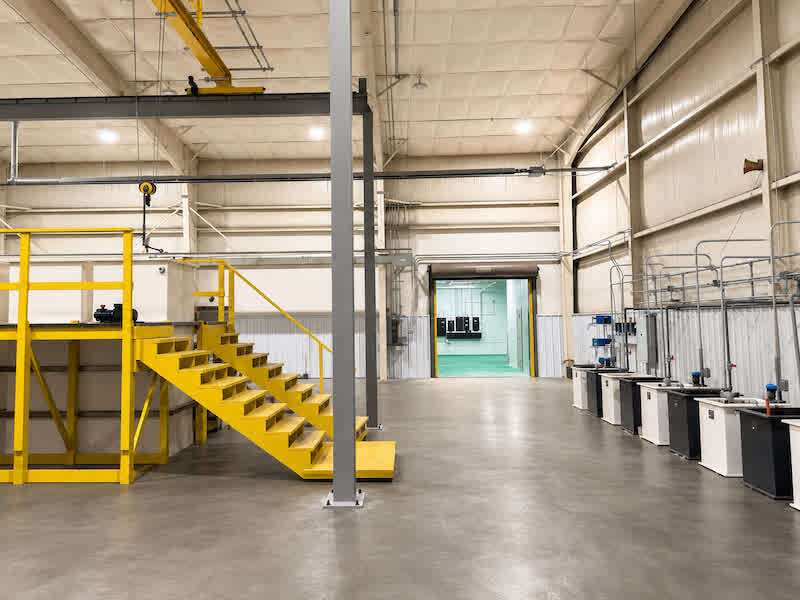 The large and smaller lines at the Michigan facility.The timing of MaxShield's development comes as regulatory scrutiny surrounding hexavalent chromium continues to increase globally.
According to recent announcements associated with the Department of Defense evaluation program, hard chrome remains widely used on hydraulic rods, cylinders, and other highly stressed industrial components. However, growing concerns surrounding worker safety, compliance costs, emissions controls, waste handling, and long-term liability are creating pressure for alternatives. Regulatory developments under OSHA, EPA TSCA, and European REACH programs are driving many manufacturers to evaluate new options.
MaxShield was developed specifically with those realities in mind.
According to Maxterial, the coating eliminates hexavalent chromium and other hazardous substances while maintaining compatibility with industrial plating processes. The company reports that both internal and third-party testing have demonstrated strong performance in wear resistance, corrosion resistance, adhesion, and durability metrics.
 Hydraulic Maxterial Sample.
Military Interest Accelerates Validation
Perhaps the most significant development for Maxterial in recent years has been its growing relationship with the U.S. military.
Kargar first began pursuing Department of Defense opportunities through industry events and government technology programs.
“I attended Army trade shows and presented the technology through programs such as ESTCP,” he says. “The Army already had an internal mandate focused on reducing reliance on chromium-containing processes, so there was natural interest.”
The company's current efforts with the Army center primarily on ground vehicle applications.
“When you talk about aerospace systems, there are many additional qualification requirements,” Kargar explains. “Ground vehicles allow a faster pathway for demonstrating the technology.”
The Army's ongoing work includes testing and evaluation designed to support development of future military specifications.
“What is currently funded is testing and evaluation,” Kargar says. “The goal is to help create a MIL-SPEC and demonstrate adoption pathways eventually.”
According to Maxterial's public announcement, the ESTCP program's selection of MaxShield signals growing interest in alternatives capable of supporting demanding hydraulic applications that are traditionally dominated by hard chrome coatings.
Moving Beyond the Laboratory
One challenge facing any new coating technology is proving that it can survive outside controlled testing environments.
Kargar says MaxShield has already passed that hurdle.
“The hydraulic parts for this product have been in multiple factories around the world for one-and-a-half years already,” he says. “We're very confident in the field performance.”
The company has also conducted testing in severe industrial environments.
“We've worked on applications such as steel production work rolls,” Kargar says. “In some cases where chrome lasts four to six hours, we have seen early performance lasting roughly twice as long.”
Rather than focusing first on large OEM approvals, Maxterial has concentrated on maintenance markets and repair operations.
“We start with maintenance shops and field applications,” Kargar explains. “That allows you to demonstrate performance and generate data more quickly than pursuing large OEM programs right away.”
He believes that strategy helps accelerate adoption.
“If the Department of Defense develops a specification, many other specifications are expected to follow naturally,” he says. “We believe that can significantly shorten the pathway for broader acceptance.”
Building a Commercial Network
While defense applications have attracted attention, commercial adoption remains a major focus.
Maxterial currently operates its own facility in Brown City, Michigan, where customers can evaluate coated parts and conduct testing.
The company currently serves customers across several regions.
“I believe we already have more than 10 collaborations with customers from around the world,” he says. “We have customer interest from Italy, Australia, Canada, and the United States that have reached out, and some have begun trials.”
“Don't test forever,” Kargar says. “Build something that works in the field, prove it, and move forward.”
Maxterial's long-term business model focuses primarily on supplying chemistry and licensing the process rather than becoming a large-scale coating applicator.
“We intend to be a chemical supplier and licensing company,” Kargar explains. “However, we can also provide coating capacity during the transition period while customers are establishing their own lines.”
For larger applications, Maxterial has demonstrated a willingness to work directly at customer facilities.
“For certain specialty applications and very large parts, we go directly to the customer's site,” he says. “We bring the chemistry and support the trial directly at their facility.”
Lessons for the Industry
For Kargar, the Maxterial story extends beyond a single coating technology. He sees it as a case study in how innovation can be brought into an industry traditionally known for long adoption cycles.
The founder acknowledges that commercializing advanced materials requires persistence.
“I've been working on coatings since 2009 and metal finishing since roughly 2013,” he says. “The journey since founding Maxterial in 2015 has involved science, manufacturing, financing, government programs, and customer adoption. Every year you continue learning.”
He hopes the company's experience encourages further innovation throughout the finishing industry.
“I hope it gets adopted,” Kargar says. “I hope it serves as a lesson for future entrepreneurs and encourages more investment in this domain.”
Most importantly, he believes the technology represents an opportunity to achieve both environmental and operational benefits simultaneously.
“I believe it has the potential to reduce downtime,” he says. “I believe proper environmental work has true value for everyone.”
Looking Ahead
The next several years will likely determine whether MaxShield becomes another promising coating technology or one of the few true alternatives to hard chrome that achieves widespread commercial acceptance.
The company appears to have several factors working in its favor: more than a decade of development, field validation, international customer interest, licensing partnerships, and growing support from defense organizations seeking chromium-free solutions.
For an industry that has spent years looking for viable replacements to hexavalent chromium-based coatings, Maxterial may represent one of the most closely watched developments currently underway.
“Don't test forever,” Kargar says. “Build something that works in the field, prove it, and move forward. That is how we demonstrate that technologies in this sector can successfully transition from the laboratory to the market, attracting more investment and enabling the next generation of entrepreneurs and innovators.”
Visit https://www.maxterial.com.