


The hard chrome baths used today typically have a chromic acid concentration around 35 oz./gallon.
 Eric Svenson Sr.Some baths operate as low as 30 and some as high as 40 oz./gallon, especially those with high impurity levels. There isn’t an ideal chrome level because it’s the sulfate ratio and not the chromic acid concentration that’s most important.
The only issue is that chrome concentration should increase when impurities do, typically trivalent iron and copper levels in the bath. Many operations today control their baths at 35 oz./gallon because this provides a good combination of deposit quality and impurity tolerance.
Low-Concentration Baths
The hard chrome industry briefly experimented with low-concentration baths in the 1970’s and 1980’s to save chromic acid, the single most expensive chemical used. Some operations plated at only 15 oz./gal, while others found better success at 20 oz./gal. Low-concentration baths are considered those that operate anywhere between 15-25 ounces per gallon of chromic acid.
One industrial area in the Midwest had over 30 hard chrome operations within a 45-mile radius, both captive OEM and job shop companies. Over half of them used the low-concentration bath with great success. That trend gradually subsided as impurity levels eventually increased because methods to control them were not well known at the time.
The trend of using low-concentration baths has been revised as a viable tactic for hard chrome platers today. See ‘The Sensible Approach’ below for the best way to use this technology. Nothing else in the process changes; the anodes, bath temperature, and current density used all stay the same.
The Benefits
There are several important advantages to consider for using the low-concentration bath:
- Chromic Acid Savings: The biggest upside is a savings in the amount of chromic acid needed. This could amount to more than 1,100 pounds for a typical 1,200-gallon bath; at today’s costs, that could save more than $4,500.
- Reduced Chrome Misting: Misting produced by a low-concentration bath contains about 40% less chromic acid. This keeps the workplace safer and cleaner, and it reduces the load on the ventilation system.
- High-Quality Deposits: The hard chrome deposits produced in the low-concentration bath are equal in quality to those plated in 30-40 oz./gal. baths. They have the same metallurgical properties.
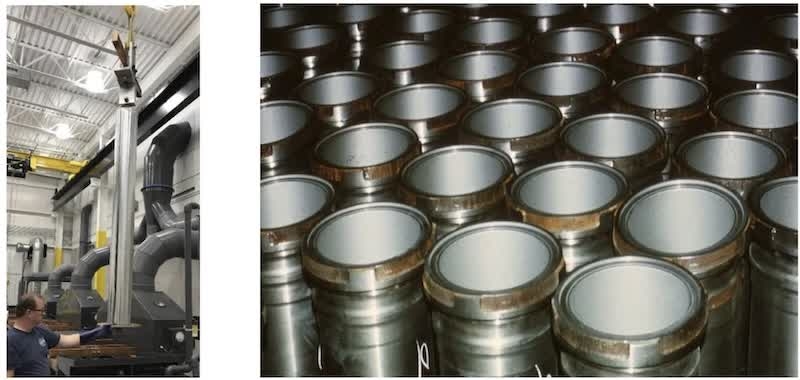 Examples of high-quality deposits from low-concentration baths. On the left, OD plating on rod; at right, ID plating on cylinders.
The Downsides
There are only a few downsides to using a low-concentration bath. However, these are easy to manage while still providing the desired savings and other advantages.
- Higher Voltage Needed: Because the low-concentration bath is somewhat less conductive, a slightly higher voltage will be needed for the same current density. A typical difference might require using 7 instead of the normal 6 volts. Just be sure the rectifier used has the extra voltage capacity available.
- More Frequent Chrome Additions: Low-concentration baths require slightly more frequent bath analysis because they need chromic acid additions made more often. For example, a busy 1,000-gallon tank might change from adding 120 pounds once a month to 60 pounds every other week. However, the amount of chrome added for a particular workload will be the same, or slightly less because of the reduced misting.
- Lower Impurity Tolerance: These baths don’t tolerate typical impurities like trivalent iron and copper as well as higher concentration baths do. In general, and within limits, the higher the chromic acid level, the more impurity tolerant the bath will be. Fortunately, there is a simple fix for this; see ‘The Sensible Approach’ below.
Suitable Bath Types
Low-concentration hard chrome baths aren’t particularly useful with the old-style generic 100:1 bath (the standard bath) because that basic chemistry is overly sensitive to concentrations. However, the newer dual-catalyst baths such as the Dura-2000 and Dura-3000 processes perform exceptionally well at lower chromic acid levels. Most platers choose the Dura-3000 bath for its faster plating speed and much better ability to tolerate impurities.
Both baths can be used for low-concentration flash or heavy build-up work, either OD or ID, on any base metal that is hard chrome plated. This includes high-speed/high-efficiency plating using the modern Dura-3000 catalyst system.
The only exception might be where very small IDs are plated, and the anode spacing is less than 0.25”. In those cases, a higher chromic acid level may prove better, especially if the bath lacks sufficient agitation.
The Sensible Approach
Low-concentration baths are best used when making up a new solution because they save a significant amount of costly chromic acid. This would apply to new bath make-ups or when remaking an existing bath.
The low-concentration bath performs like the higher-concentration baths until impurities reach a TCL value of 4.0. TCL stands for total contaminant loading; it includes the sum of the trivalent percent plus the grams per liter of iron and copper.
If the bulk of the TCL is trivalent, this can easily be reduced after adding some CR-3 Reducer. The bath can then continue operating with low chrome concentrations; however, if the iron and copper levels reach the 4.0 TCL point, it’s best to increase the chromic acid concentration gradually. This can be done in several steps over time until the bath is eventually at the normal 35 ounce per gallon chrome level. The chart in Table 1 below shows four typical steps for this.
Table 1
| Item | Step 1 Original Bath | Step 2 | Step 3 | Step 4 |
| TCL Level: | 0 - 3 | 4 | 5 | 6 |
| Chromic Acid: | 20.0 | 25.0 | 30.0 | 35.0 |
| Sulfate: | 0.17 | 0.21 | 0.25 | 0.29 |
| Booster Catalyst: | 1.5 | 2.0 | 2.5 | 2.5 – 3.0 |
Low-concentration baths also reduce the amount of booster catalyst needed for high-efficiency plating. The above is for a 120:1 sulfate ratio, which usually provides the best throwing power. Some operations prefer using a 90-100:1 ratio. If so, adjust the above sulfate concentrations accordingly.
Fixing the Sulfate Problem
Hard chrome baths tend to build sulfate gradually over time, causing maintenance headaches from the required barium carbonate treatments. The constant sulfate increase that plagues many operations is mainly caused by using certain brands of chromic acid and/or unpurified city water. Starting a new bath at a low chrome concentration and gradually raising the chrome level over time keeps the ratio in check without needing barium additions. This is an easy and inexpensive way to coordinate the ratio with this increase.
Ironically, this timing also seems to coordinate with the impurity increase, which requires a higher chrome level anyway. It’s an easy fix that eliminates the messy sludge-forming barium treatments. There’s nothing like killing two birds with one stone.
The Risk Factor
There’s really no downside or risk in trying the low-concentration bath the next time you need to make a fresh solution. The obvious upside is the huge savings on the amount of chromic acid needed. If this doesn’t meet your expectations, for any reason, add the amount of chromic acid you would have used initially; nothing is lost. However, experience shows that using a low-concentration bath saves considerable cost when making up a new solution.
Eric Svenson Sr. is CEO of Plating Resources and a Master CEF and IUSF member. Visit www.Plating.com. If you have any questions or wish to explore this topic further, please get in touch with Vicky at Vicky@Plating.com.