

Electric or Gas? That is the question. As industries race toward carbon neutrality, “going electric” often seems like the obvious path.
 Marhya OsheaskiElectricity feels cleaner, more modern, and easier to integrate into sustainability goals—especially compared to fossil fuels.
But when it comes to curing processes, the story isn’t that simple.
At WolfRayet, we design gas-catalytic infrared ovens, and many of our customers are committed to reducing both their energy consumption and their carbon footprint. Yet, as I dug deeper into where our electricity actually comes from in the U.S., the results were surprising—and important for any manufacturer trying to make data-driven environmental decisions.
How U.S. Electricity Is Really Generated
Here’s the current breakdown of U.S. power generation:
- Natural Gas: 43%
- Coal: 16%
- Nuclear: 18%
- Wind: 10.2%
- Hydropower: 6.2%
- Solar: 3.2%
- Petroleum: 0.4%
- Other (biomass, geothermal, etc.): small remainder
While CO₂ drives global warming, nitrogen oxides (NOₓ) are a direct health hazard—they contribute to smog, acid rain, and respiratory disease.
In other words, nearly 60% of our electricity still comes from fossil fuels. That means the “clean” electricity powering your plant—or your EV car you drive—may originate from burning natural gas or coal.
The Hidden Emissions Behind Electricity
Each energy source produces a very different emission profile. Also, it is a fact that the average amount of fossil fuel energy (natural Gas or Coal) required to produce 1 kW (3,412 BTUs) is 10,000 BTUs. Based on this fact, the emissions are as follows…
CO₂ emissions per KW by energy source:
- Natural Gas: ~0.96 lb (0.44 kg)
- Coal: ~2.07 lb (0.94 kg)
- Nuclear: ~0.026 lb (12 g)
NOₓ emissions per KW by energy source…
- Natural Gas: ~0.1 g
- Coal: ~1.6 g
- Nuclear: negligible
Weighted across the U.S. grid, electricity generation produces roughly 0.367 kg CO₂ and 0.299 g NOₓ per KW. So, while electric systems emit nothing directly, the electricity they use still carries an indirect carbon and NOₓ burden.
While CO₂ drives global warming, nitrogen oxides (NOₓ) are a direct health hazard—they contribute to smog, acid rain, and respiratory disease.
Both matter, but NOₓ has a more immediate impact on human health.
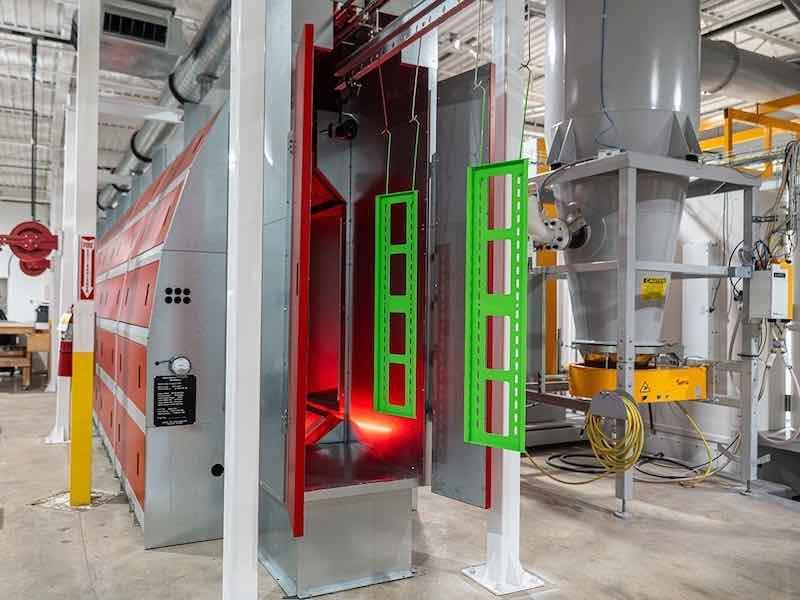
Gas catalytic infrared ovens convert natural gas or propane into heat through a platinum-catalyzed reaction, not open combustion.
The “Green” Reality Check
If your facility’s electricity is generated mostly from natural gas or coal, running electric infrared ovens doesn’t eliminate your carbon footprint—it shifts it upstream to the power plant.
You can verify your region’s electricity mix using the EPA’s Power Profiler at https://www.epa.gov/egrid/power-profiler.
Let’s look at what happens when you choose electric infrared (IR) versus gas catalytic infrared (IR) ovens for your curing line.
In this example, let’s compare an electric oven with a 330 kW/h connected load to an equivalent gas oven with a 1,000,000 BTU/h connected load. Remember the energy equation: 1 kW = 3,142 BTUs.
Electric Infrared Oven:
- Operating at 330 kW/hour
- Operates ~2,000 hours per year → 660,000 kWh annually
- CO₂ emissions: 660,000 × 0.367 = 242,220 kg/year
- NOₓ emissions: 660,000 × 0.299 = 197 kg/year
While the oven itself doesn’t generate pollutants, the power plants feeding it certainly do.
Gas Catalytic Infrared Oven:
- Operating at 1,000,000 BTUH = 10 Therms / hour
- Operates ~2,000 hours/year → 20,000 Therms
- CO₂ emissions: 20,000 × 4.4kg = 88,000 kg/year
- NOₓ emissions: Zero
That’s less than half the CO₂ and no NOₓ emissions.
Why Gas Catalytic IR Is Different
Gas catalytic infrared ovens convert natural gas or propane into heat through a platinum-catalyzed reaction, not open combustion.
This process produces infrared energy, water vapor, and CO₂, but no NOₓ or particulate emissions.
It’s a clean reaction that directly converts 80% of the BTUs in Natural Gas into radiant heat—no flame, no exhaust gases, and minimal waste.
| Oven Type | CO₂ (lbs./MMBTU) | NOₓ (lbs./MMBTU) |
| Electric IR | 230.28 | 0.585 |
| Gas Catalytic IR | 117 | 0.000 |
| Gas Convection | 117 | 0.1 |
The Efficiency and ROI Advantage
Beyond emissions, gas catalytic IR ovens offer practical benefits:
- Faster heating: Infrared energy transfers heat directly to the coating, reducing cycle time.
- Lower operating costs: Natural gas remains significantly cheaper per kilowatt than industrial electricity.
- Short payback period: Most users see ROI within 18 months through reduced utility costs and improved throughput.
- Maintenance costs are reduced, with no burned-out electric heaters or connections.Catalytic heaters have an unlimited life – the catalyst is not consumed in the reaction.
The Bottom Line
If your goal is truly to reduce total carbon footprint, not just shift where emissions occur, gas catalytic infrared ovens are often the more sustainable choice.
They offer:
- Lower total CO₂ output compared to electric IR systems.
- Zero NOₓ emissions, protecting both the environment and human health.
- Higher process efficiency translates to faster curing and reduced energy costs.
Final Thoughts
Reducing emissions is critical—for the planet, for our health, and for business sustainability. But achieving that goal requires a complete view of the energy lifecycle, not just the endpoint.
If you’re currently using electric or convection ovens, switching to gas catalytic infrared can lower your carbon footprint, reduce operating costs, and support your company’s sustainability goals—without compromising performance.
Curious about how this could work for your process? Reach out to info@wolfrayet.com to learn more.
Marhya Osheaski is President of WolfRayet and has over 20 years of business experience and a distinguished track record in the chemicals and coatings industry. Her previous roles included vice president of sales at IFS Coatings, where she was instrumental in driving sales growth, sales manager at Axalta Coatings, and sales manager at Clariant Masterbatches.