


When Nelson Zimmerman looks at the future of Keystone Koating, he sees much more than a powder coating operation approaching its 40th anniversary.
He sees a growing manufacturing enterprise that continues to expand its footprint while remaining grounded in the same principles that launched the company in 1986.
 That vision was underscored recently when Keystone Koating, along with sister company PBZ Manufacturing, announced the acquisition of a 170,000-square-foot manufacturing facility in Lebanon, Pennsylvania. The facility, formerly used for agricultural equipment manufacturing, represents the next major chapter in the company’s growth story. According to Keystone Koating, the site will eventually house fabrication operations, blasting capabilities, and a new powder coating line, dramatically expanding the company’s production capacity.
For Zimmerman, founder and family business partner of Keystone Koating, the acquisition is simply the next step in a decades-long philosophy of continuous improvement.
What makes the company’s story particularly interesting, however, is that Keystone’s growth has never been driven by a pursuit of size alone. Instead, the organization has focused relentlessly on providing higher-quality finishing services, investing in advanced pretreatment technologies, developing employees, and building a culture centered on long-term customer success.
“The first few months I just wanted powder to stick on the parts,” he says. “I would say, ‘Can I get powder to stick on this thing?’”
The result is a company that has expanded from a single powder coating line in rural Pennsylvania into a multi-facility operation serving diverse industries ranging from agriculture and retail to data centers and industrial manufacturing.
“We’ll let the cheap guys have their cheap stuff,” Zimmerman says. “We’ll do the good stuff.”
That simple philosophy has become the foundation for Keystone Koating’s growth strategy.
From Hardware Store to Manufacturing Enterprise
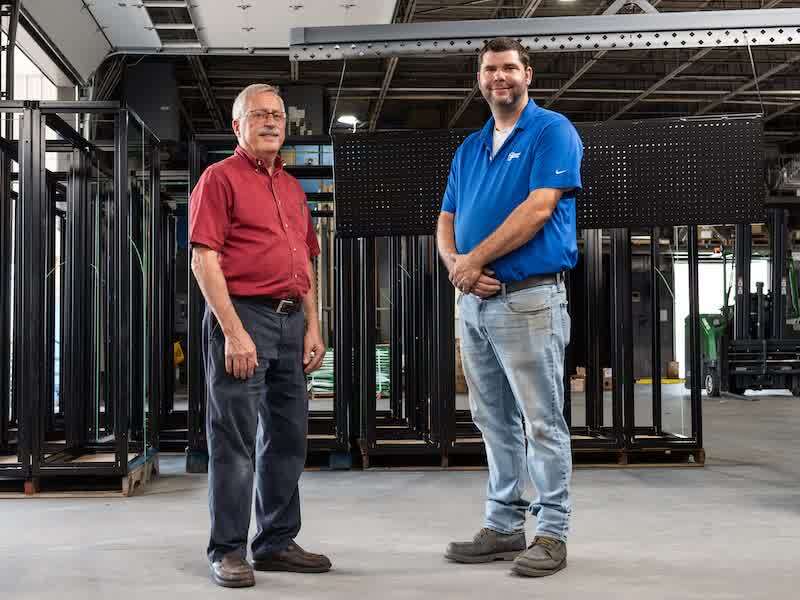 Nelson Zimmerman and Jared Miller, Plant Manager at the Lititz facility.Keystone Koating's origins stretch back nearly four decades, before the first powder-coated part rolled off a conveyor.
“My father started our business in 1947 doing general repairs and selling some hardware,” Zimmerman explains. “Through the years, we’ve grown; our manufacturing services have separated from our retail and wholesale hardware division, which is running strong.”
Today, the organization operates several business units, including retail hardware, wholesale hardware, agricultural equipment manufacturing, fabrication, and powder coating services.
“It’s kind of a three-legged stool there,” Zimmerman says.
The manufacturing side of the business naturally led to the eventual creation of the powder coating operation. Like many manufacturers in the early days of powder coating, the company initially outsourced finishing work. When the opportunity arose to bring those capabilities in-house, leadership recognized powder coating’s potential.
The timing was far different than today’s mature powder coating market.
“There weren’t any,” Zimmerman says about powder coating operations in the region during the mid-1980s. “It felt very new.”
“It’s been strong,” Zimmerman says of current business conditions. “It’s been a struggle to keep up with the demands that are here right now.”
The company built its first coating facility in 1985, installed the line, and officially began powder coating operations in 1986. Success came quickly, but not without challenges. Reflecting on those early days, Zimmerman recalls the extreme learning curve.
“The first few months I just wanted powder to stick on the parts,” he says. “I would say, ‘Can I get powder to stick on this thing?’”
Forty years later, Keystone Koating has evolved into a sophisticated finishing operation featuring multiple coating lines, advanced pretreatment systems, computerized process monitoring, and industry certifications that place the company among the region’s elite powder coating providers.
Building Capacity to Meet Demand
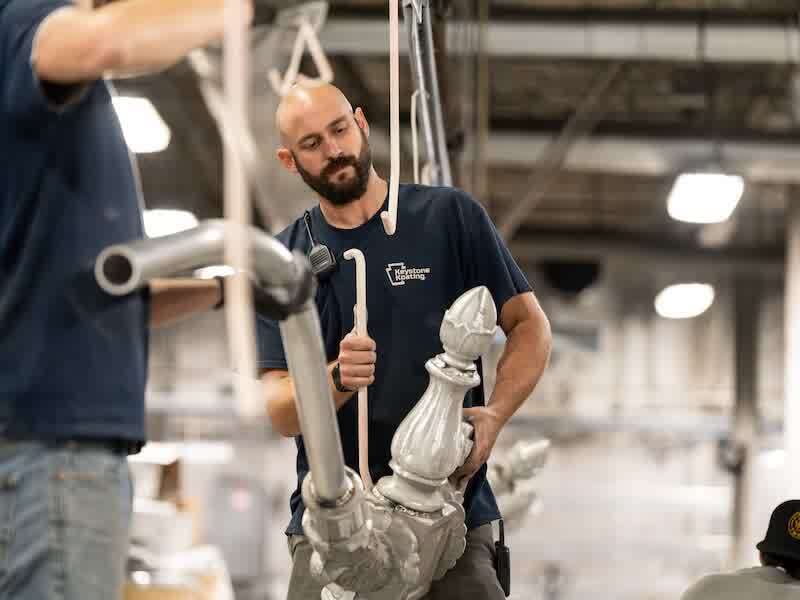 Today, Keystone Koating operates facilities approximately 90 miles apart in Lititz and Mifflintown, Pennsylvania.
The Mifflintown operation opened in 2006 after the company identified both a strategic customer need and a growth opportunity.
“We had a customer in the same industrial park where we expanded into,” Zimmerman explains. “That was our largest customer throughout the whole business, actually. They still are a significant customer of ours, so we moved into their neighborhood to service them better and expand our footprint of coating services.”
The decision reflects a recurring theme throughout Keystone’s history: expansion is driven by customer service rather than arbitrary growth goals. Today, the company operates three conveyorized lines and three batch systems and employs about 70 people across both locations.
“We operate with about 40 employees here at this facility and 30 up north at our Mifflintown facility,” says Jared Miller, Plant Manager at the Lititz facility.
Even with that substantial footprint, demand is continuing to outpace available capacity.
“It’s been strong,” Zimmerman says of current business conditions. “It’s been a struggle to keep up with the demands that are here right now.”
Instead of lowering standards, Keystone doubled down on quality. “We just said, ‘Let’s just leave that behind and go for the better stuff.’”
That reality is one reason the Lebanon facility acquisition matters. The company plans to move certain operations into the new building, add fabrication capabilities, add blasting capacity, and eventually install another powder coating line.
“We’re way over capacity in our current location,” Zimmerman says.
In parallel, Keystone is also engineering an addition at its Mifflintown facility that will further increase fabrication capacity and add another coating line.
Looking out five years, the company expects to operate coating lines across all three locations, dramatically increasing its ability to serve customers throughout the region.
A Deliberate Shift Toward Premium Finishing
 While additional space and equipment are important, the defining moment in Keystone Koating’s evolution may have occurred around 2005.
At the time, the powder coating market was becoming increasingly crowded. New competitors were entering the industry, often competing primarily on price. Rather than joining the race to the bottom, Keystone chose another path.
“I think it was right around 2005 plus or minus,” Zimmerman says. “The line we installed at Mifflintown in 2006 was a shift toward significantly improving the quality of our coating.”
The decision partly responded to growing competitive pressures.
“In our neighborhoods, we were competing with new startups that were offering — I’ll use the word appropriately — cheap coating,” Zimmerman says. “And they were hard to compete with when you want to do a good job.”
Instead of lowering standards, Keystone doubled down on quality.
“So we just said, ‘Let’s just leave that behind and go for the better stuff,’” he says.
That choice has defined the company’s strategy ever since. Today, Keystone’s finishing systems meet demanding performance specifications, including AAMA 2605 architectural coating requirements and other high-performance applications.
Those capabilities have allowed the company to attract customers who view finishing not as a commodity but as a critical performance requirement.
The Importance of Pretreatment
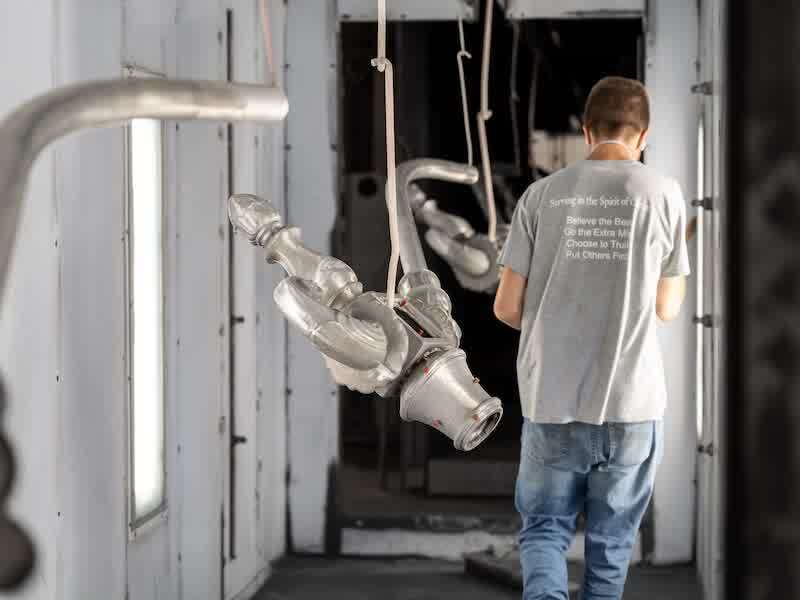 Few areas illustrate Keystone’s commitment to quality more clearly than its pretreatment systems. Many powder coaters talk about the importance of surface preparation. Keystone has built its operation around it.
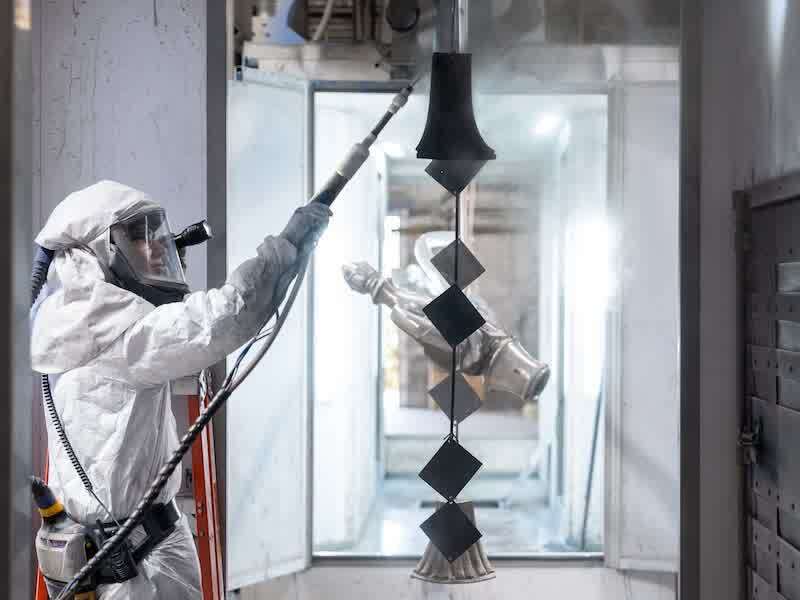
All three of the company’s conveyorized coating lines utilize eight-stage pretreatment systems paired with zirconium sealing technology. While some might view an eight-stage washer as excessive, Zimmerman sees it differently.
“It’s more expensive to install one,” he says. “But it’s less costly to run.”
The process includes:
- Alkaline cleaning
- Two rinse stages
- Iron phosphate conversion coating
- Two additional rinse stages
- Reverse osmosis rinse
- Dry-in-place zirconium seal
The payoff comes in process stability and long-term performance.
“The chemistry runs much cleaner,” Zimmerman says. “With double rinses after the chemistry, it just runs much more stable and clean.”
Ultimately, the goal is straightforward: “It’s able to perform what it’s supposed to perform better,” he says.
That attention to pretreatment aligns with what many leading finishers have learned over the years: coating performance begins long before powder is applied.
Keystone supplements those pretreatment systems with extensive blasting capabilities, creating multiple pathways to achieving the surface conditions required for demanding applications.
Serving a Diverse Customer Base
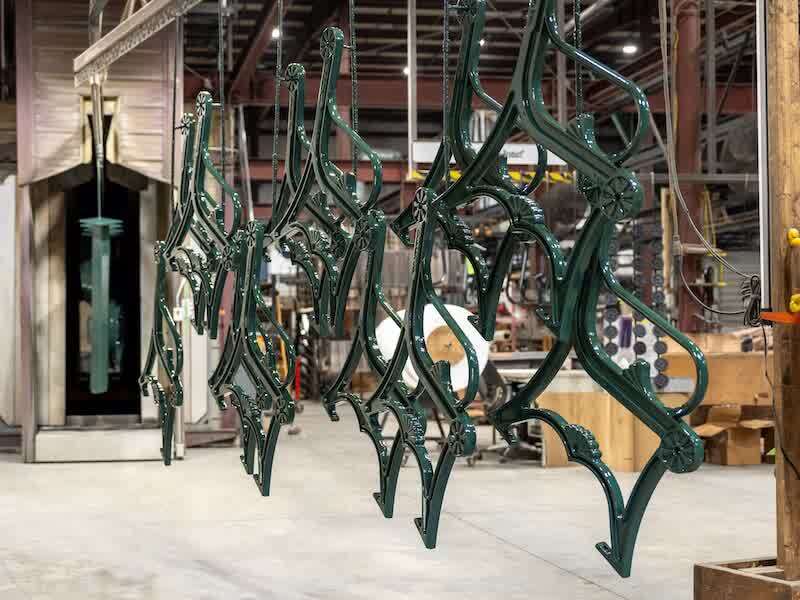 One reason Keystone has remained resilient throughout changing economic cycles is its commitment to customer diversification.
Miller says they are working on parts in the agricultural, retail, and data center manufacturing sectors. The company serves a broad range of industries and deliberately avoids becoming overly dependent on a single sector.
“A diverse market is really important to us,” Miller says.
That strategy has become particularly valuable in today’s manufacturing environment, where different industries experience dramatically different business cycles.
Agricultural equipment remains a significant market segment, partly due to the company’s manufacturing roots. At the same time, growth opportunities have emerged in newer sectors. Among the most notable is the rapid expansion of data centers across the United States.
“We’re doing some of the frameworks, frames and other parts,” Miller says. “And we’re also doing some components for fan brackets and other parts.”
“Our plants all run on a computer system that’s all interlinked. Our staff anywhere can see what everything’s doing.”
The amount of work entering the facility from data center projects has been significant.
“They’re popping up all over,” Miller says. “They’re huge; it’s just a lot of material flowing through our shops with that kind of parts at this point.”
The company has also benefited from parts of the ongoing reshoring trend, supporting customers bringing manufacturing operations back to the United States.
“We do have one customer that has come along and reshored here in the U.S.,” Miller says.
By maintaining a diverse customer portfolio, Keystone reduces risk while creating opportunities across multiple industries.
Technology Driving Better Results
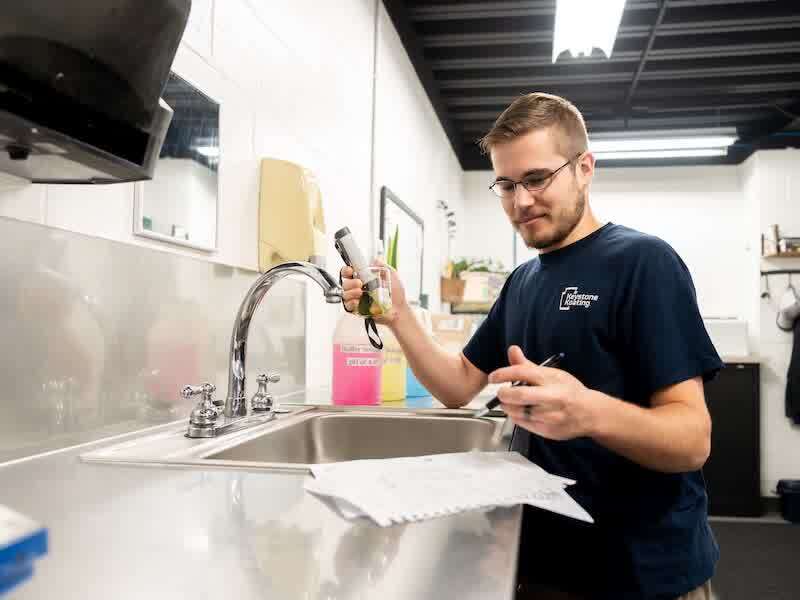 As coating performance requirements have increased, so has Keystone’s investment in technology.
Zimmerman has witnessed dramatic changes since the company’s early years.
“Certainly, the requirement for excellent performance has risen,” he says. “There is an expectation of performance.”
Alongside those rising expectations have come advances in powder formulations, pretreatment chemistry, and process technology. One of the biggest transformations has occurred in data collection and plant monitoring.
“Our plants all run on a computer system that’s all interlinked,” Zimmerman says. “Our staff anywhere can see what everything’s doing.”
Modern process control technologies also provide extensive documentation and quality tracking.
“It’s a lot of logging,” Zimmerman says. “You get information, take pictures of everything on the line as it runs through.”
For someone who remembers powder coating in 1986, the difference is remarkable.
“It’s just astonishing,” he says, comparing today’s systems to the technology available when Keystone started operations. The result is improved consistency, greater traceability, and enhanced quality assurance.
Creating a Culture of Quality
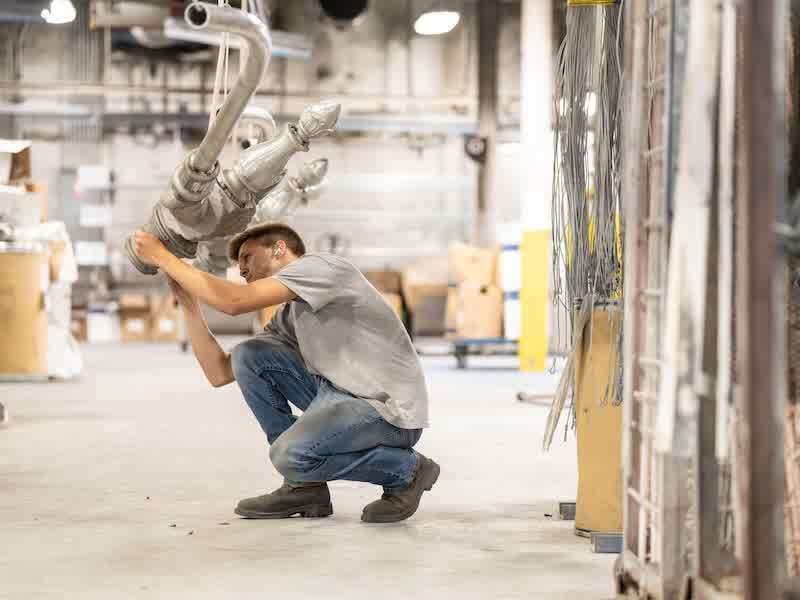 While technology and pretreatment systems are critical, both Zimmerman and Miller repeatedly return to the same conclusion when discussing Keystone’s success: people matter most.
Quality is not simply a specification posted on a wall or a certification hanging in an office. At Keystone, it is embedded throughout the organization.
“I think we start talking about it on day one, on somebody’s first day,” Miller says, as quality expectations are introduced immediately during onboarding and reinforced continually. “Those are the fundamentals behind providing great service for our customers.”
The conversation does not end after orientation.
“It trickles down through all of the meetings that we have,” he says. “It’s discussing quality and the importance of it and just making sure that people are trained. Quality is just the number one fundamental.”
“People want to continue to grow as individuals. When we’re adding these opportunities, it allows for some people to grow.”
According to both leaders, achieving that level of commitment requires more than technical training alone.
“It requires a good personality, good culture, and all those things to make those things possible,” Miller says.
That philosophy reflects a broader organizational belief. As a family-owned business, Keystone places significant emphasis on creating an environment where employees feel engaged and valued.
“One of the things that — as a family business — we put an amazing amount of energy into is building a really solid culture,” Zimmerman says, adding that the company invests heavily in creating meaningful interactions between employees, managers, and leadership.
“We say we want it to be a great place to work and do business with.”
Employee Growth and Long-Term Retention
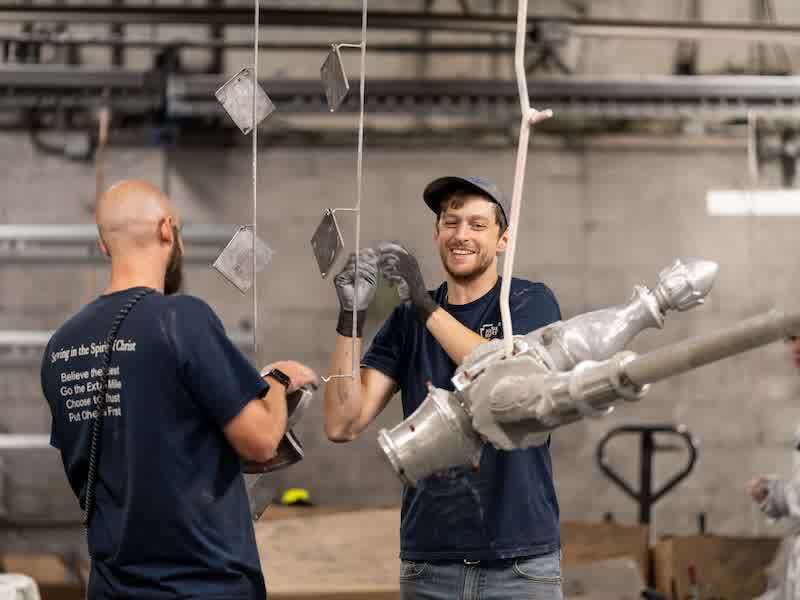 The labor challenge affecting manufacturing has not bypassed Keystone Koating. Recruiting skilled workers remains difficult, particularly as the company expands.
“That has been a challenge,” Miller says.
Yet leadership believes part of the solution is providing opportunities employees cannot easily find elsewhere. When people join Keystone, they enter a broader organization rather than a single department.
The company offers opportunities in fabrication, powder coating, retail hardware, wholesale hardware, agricultural equipment manufacturing, maintenance, and corporate operations.
“Anybody working here has the opportunity to pursue other areas within the whole business almost equally,” Zimmerman says.
Employees frequently move between roles and departments, gaining new skills while broadening their careers.
“We do shift people around some,” he says.
Miller believes those opportunities contribute to employee retention.
“People want to continue to grow as individuals,” he says. “When we’re adding these opportunities, it allows for some people to grow.”
Combined with extensive training programs and a strong company culture, those growth opportunities create a compelling employment environment.
Collaboration Over Competition
 Perhaps one of the most unusual aspects of Keystone Koating’s philosophy is its openness toward competitors. In many industries, finishers closely guard operational practices and facility access.
Zimmerman takes a different view.
“We’re better together than we are alone,” he says.
For example, Zimmerman took Ingham Powder Coating owner Kyle Ingham around their shop when Ingham first started and showed him things he might never have learned about powder coating—and about working with customers—that he would never have learned on his own, or that would have taken him years to learn.
“I was able to go into his plant and spend time learning powder coating,” Ingham says. “The highest compliment I ever got—other than from my father—was when Nelson came to see my new plant. As he was leaving, he said, ‘Kyle, you really did a nice job setting up this plant.’ I have tremendous respect for him.”
When discussing industry peers, he emphasizes that success ultimately comes down to execution, not secrets. High-performing operations are built through leadership, employee engagement, training, and culture.
“For the most part, there’s no big secret in the industry really,” Zimmerman says. “It comes down to good guys like Jared and good guys like our teams out there and doing the job well.”
“Over the years, our ambition has not been to hit growth targets. It’s much more about hitting service targets for the customer.”
Customers frequently notice that difference when visiting Keystone facilities.
“They really appreciate the engagement of our staff here,” Zimmerman says. “They seem to care and be open and honest about what’s going on. That goes back to building a culture that puts great value on being people of value.”
Zimmerman has even launched a consulting business to provide advice and training to help a wide variety of manufacturers implement and improve their powder coating process.
Christopher Wenger from Key-Link Fence and Railing says Zimmerman was instrumental in helping their powder coating and manufacturing operation streamline their efforts and produce a higher-quality finished part.
“Nelson gave me 25-30 years of powder coating experience in a year,” Wenger says.
Growth Through Service
As Keystone Koating expands into new facilities, adds coating lines, and increases fabrication capacity, it's easy to assume the company is aggressively chasing growth metrics.
Zimmerman says that has never been the objective.
“Over the years, our ambition has not been to hit growth targets,” he says. “It’s much more about hitting service targets for the customer.”
That philosophy appears to have created a positive cycle.
By investing in pretreatment, technology, quality systems, employee development, and customer relationships, the company earns repeat business. That business creates demand. Demand drives expansion.
“That becomes known,” Zimmerman says, “and the demand grows on its own if you have satisfied customers.”