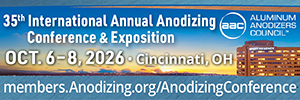


When the Aluminum Anodizers Council (AAC) gathers in Cincinnati, Ohio, October 6-8 for its 35th Annual Anodizing Conference and Exposition, attendees will not only be participating in one of the industry's premier educational and networking events.
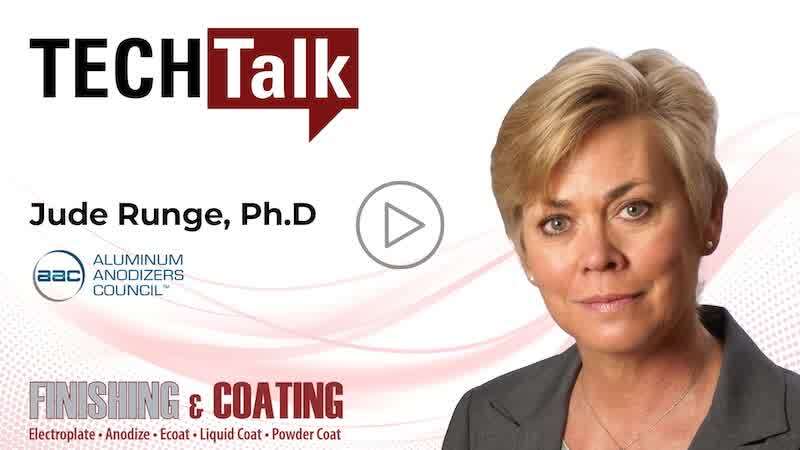
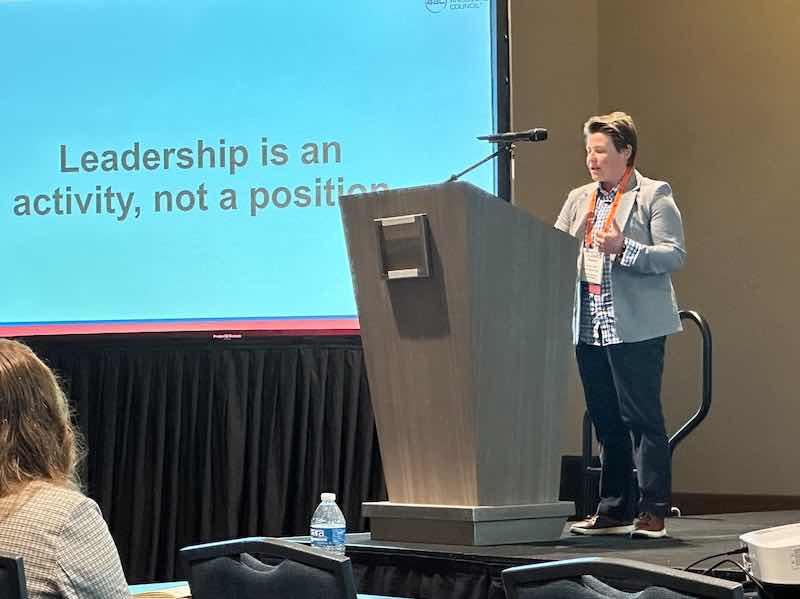
They will also be marking the end of an era, as this year's conference will be the final AAC conference led by Jude Runge, Ph.D., as chairperson of the organization's technical and educational programming. Since joining the effort in 2008, Runge has helped shape the conference's educational foundation by developing courses, recruiting world-class instructors, and creating a learning environment that serves everyone from first-time anodizers to some of the industry's most experienced technical professionals.
While Runge is stepping away from the demanding leadership role, she isn't leaving the industry.
"I'm always going to be around to support," she said. "But to be the actual education committee chair, it does take a lot of time and energy."
"We do a really nice treatment of aluminum metallurgy," Runge says. "It's not a daunting deep dive, but it gives students an idea of what the alloy designations mean and what the alloying elements' impact is on how the oxide grows."
Her longtime co-chair, George Oh, will lead the program moving forward.
"George and I are a good team," Runge said. "He'll be taking over from me as the chairman, and I'm sure he's already thinking about who he'd like for his co-chair."
As Runge prepares to hand over the reins, the educational offerings she helped build are stronger than ever. The conference's pre-conference educational sessions, Anodizing Essentials and Advanced Anodizing, scheduled for October 5-6 at the Hyatt Regency Cincinnati, may represent the most comprehensive anodizing education available anywhere in North America.
A Foundation Built on Understanding
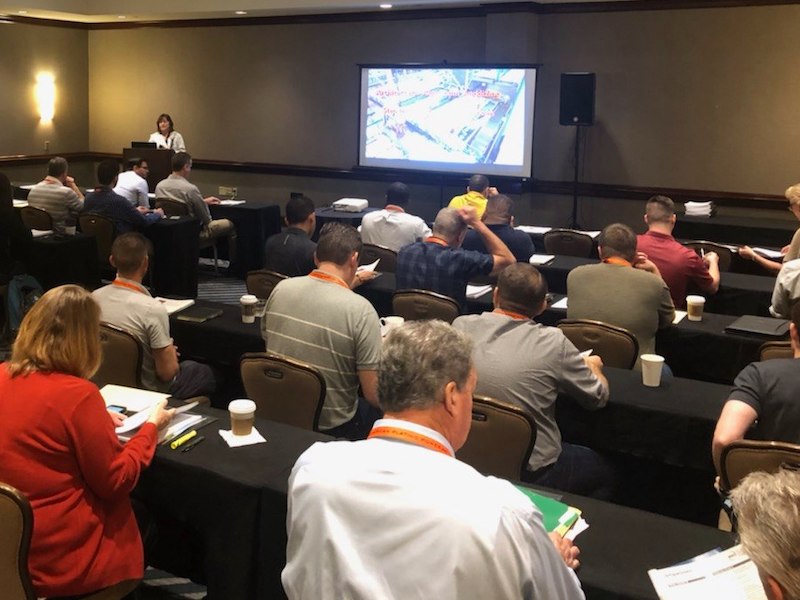
 Among the most popular features of every AAC conference is Anodizing Essentials, a course designed to provide a complete understanding of the anodizing process from beginning to end.
Runge describes the course as a comprehensive step-by-step journey through anodizing.
"Anodizing Essentials is a comprehensive step-by-step class that takes the students through the process," she said. "We start with an overview and video of the entire anodizing process and then move through every step."
The course begins where all anodizing begins: with aluminum itself.
Participants learn the fundamentals of aluminum metallurgy, including alloy classifications, alloying elements, and how those elements affect oxide growth during anodizing.
"We do a really nice treatment of aluminum metallurgy," Runge says. "It's not a daunting deep dive, but it gives students an idea of what the alloy designations mean and the alloying elements' impact on how the oxide grows."
From there, students move through the complete process flow, including:
- Material preparation
- Racking
- Power supply fundamentals
- Cleaning
- Rinsing
- Anodizing
- Dyeing
- Electro-coloring
- Sealing
- Post-treatment operations
Rather than relying on a single instructor, the course features specialists recognized as experts in their specific areas.
Years ago, the course was known as Anodizing A-to-Z and was taught by one instructor.
"Richard Mahn taught it, and he did a tremendous job," Runge said. "But by having experts from every step of the process as faculty members, students get a more well-rounded approach."
That multidisciplinary approach has become one of the course's greatest strengths.
Learning the "Why" Behind the Process
What distinguishes Anodizing Essentials from many training programs is that it focuses not simply on procedures, but on understanding.
Runge believes many anodizers learn operational practices from coworkers, supervisors, or suppliers. While that knowledge is valuable, AAC's role is different.
"We're not there to teach you what to do on your line," she said. "We're here to tell you what happens when you do things."
"It's nice to learn from somebody else's problems," she says with a laugh.
That distinction may sound subtle, but it is critically important.
The course examines the science behind every process step, helping participants understand cause-and-effect relationships that directly impact quality, consistency, and troubleshooting.
"What happens when you're removing all of the residues from production that preceded anodizing?" Runge said. "Why do you have to rinse? Why is rinsing most important? What happens when you are pushing current through that anode?"
By understanding the mechanisms involved, attendees can diagnose problems and optimize processes instead of following established routines.
"How do you end up with this perfectly ordered oxide?" Runge says. "Why does it spontaneously form? I think the entire class is a real asset to the industry."
The Most Important Step Nobody Talks About
 Among the many process stages covered in the course, Runge believes one is frequently overlooked despite its enormous importance.
"Rinsing is probably the most important," she said.
While discussions about anodizing often focus on chemistry, current density, coatings, or sealing technologies, inadequate rinsing remains one of the most common causes of process contamination and quality issues.
AAC's focus on this often-underappreciated topic shows the course's practical nature. Students are exposed not only to major process technologies but also to the everyday operational details that can make or break production quality.
Beyond technical instruction, Runge says one of the course's greatest benefits is the interaction among participants and instructors.
"There is always time for questions," she said. "And if there isn't enough, at the end of a segment we have breaks where we can really do a lot more intensive Q&A."
For many attendees, those discussions become just as valuable as the formal presentations.
Experienced anodizers share real-world challenges. Newcomers ask questions that others may have been reluctant to raise. Faculty members offer practical guidance drawn from decades of experience.
Runge acknowledges that one of the most valuable aspects of industry education is learning from others' experiences.
"It's nice to learn from somebody else's problems," she says with a laugh.
The result is an environment where participants leave not only with technical knowledge but also with a network of industry contacts they can call upon long after the conference concludes.
Designed for Everyone in the Industry
The Essentials course attracts a broad range of attendees. New employees gain a structured introduction to anodizing fundamentals. Process engineers deepen their technical understanding. Supervisors and managers develop a broader perspective of how each operation affects overall performance.
The curriculum covers castings, forgings, extrusions, and other aluminum products, making it relevant across numerous market segments.
According to Runge, the course's value lies in helping people understand the complete process rather than just their portion of it.
"This year it is a brand-new course," she says.
That broader perspective often improves communication between departments, strengthens troubleshooting, and builds more effective employees.
For shop owners and managers investing in workforce development, the course offers an opportunity to accelerate employee growth while exposing them to industry best practices and leading experts.
Taking the Next Step: Advanced Anodizing
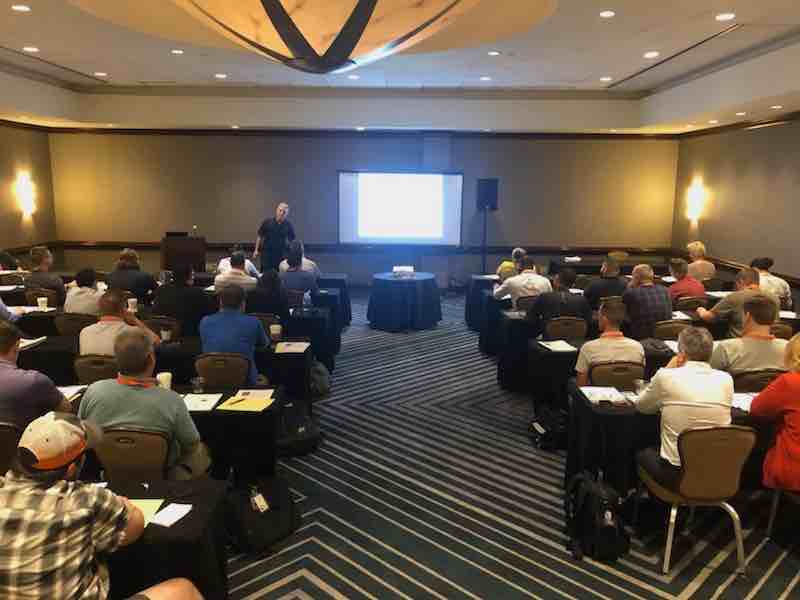 For those seeking a deeper technical understanding, AAC will also offer its Advanced Anodizing course on October 6.
Runge calls the program one of her proudest accomplishments.
"Advanced Anodizing is my brainchild," she said.
The course emerged from a recognition that even a comprehensive program like Anodizing Essentials cannot cover every technical detail.
"We don't really do a deep dive into the details of the actual reactions that happen during the various steps of the process in Anodizing Essentials.” Runge says. "We can’t get into the chemistry of pretreatment. We don't talk about anodizing for design and function. We don’t have time!"
Advanced Anodizing fills those gaps. The course explores the underlying chemistry, metallurgy, and electrochemical principles that govern anodizing performance.
"This became a class 10 or 12 years ago," Runge said. "We've offered it maybe four times, and the last time was three years ago."
For 2026, the course has been substantially refreshed and updated.
"This year it is a brand-new course," she says.
Diving Into the Science
Advanced Anodizing features presentations from several of the industry's leading technical experts. Topics include:
Pretreatment Chemistry: George Oh from Quaker Houghton will lead discussions examining the chemical mechanisms that occur during pretreatment operations. Participants will gain a deeper understanding of cleaning, etching, desmutting, and other critical surface preparation processes.
Anodizing for Design and Function: Runge's presentations will focus on tailoring anodizing processes to achieve specific functional and performance objectives. This includes understanding how process variables influence oxidecharacteristics and how to optimize anodizing for particular applications.
Complex Alloys and Difficult Challenges: One of the course highlights will be presentations by Jeff Almeyda of Aerotech Processing. Runge describes Almeyda as one of the world's leading experts in anodizing difficult alloys.
"He takes those processes and makes really impossible things happen with the most difficult alloys," Runge said.
The sessions will address challenges associated with 2000-series alloys, 7000-series alloys, rapidly solidified materials, nano-grained specialty alloys, and high-performance aerospace materials
These materials often present unique challenges due to their microstructures and alloy compositions. Understanding how to anodize them successfully can be critical for aerospace, defense, and advanced manufacturing applications.
Post-Treatment Chemistry: Pinakin Patel will conclude the course with a detailed examination of dyeing, sealing, and post-treatment chemistry. Participants will explore the pore-level reactions that occur during sealing and learn how these processes influence corrosion resistance, wear resistance, and long-term coating performance.
"The chemistry of driving the reactions that happen on the pore level during dyeing and sealing," Runge says, "actually makes the oxide attractive while have the most outstanding corrosion resistance while maintaining other mechanical properties."
A New Schedule Designed for Better Attendance
This year's educational program also features a significant scheduling change. Historically, attendees often needed to arrive Sunday evening to participate in Monday morning classes.
To reduce travel burdens and improve participation, AAC adjusted the schedule.
"It was decided with a directive from the board of directors that we're trying to increase attendance," Runge said.
Classes will now begin Monday afternoon with lunch provided.
"We're starting the classes midday on Monday," she says. "We're providing lunch, starting discussions over lunch, and then teaching halfway through the process before we adjourn for the evening."
"As an anodizer, I wish my young people would come in with this basic knowledge," Runge said, describing the types of conversations she hopes will occur. "Is it possible? Can you teach this?"
Participants will have Monday evening free to network, reflect on the material, and prepare for the second day of instruction. Tuesday morning will complete the Essentials curriculum before transitioning into Advanced Anodizing.
The revised schedule culminates with the conference's opening networking event Tuesday evening.
"It's a great idea," Runge says. "It gives people time to think and get their head around all the content that's been presented."
Education Continues Throughout the Conference
The educational focus doesn't end with the courses. Runge noted that one of the most significant changes to this year's conference is the addition of panel discussions at the conclusion of every session.
Highlights include a Young Anodizers Panel featuring professionals under age 40 discussing how they entered the industry and what keeps them engaged.
"Anodizing is an aging industry," Runge says. "We have to see what our young workforce is finding in our industry so that other people can be encouraged to become part of it."
Additional panel discussions will bring together university researchers and industry professionals to discuss workforce development, education, and the skills future anodizers need.
"As an anodizer, I wish my young people would come in with this basic knowledge," Runge said, describing the types of conversations she hopes will occur. "Is it possible? Can you teach this?"
The goal is to strengthen the connection between academia and industry while helping educators better understand employers' needs.
Small Enough to Talk, Big Enough to Matter
Unlike some large industrial trade shows where attendees can feel anonymous, AAC's annual conference remains intentionally intimate with between 170 to 200 attendees.
That size creates opportunities for meaningful conversations.
"I loved your talk. I want to know more," Runge said, describing the interactions that frequently occur between attendees and presenters.
Those conversations often continue long after presentations end, creating relationships that can last throughout careers.
For many anodizers, that access to industry experts may be just as valuable as the formal education itself.
A Lasting Legacy
As Runge prepares for her final conference as Education chair, the technical program structure she helped build remains one of AAC's greatest strengths.
From Anodizing Essentials to Advanced Anodizing, the programs reflect nearly two decades of continuous refinement. The courses deliver technical knowledge, practical insight, and industry connections that participants can take back to their facilities immediately.
Most importantly, they embody Runge's long-standing philosophy of education: helping people understand not just what happens in anodizing, but why.
"I really like to teach," Runge says.
That passion is evident throughout the AAC educational program and will continue long after she hands leadership responsibilities to the next generation.
For anodizers looking to improve processes, develop employees, solve technical challenges, and build professional relationships, Cincinnati will offer a unique opportunity this October.
And for Jude Runge, it will be a fitting final chapter in a remarkable run as one of the industry's most influential educators.
The AAC 35th Annual Anodizing Conference & Exposition will be held October 6-8, 2026, at the Hyatt Regency Cincinnati in Cincinnati, Ohio. Anodizing Essentials and Advanced Anodizing courses will be offered October 5-6. Registration information is available through the Aluminum Anodizers Council at https://www.anodizing.org.