
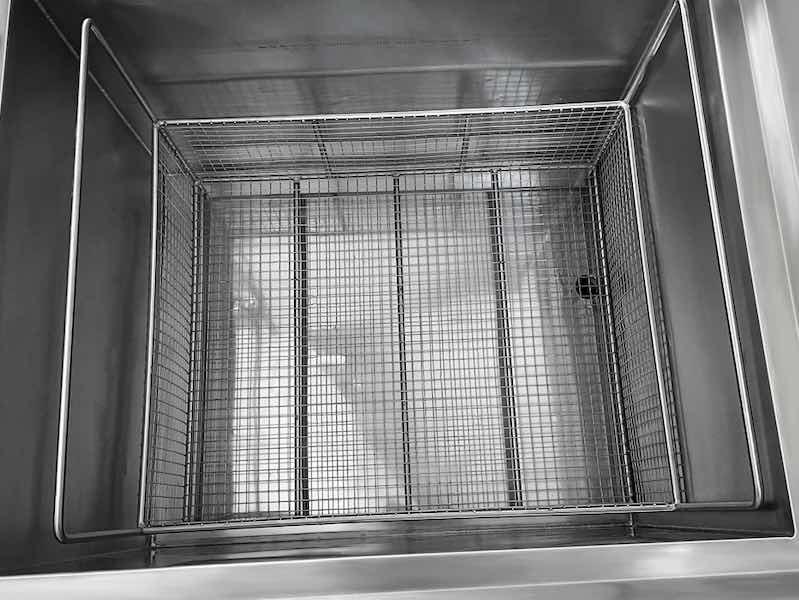
Writing an enormous check for cleaning equipment can be scary.
 Barbara and Ed KanegsbergManufacturers engaged in critical cleaning and surface preparation understand that effective product cleaning is essential for robust finishing and product reliability. How much should you spend? Are you spending wisely? What is the “just right” decision? The decision of how much to spend and what kind of cleaning equipment to purchase is only as good as the knowledge and experience of you and your team.
We love success stories, and we periodically report favorable case studies. Hearing that the manufacturer purchases new cleaning equipment, and as a result, the company makes better products, happily ever after, provides reassurance. However, understanding why problems happen provides knowledge and true confidence. We present two anonymous case studies in which purchasing new cleaning machines did not result in a Hollywood ending. In the first case study, “Does costly equipment translate to more effective cleaning”? You will discover that investing in costly, well-designed, high-quality cleaning equipment does not in and of itself guarantee success. – not without considering the combination of chemical properties and fixturing.
The second example, “Does more power mean better cleaning?” learn why the answer is – not necessarily.
Does Costly Equipment Translate to More Effective Cleaning?
Not necessarily. A manufacturer produces a high-volume product at several facilities. Given regulatory concerns, corporate management demanded that a facility using a halogenated solvent for product cleaning stop the practice. An engineer with expertise in equipment design and process flow was tasked with finding a solution. They selected equipment from an experienced, reliable equipment provider and a non-halogenated solvent. The throughput appeared to be based on cycle time, using fixtures that stacked as many parts as possible into the cleaning chamber. To avoid downtime during equipment maintenance, the facility purchased not one but two pieces of cleaning equipment. The plan was to use the second piece of equipment only during maintenance/repair to eliminate downtime. The cleaning machines had a large footprint and required substantial engineering controls. The initial capital investment was in the high six-figure range, and the facility had two expensive systems that occupied substantial manufacturing real estate.
Unfortunately, the new cleaning process did not adequately remove soils. The product had to be cleaned sequentially, using both orders of large cleaning equipment, to achieve a clean. There was nothing inherently wrong with the cleaning machine; there was nothing inherently wrong with the solvent. However, the combination of chemistry and fixturing did not provide adequate contact between the parts and the cleaning agent. Although this was an urgent process change driven by corporate concerns, investing in process development time, including coordination and communication among chemists, production personnel, and equipment designers, would likely have yielded a better outcome.
Does More Power Mean Better Cleaning?
Not necessarily. In the second example, the R&D chemists selected a cleaning agent and tested a small-scale system for cleaning low-volume, high-value parts using a solvent and ultrasonics. The R&D team tested several solvents and selected one with appropriate solvency and high wettability to achieve adhesion to complex surfaces. They evaluated cleaning using high-frequency ultrasonics (over 100 KHz). The higher the frequency, the smaller the cavitation “bubbles,” the more gentle the cleaning. While low-frequency ultrasonics (40 KHz) can be a good choice for large, heavy metal parts, very delicate parts, especially those made of non-ferrous metals or non-metals, can be damaged.
Next, the engineering department was responsible for the equipment. They hypothesized that more power would yield better and faster cleaning, so they ordered cleaning equipment with lower-frequency ultrasonics. What happened? Think of the iconic “Home Improvement” sitcom featuring Tim Allen, Tim “The Toolman” Taylor. If you’re too young to remember the show, stream it. Tim’s approach to life was the more power, the better. As a result, Tim landed in the emergency room, and/or there were large holes in his home improvement projects.
In manufacturing as in sitcoms, more power is not necessarily better. The product cleaning equipment destroyed the parts. This is the point where we were asked to troubleshoot the problem. Because the transducers could not readily be swapped or replaced at higher frequencies, the only solution was to order replacement equipment. The aggravation could have been avoided had the R&D team and the equipment orderers exchanged information, or had R&D been allowed to review the equipment specifications.
It’s Not Just the Cleaning Equipment
It takes a village to successfully change a cleaning process, not just equipment designers, not just chemists. Use the expertise of your team. Communicate that expertise! Communicating involves not only articulating your ideas and concerns. It also entails listening to and taking seriously what others are saying. In Part 4, we will present additional illustrations of mistakes in selecting cleaning equipment. We will also get into agendas.
References
- “Update or Replace Cleaning Equipment,” (Part 1) Clean Source, August 2025.
- “New Cleaning Equipment Part 2 – Begin the Quest,” Clean Source, September 2025.
Barbara and Ed Kanegsberg founded BFK Solutions in 1994 as a critical cleaning consulting service and the go-to resource to eliminate cleaning, surface quality, and contamination problems, or — even better — to prevent them altogether. Barbara, widely known as “The Cleaning Lady,” is an expert and trusted adviser in critical cleaning. Ed is known as “The Rocket Scientist.” They write Clean Source, an approximately monthly e-newsletter that provides practical ideas to improve cleaning, contamination control, and product quality. They are co-editors and contributors to the acclaimed two-volume “Handbook for Critical Cleaning,” CRC/Taylor & Francis, 2011. Visit https://bfksolutions.com