

Contamination on parts is expected in the finishing industry, but occasionally it becomes disruptive enough to ripple through every part of an operation.
 Jason PottsOils that resist conventional cleaning don’t just affect quality; they drive up labor costs, increase expenses, and create safety concerns.
That was the reality for one finishing facility until a closer look at the root cause—and a targeted chemistry solution—transformed its process.
During a routine visit, Jason Potts, Technical Representative at Hubbard-Hall, encountered a situation that immediately stood out.
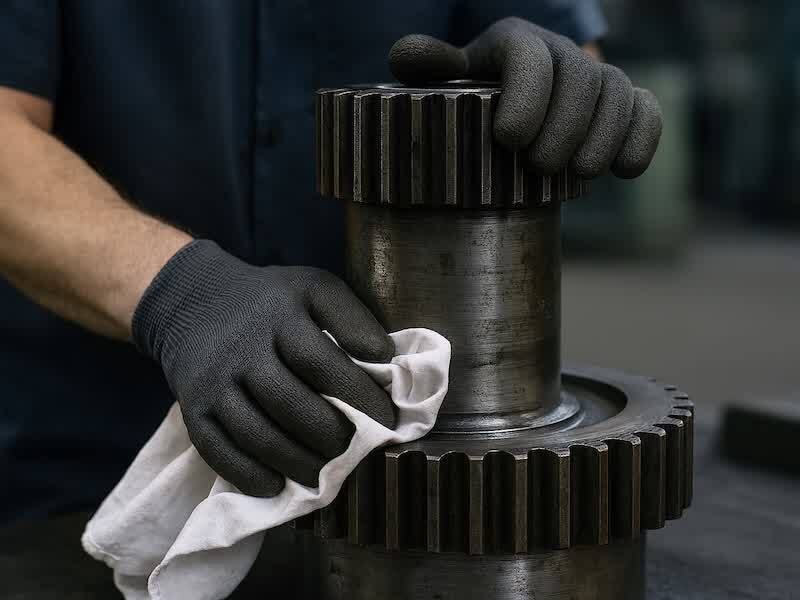
“I was walking into the shop, and the owner said, ‘Take a look at what I have my employees doing,’” Potts says. “Three or four people were wiping every single part down by hand.”
The parts were coated with a stubborn oil that the facility’s existing cleaning system couldn’t remove. To compensate, operators wiped each component with acetone before sending it through the line.
“He told me, ‘I’ve got them using acetone because whatever’s on here, it doesn’t come off,’” Potts says. “And if they didn’t wipe it, they weren’t getting good parts.”
What started as a workaround had become a permanent fixture in the process.
The Compounding Costs of Manual Cleaning
While the acetone wipe-down step allowed the facility to maintain acceptable quality, it introduced a cascade of inefficiencies.
“Once I hear paraffin-based, I cringe,” Potts says. “Most finishers do. It’s just nasty. It doesn’t want to come off.”
Multiple employees were tied up performing a non-value-added task. Production slowed as every part required manual handling. Chemical costs rose with the ongoing purchase of acetone. And workers were exposed to solvent fumes throughout the day.
“Manpower plus the cost of the acetone—there was a huge cost factor,” Potts says. “And you don’t want people breathing that in all day either.”
Even more problematic, the manual nature of the process introduced variability. Inconsistent wiping could leave residues behind, risking downstream adhesion failures.
The operation was functional—but far from optimized.
Tracing the Problem Upstream
Rather than focusing solely on the cleaning stage, Potts worked backward to understand the source of the contamination.
“We had to go back, look at the prints, and call the manufacturer,” he says. “Once we did that, we found out it was a rust preventative—and it was paraffin-based.”
That discovery changed everything.
Paraffin-based oils are among the most difficult contaminants to remove in a finishing environment. Their waxy, water-repellent nature makes them resistant to standard alkaline cleaners.
The product, AquaEase PL 918, was designed specifically for challenging soils, including paraffin-based compounds. Just as importantly, it could perform effectively at lower temperatures.
“Once I hear paraffin-based, I cringe,” Potts says. “Most finishers do. It’s just nasty. It doesn’t want to come off.”
In many shops, the typical response is to push cleaning systems harder—higher temperatures, more caustic chemistry, longer cycle times. But even those measures don’t always guarantee success.
“It’s not fun,” Potts says. “I wish nobody would use it, but it’s used a lot.”
A Chemistry-First Approach
With the contaminant identified, the next step was finding a cleaner capable of removing it—without requiring extreme operating conditions.
Potts turned to prior experience within Hubbard-Hall, where a high-performance alkaline cleaner had proven effective in demanding applications involving heavy oils.
“I had talked to some colleagues who had used AquaEase PL 918 in automotive applications,” he says. “They told me it was unbelievable at removing oils.”
The product, AquaEase PL 918, was designed specifically for challenging soils, including paraffin-based compounds. Just as importantly, it could perform effectively at lower temperatures.
That detail mattered. The facility’s cleaning line was limited to 160°F—below the temperature many shops rely on for removing stubborn oils.
“They couldn’t go to 180 degrees,” Potts ays. “But I knew this cleaner could work at lower temperatures, so I said, ‘Let’s give it a shot.’”
Overcoming Skepticism
The proposed solution was met with hesitation.
“They told me, ‘There’s no way it’s going to work, and we’ve tried everything,’” Potts says. “They were convinced they had to keep wiping parts.”
Despite the skepticism, the facility agreed to a trial.
The implementation followed standard guidelines: the cleaner was run at the higher end of its recommended concentration and at the system’s maximum temperature of 160°F.
“We didn’t have to reinvent the wheel,” Potts explains. “This was an off-the-shelf product, but it’s a high-end cleaner. We knew what it could do.”
From the start, the results were encouraging.
“We put it in on a Monday, and it started working right away,” Potts recalls. “Every day I’d hear, ‘It’s working, it’s working, it’s working.’”
By the end of the week, the improvement was undeniable.
“They were 100% satisfied,” he says. “No more acetone. No more wiping parts.”
Immediate Operational Gains
With the manual step eliminated, the facility quickly realized benefits across the board.
- Labor Efficiency: Employees previously assigned to wiping parts were reassigned to more productive roles.
- Increased Throughput: Removing the bottleneck allowed parts to flow through the line without interruption.
- Lower Chemical Costs: The facility no longer needed to purchase acetone, simplifying its chemical program.
- Improved Quality: Consistent, automated cleaning replaced variable manual effort, enhancing coating adhesion.
And of course, there were better safety conditions for the facility staff.
“Eliminating the acetone also removed that health hazard,” Potts notes. “That’s a big deal.”
Why It Worked
The success of this solution wasn’t about increasing cleaning intensity—it was about matching the chemistry to the contaminant.
“We didn’t have to reinvent the wheel,” Potts explains. “This was an off-the-shelf product, but it’s a high-end cleaner. We knew what it could do.”
By targeting the specific challenges of paraffin-based oils, AquaEase PL 918 achieved what higher temperatures and more aggressive conditions could not.
“You just run it the way the technical data sheet says—high-end concentration, 160 degrees—and let it go,” he says. “It worked wonderfully.”
The Value of Fresh Eyes
One of the most important aspects of this case is how the issue was identified in the first place.
The facility hadn’t initially flagged the cleaning problem as solvable. The acetone wipe-down had become routine—an accepted part of the process.
“It’s always good to win one,” he says. “But more importantly, it’s about helping the customer run better.”
“That’s what happens a lot in this industry,” Potts says. “People do the same thing every day, and if it works, they don’t question it.”
It often takes an outside perspective to recognize when “working” isn’t the same as “optimal.”
“What about if we can improve it?” he adds. “That’s what I’m always looking for—how can I help make this better?”
Lessons for Finishers
Potts offers several takeaways for finishing professionals facing similar challenges:
- Understand the Soil: Identifying the exact nature of contamination is critical. Paraffin-based oils require different solutions than lighter, more conventional oils.
- Question Established Practices: Longstanding workarounds may be hiding inefficiencies. Regularly reassessing processes can uncover opportunities for improvement.
- Focus on Chemistry Fit: The right cleaner can outperform more aggressive conditions applied with the wrong formulation.
- Evaluate Total Impact: Labor, throughput, safety, and quality all factor into the true cost of a process—not just chemical spend.
- Leverage Supplier Expertise: Experienced partners bring insights from a wide range of applications, often accelerating problem-solving.
A Faster, Safer, More Efficient Process
In just one week, this finishing facility replaced a labor-intensive, solvent-heavy workaround with a streamlined, automated cleaning process.
What changed wasn’t the equipment or the production line—it was the understanding of the problem and the chemistry used to solve it.
For Potts, the outcome was as satisfying as it was instructive.
“It’s always good to win one,” he says. “But more importantly, it’s about helping the customer run better.”
Visit https://www.hubbardhall.com.