


A batch of 6061-T6 chassis plates comes off the line with an even golden tint. Salt spray passes at 72 hours. Then the bond meter reads 6,800 microhms on one grounding pad, and the lot goes on hold.
 Jon WuNothing in the tank looked wrong. The failure was built in earlier: a deoxidize step that ran short for that alloy, rinse water that had drifted past 150 µS/cm, and a rack contact sitting on the same pad the inspector probed.
Class 3 chem film is a thin coating, and it forgives a lot. What it does not forgive is drift at four points in the process. Get those four right and the batch passes without drama.
What The Specification Actually Asks For
MIL-DTL-5541 covers chemical conversion coatings on aluminum. Two type designations matter in practice. Type I is hexavalent chromium chemistry, the traditional gold iridescent film. Type II is trivalent chromium, usually shortened to TCP, and it exists because RoHS and REACH pushed hex chrome out of most supply chains.
Then there are the classes. Class 1A is built for corrosion protection and carries a heavier coating. Class 3 is built for electrical conductivity and caps contact resistance: same specification, opposite priorities.
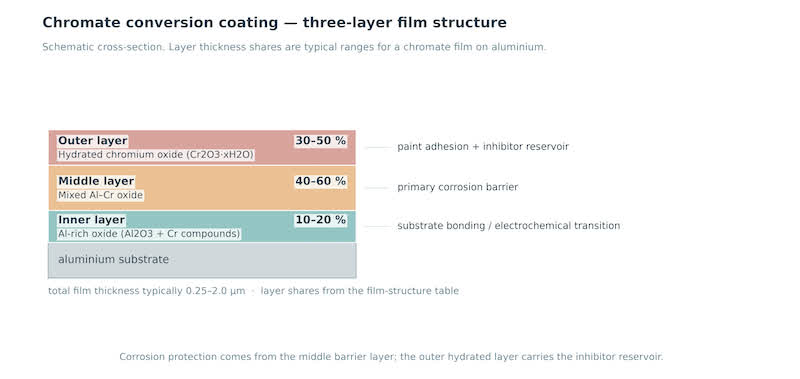
Figure 1. Cross-section of a chemical conversion coating on aluminum: the film sits as a thin layered system over the base metal.
| Requirement | Class 3 | Class 1A |
| Contact resistance ceiling | 5;000 µΩ | Not specified |
| Salt spray; ASTM B117 | 24 hours minimum | 168 hours minimum |
| Coating weight | No minimum specified | 40 mg/ft² (430 mg/m²) minimum |
| Typical film thickness | 0.05 – 0.5 µm | 0.5 – 2.0 µm |
| Dimensional change per surface | under 0.1 µm | under 0.5 µm |
Control Point 1: Deoxidize to the Alloy, Not to the Clock
Every conversion coating starts as a reaction with clean aluminum. The deoxidizer removes the smut left by caustic etch and the oxide that grew while the part sat between operations. Time on the clock is a poor guide, because the amount of smut depends on the alloy.
Copper-bearing alloys are the usual trouble. On 2024, the copper-rich intermetallics resist conversion and leave a patchy film, so the deoxidize step must be aggressive enough to expose a clean matrix without smearing copper across the surface. On 7075, the zinc and copper together push contact resistance up even when the film looks perfect. A356 castings are worse: silicon does not react, and a standard deoxidizer leaves islands that never coat.
| Alloy | Film quality for Class 3 | Typical contact resistance | What goes wrong |
| 1100 | Excellent | 600 – 1;200 µΩ | Nothing; it is the reference alloy |
| 6061-T6 | Excellent | 800 – 2;000 µΩ | Rarely the problem |
| 5052-H32 | Good | 1;000 – 2;200 µΩ | Uniform film; weak on heavy smut |
| 2024-T3 | Good to fair | 1;500 – 3;500 µΩ | Copper smut; patchy conversion |
| 7075-T6 | Fair | 2;000 – 4;500 µΩ | Zinc and copper raise resistance |
| A356 cast | Poor to fair | 3;000 – 5;000+ µΩ | Silicon islands resist conversion |
Those ranges come from production lots, not lab coupons. The spread inside a single alloy is wide enough that the only honest way to hold 5,000 µΩ on 7075 is to run it, measure it, and keep the deoxidize step under control.
Control Point 2: Stay Inside the Bath Window
The process window for Class 3 is narrow in one direction only. Too little immersion and the film is incomplete: bare spots, no corrosion protection, adhesion failures downstream. Too much immersion and the coating weight climbs, the film turns from clear to a darker gold, and contact resistance climbs with it. That second failure is the one that ruins good parts, because the parts look fine.
| Parameter | Minimum | Target | Maximum |
| Solution temperature | 18 °C (65 °F) | 25 °C (77 °F) | 35 °C (95 °F) |
| pH | 1.3 | 1.6 | 1.9 |
| Immersion; Class 3 | 10 seconds | 20 – 30 seconds | 60 seconds |
| Rinse conductivity | — | under 50 µS/cm | 200 µS/cm |
| Drying temperature | Ambient | 40 °C | 60 °C |
pH is the parameter that drifts without anyone noticing. Baths loaded with dissolved aluminum creep upward, and a pH of 2.1 still coats parts. It just coats them thinner and slower, which operators answer by leaving parts in longer. Two small errors that cancel on appearance and stack up on resistance.
Drying temperature gets ignored until parts crack. Conversion coatings hold water, and driving them dry at 80 °C or above can craze the film. Forty degrees and moving air do the job.
Control Point 3: Rinse Quality is a Measured Number
Rinse water is where Class 3 quietly fails. Tap water carries calcium and chloride, and both leave residue in a film only a few tenths of a micron thick. Under 50 µS/cm is the target for the final rinse, 200 µS/cm the ceiling, and a tank that started a shift at 30 can finish it at 180 without a visible change. Log conductivity at the start of every shift and dump the rinse on a schedule. A conductivity pen costs less than one scrapped lot.
Control Point 4: Measure Contact Resistance the Same Way Every Time
The 5,000 µΩ limit only means something if the probe placement repeats. Two inspectors on the same part can differ by a factor of two if one presses on a coated area and the other hits a masked pad with a little more force.
Write the method down: which features get probed, how many readings each, dry or after a wipe. Then treat stored parts as their own case. Class 3 film grows oxide slowly in humid air, so a part reading 1,400 µΩ in week one can read 3,000 µΩ after a year in a coastal warehouse. TCP drifts a little faster than Type I, having no mobile chromium to repair a scratch.
Type I Against Type II, Decided by the Drawing Not the Shop
Type II TCP has largely replaced Type I on new programs, for the obvious reason: no hexavalent chromium, which means no REACH authorization problem and no special waste stream. It also has real limits.
| Property | Type I (Cr⁶⁺) | Type II (Cr³⁺ TCP) |
| RoHS / REACH | Not compliant | Compliant |
| Class 3 contact resistance | 800 – 2;500 µΩ | 1;200 – 3;500 µΩ |
| Salt spray; Class 3 | 48 – 120 hours | 24 – 96 hours |
| Scratch healing | Yes; chromate ions migrate | Limited |
| Typical shelf life | 12 months and up | 6 – 12 months |
The resistance gap is the part engineers miss. TCP runs 400 to 1,000 µΩ higher than hex chrome on the same alloy, still inside the 5,000 µΩ ceiling. It stops being comfortable on 7075 with a marginal deoxidize, which is where the choice between the two types turns into a final-test problem instead of a quoting decision.
The Machining Side Decides Half of It
Finishers inherit whatever the machine shop left behind. Three things matter more than the rest.
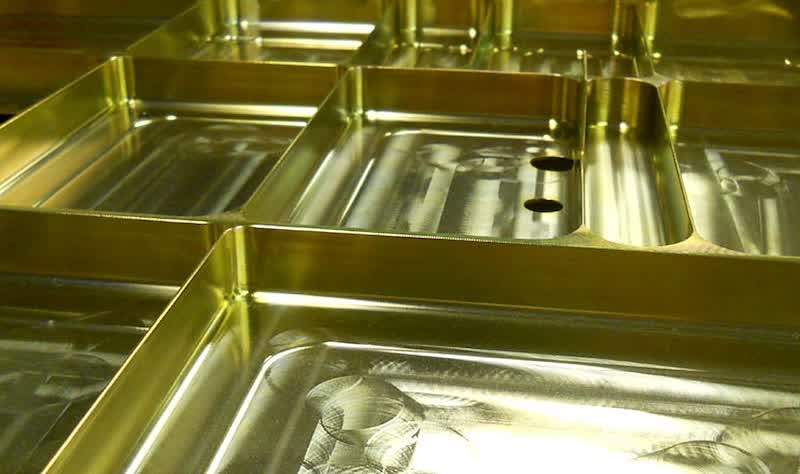
Figure 2. CNC-machined aluminum parts after chemical conversion coating.
Surface roughness sets the real contact area. For EMI gasket mating faces, 0.8 to 1.6 µm Ra gives the gasket something to bite into. For grounding pads, 0.4 to 1.6 µm Ra holds resistance down without polishing the surface so smooth that the coating struggles to anchor. A mirror finish on a bonding pad is not an improvement.
Residue is the second. Coolants carrying silicone, or heavy sulfur EP additives, leave films that survive a standard alkaline clean and then block conversion in patches. If a shop runs the same machine on both silicone-bearing and clean work, the finishing line pays.
Masking is the third, and it is where chem film jobs get expensive. Every masked hole, thread, and datum costs labor, and a part with twenty masked features can cost more to mask than to coat. Design reviews that move a ground pad off a sealed flange pay for themselves on the first order.
Acceptance Testing Worth Writing Into the Purchase Order
MIL-DTL-5541F leaves the test menu partly to the buyer. For Class 3 work, four checks cover the failure modes that actually show up.
Contact resistance, mandatory for Class 3, and the check that catches over-immersion. Salt spray at 24 hours per ASTM B117, which catches incomplete films and bad rinsing. Coating presence and continuity, judged visually for color and uniformity on a coupon from the same load. Adhesion, usually by tape test on a witness coupon, which catches the deoxidize step that ran short.
Coating weight is optional for Class 3 and rarely worth arguing, since there is no minimum to hold. Ask for contact resistance on a defined feature set instead.
What to Put on the Drawing
One line, three decisions: type, class, and what stays conductive.
"Chemical conversion coating per MIL-DTL-5541F, Type II, Class 3. Mask threads and bores as indicated. Contact resistance 5,000 µΩ maximum at grounding pads A and B. Rinse water conductivity to be recorded per lot."
That last sentence is not standard practice, and it should be. The number is cheap to log, and when a lot fails six months later, the log answers the first question everyone asks: was it the coating, or the storage?
Where Batches Actually Fail
In production, the failures I have seen break down like this: pretreatment problems outnumber bath chemistry problems, and those outnumber specification problems. The tank is usually doing what it was told—the steps before it were not.
Fix the deoxidize step per alloy, log rinse conductivity, hold immersion inside 20 to 30 seconds, and probe the same feature the same way every time. The other variables get much easier after that.
Jon Wu handles technical quoting at JLYPT, a machining and surface finishing shop in Shenzhen. Most days, the problem is the same from two sides: what the drawing asks for and what the part does once it goes into the tank. Email him at service@jlypt.com and visit www.jlypt.com.