


The ability to test, validate, and refine finishing processes before they ever hit a production line has become invaluable.
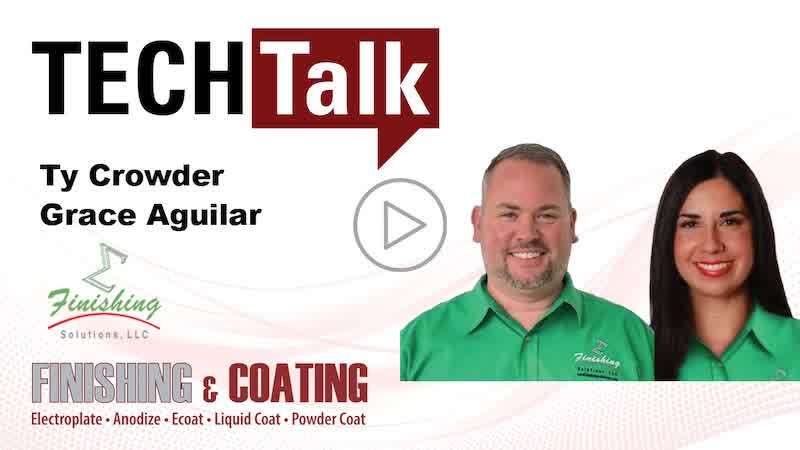
That’s exactly the philosophy driving the evolution of the new lab facility at Total Finishing Solutions—a rapidly expanding, hands-on environment designed to bridge the gap between theory and real-world application.
Located in Vancouver, just across the river from Portland, the Total Finishing Solutions (TFS) lab has quietly grown into one of the most versatile testing and training centers in the finishing industry. What began as a modest operation has transformed into a nearly 20,000-square-foot space of equipment, classrooms, and collaborative spaces—purpose-built for customers who want more than a brochure or a video.
“We opened up the lab about two years ago,” says Ty Crowder, President of TFS. “But it’s been a long-term project to get it to the state that it’s at now, where I feel it’s a fully operational Death Star now—we’re ready to fire.”
A Lab Built for Real-World Validation
 Crowder’s tongue-in-cheek analogy underscores a serious point: the TFS lab is designed to replicate real production environments as closely as possible. Rather than theoretical demonstrations, customers are encouraged to bring their own parts, coatings, and challenges into the facility.
“We invite the customers in,” Crowder says. “They’re able to have a day or two in the lab personally using all the equipment where they’re getting training. They’re able to see the ease of use, really validate any of their concerns.”
This hands-on validation addresses a persistent issue in capital equipment sales—uncertainty. No matter how detailed a proposal may be, most buyers eventually ask the same question: Where can I see it run?
At TFS, the answer is simple: right here, with your own product.
“Most commonly, the customers will ship in their own paint and their own parts,” Crowder says. “And then we run their actual production here.”
Three Labs, One Integrated Vision
 The TFS facility is divided into three primary lab environments, each designed to address specific segments of the finishing process: particle (powder), horizontal liquid, and vertical liquid applications. Together, they create a comprehensive ecosystem for testing nearly any finishing scenario.
The particle lab focuses on dry materials and surface preparation—an essential foundation for any successful coating system. Here, TFS has assembled a range of equipment tailored for both powder coating and substrate preparation, particularly for wood and millwork applications.
“We have basically three parts to the lab, and the particle lab is dedicated to dry materials,” Crowder says.
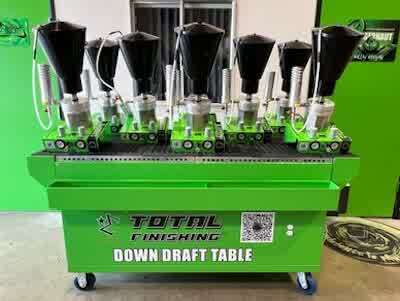
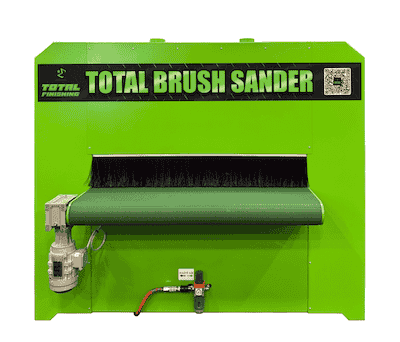
The space includes specialized sanding systems for cabinetry, doors, and face frames, as well as a custom downdraft table for manual work and training exercises. Powder coating capabilities are equally robust, featuring quick-change color booths, batch curing ovens, and cartridge-style spray systems.
Perhaps most notably, the lab integrates infrared curing technology, allowing users to test both powder and liquid coatings under controlled, high-efficiency conditions.
“We can actually go cure liquid or powder coating parts with infrared in the lab as well,” Crowder notes.
On the liquid side, the horizontal lab showcases advanced automation designed to reduce labor while improving consistency.
At the center of this space is TFS’s flat line automation system—an award-winning piece of equipment recognized at the International Woodworking Fair 2024.
“That’s a flat line made in Italy with a material handling system that will allow one operator to use the machine,” Crowder explains. “It basically will automatically spray the parts and rack them without any extra humans to move parts around.”
“If they say they want to buy a large system and then they want to send employees back for training, we can set up ancillary training right here on site,” Crowder says. “They can be pre-trained before it even arrives.”
Complementing the flat line are additional lineal spray systems and a flood-and-brush machine optimized for exterior stain applications. Together, these tools allow customers to evaluate throughput, finish quality, and labor efficiency in a controlled setting.
The vertical lab brings automation to another level, incorporating robotics, conveyorized systems, and high-temperature curing capabilities.
A standout feature is the Elio robotic spray system, which uses a teach-and-repeat model that lowers the barrier to entry for automation.
“Basically, if you can run an iPhone, you can run that robot,” Crowder says. “You go in the first time, put it in teach mode, do the painting motion yourself—it records everything. Then you can play it back and even increase the speed.”
The lab also includes a 16-foot open-face spray booth, lineal spray machines, and a chain-on-edge conveyor system capable of simulating a wide range of production speeds. An integrated infrared tunnel enables curing at temperatures of 500–600 degrees, supporting both liquid and powder applications.
Training Meets Technology
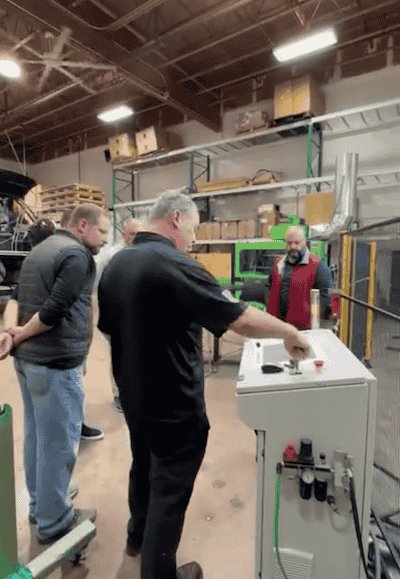 A defining feature of the TFS lab is its seamless integration of classroom learning with hands-on experience. Two classrooms sit between the powder and liquid labs, enabling immediate transitions from theory to practice.
“We can come in and do sit-down blackboard video-type presentations and then go right out into either the liquid or powder labs and do hands-on,” Crowder says.
This hybrid approach is increasingly important in an industry facing ongoing labor challenges. As companies struggle to recruit and retain skilled operators, structured training becomes a competitive advantage.
“If they say they want to buy a large system and then they want to send employees back for training, we can set up ancillary training right here on site,” Crowder says. “They can be pre-trained before it even arrives.”
For manufacturers, this eliminates a costly and often risky phase—learning new equipment on the production floor.
For Grace Aguilar, Marketing Specialist at TFS, the lab has become one of the company’s most powerful differentiators.
“I think that it’s been a really key thing for customers to come out and be able to see it for themselves,” Aguilar says. “We’ve had quite a few customers in the last few months just come out for a day or two and explore all the equipment that we have.”
Unlike traditional marketing materials, the lab offers a fully immersive experience—one that engages all the senses and builds confidence in purchasing decisions.
And in an industry where equipment investments can reach into the hundreds of thousands—or even millions—of dollars, that level of confidence is critical.
The “Armory”: A Side-by-Side Equipment Experience
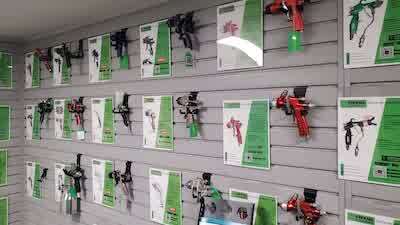
 Another unique feature of the TFS lab is what Crowder calls the “armory”—a collection of more than 85 manual and automatic spray guns available for direct comparison.
“We have an armory room that has over 85 different manual and automatic spray guns, and they’re all for use,” he says.
This setup allows customers to conduct true side-by-side evaluations, something that is rarely possible when working directly with individual manufacturers.
“Normally, you’re going to a training at an equipment manufacturer, right? So you’re only going to see their guns,” Crowder says. “When you come here, you have access to take everything side by side and go do a spray-up for yourself.”
For operators, the difference often comes down to feel and technique—factors that can’t be evaluated through specifications alone.
Beyond hands-on training, TFS has invested in documenting the learning process itself. The lab includes a full media setup, allowing sessions to be recorded and archived for future use.
“We have a full camera crew available with all the tripods and lighting,” Crowder says. “We’ll record training or lab demos.”
This capability provides ongoing value for customers, who can revisit training sessions, share them internally, and reinforce best practices long after leaving the facility.
“When the customer gets back, and maybe they had a question, we can actually have it all cataloged and ready for them,” Crowder says.
A Collaborative Hub for the Industry
Rather than developing a proprietary training curriculum, TFS is taking a collaborative approach—inviting coating manufacturers and industry partners to use the facility for their own programs.
“I really am trying not to run a curriculum because I want the people who are selling the coatings to be involved here and to have a space to use jointly with us,” Crowder says.
This open model positions the lab as a neutral ground where equipment, coatings, and processes can be evaluated together—mirroring real-world conditions more accurately than isolated testing environments.
Looking ahead, TFS plans to align the lab with industry training organizations, potentially adding it to the rotation of recognized educational facilities.
“Not only do we put paint on, but we can also take it off now, too,” Crowder says. “We can actually come here and prep with it, remove rust, and make a surface profile even with a laser.”
Interestingly, the lab's origins were less about strategy and more about circumstance.
“I was living in California, and I needed a shop,” Crowder says. “So, out of boredom, I made this place.”
What began as a 70-by-30-foot bay has since expanded dramatically, growing organically as new equipment and opportunities emerged.
“Every time some piece of equipment comes out, I’m like, ‘Yeah, I need that.’ We need more space,” he says. “We’ve been blowing out a wall and expanding. Everyone was like, that’s so much space—what are you ever going to put in there? And now it’s almost full.”
Looking Ahead: Continuous Innovation
If the lab’s past is defined by rapid growth, its future will be shaped by continuous innovation. Crowder’s strategy is straightforward: identify emerging technologies and integrate them into the lab as quickly as possible.
“I think there’s always new equipment to market, and our plan is always to be the first in that technology and bring it here,” he says.
One recent addition is laser ablation technology, which allows users to remove coatings, rust, and contaminants without traditional media blasting.
“Not only do we put paint on, but we can also take it off now, too,” Crowder says. “We can actually come here and prep with it, remove rust, and make a surface profile even with a laser.”
The Total Finishing Solutions lab represents more than just a collection of equipment—it reflects a shift in how the finishing industry approaches education, validation, and collaboration.
By combining real-world testing, hands-on training, and open access to a wide range of technologies, TFS has created a model that addresses some of the industry’s most persistent challenges: workforce development, process consistency, and investment confidence.
For customers, the value is clear. As Aguilar puts it, “It’s been a very nice feature to have.”
For the industry, it may signal something larger—a move toward more transparent, collaborative, and experience-driven decision-making.
And for Crowder, the mission remains ongoing.
“Anytime we see some kind of new technology,” he says, “we’re going to bring it in.”