

A finisher who had just been transferred to the plating department of a facility wrote to me asking about magnetism.
 Frank Altmayer“We perform electroless nickel plating for an application requiring close control over magnetic properties,” he wrote. “I’ve just been transferred into the plating department, and frankly, I don’t have a clear understanding of what magnetism even is. Aside from heat treating, are there any other ways or methods for increasing or changing the magnetism in a high or mid-phos electroless nickel plating?”
Metals fall into three levels of magnetic properties:
- Diamagnetic metals have feeble magnetic fields and are generally repulsed by the field. Examples are copper, silver, gold, and bismuth.
- Paramagnetic metals have a small positive magnetic susceptibility, and most metals fall into this category, including lithium, sodium, potassium, calcium, strontium, magnesium, molybdenum, and tantalum.
- Ferromagnetic metals exhibit a strong positive magnetic susceptibility. Included in this group are iron, cobalt, nickel, and gadolinium. Iron alloys containing these metals, manganese, or chromium are also ferromagnetic. A feature of ferromagnetic metals is that they retain some or all of their magnetism after the magnetic field has been removed.
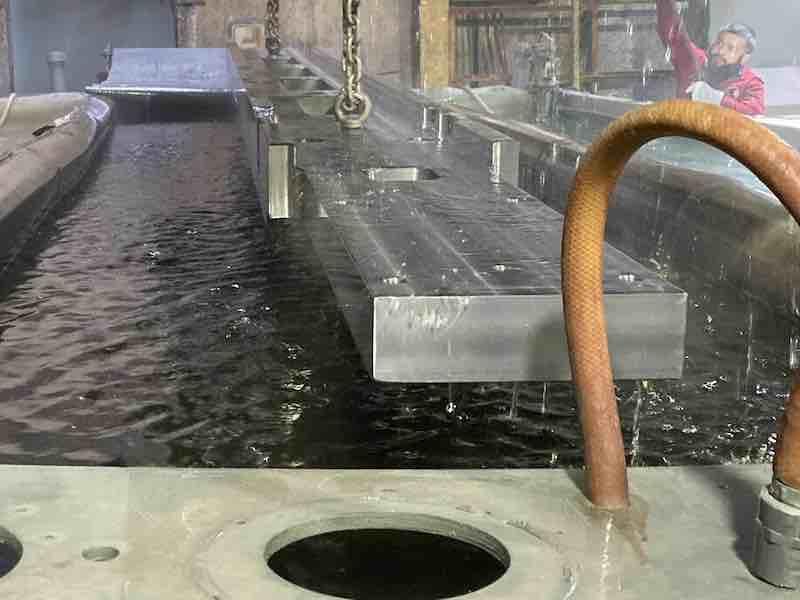
Main image courtesy of Electro-Coatings, https://www.electro-coatings.com.
Magnetic Properties
The magnetic properties of electroless nickel deposits depend upon the crystal structure of the deposit, the alloy, and, to some degree, the conditions under which plating occurred (pH, temperature, chemical composition, etc.). Crystalline electroless nickel deposits are ferromagnetic, while amorphous (no structure) deposits are considered nonmagnetic.
Magnetic properties include coercivity, the external magnetic field required to demagnetize the deposit. Coercivity is measured in Oersteds. Electroless nickel deposits ranging from 0-80 Oersteds have been reported. Another magnetic property is the remnant flux density, the amount of magnetism remaining when an external magnetic field is removed.
The remnant flux density is measured in gauss. For example, the remnant flux density of electroless nickel after heat treatment ranges from 1000 to 3000 gauss. Electroless deposits between 3-6% have coercivities of 20-80 Oersteds, and 7-9% have a coercivity of 12 Oersteds. Heat treatment increases coercivity (magnetism) to 100-300 Oersteds.
There is also the saturation magnetization property of a metal, which is measured in gauss/cc, emu (electromagnetic units)/cc, or emu/g.
Modified Levels
The level of magnetism can be reduced/modified by the incorporation of certain nonmagnetic elements in the electroless deposit. These elements include phosphorus, molybdenum, boron, and thallium. Electroless nickelphosphorus alloys become nonmagnetic when the phosphorus content in the alloy is greater than 8%.
Theoretically, the electroless deposit can be made nonmagnetic at a lower %P content if another element (such as boron, molybdenum, or thallium) that affects magnetism is alloyed into the deposit along with the phosphorus. In general, these tertiary alloying elements need to be present at concentrations much greater than 1% to affect the magnetic properties of the electroless nickel-phosphorus deposit.
The deposit can be made more magnetic by plating a ferromagnetic alloy, such as cobalt, on the alloy. For example, the level of magnetism can be controlled by plating specific cobalt-nickel-phosphorus alloys. Such alloys have been used in computer data storage devices (hard drives).
Other Data
In the AESF book, Electroless Plating, edited by Haydu and Mallory, page 265 indicates that “a variety of interesting and useful magnetic properties can be obtained by addition of other metal ions to the typical alkaline-ammoniacal electroless cobalt bath to form ternary alloy deposits. Addition of 10 g/L sodium tungstate dihydrate or 0.8 g/L potassium perrhenate to a typical bath at pH 8.9 and 98°C resulted in deposits containing 9% tungsten and 30% rhenium.”
No mention is made of the impact on magnetism following these statements, but the implication is that these alloys (iron and zinc are also mentioned) affect magnetic properties.
Safranek’s book, The Properties of Electrodeposited Metals and Alloys, provides a table of coercivity of electroless nickel and nickel-cobalt alloys. The reported data include “0” values for 1017% phosphorus electroless nickel deposits. Safranek wrote: “Although several reports state that electroless nickel becomes nonmagnetic when its phosphorus content reaches 9%, a field of 6,500 gauss showed slight magnetization for alloys containing <15% (less than 15% phosphorus. Magnetization approached zero at 15% phosphorus.”
The substrate plays no role in the magnetism of the EN deposit if it is a nonmagnetic substrate such as aluminum. If the substrate is magnetic, it will generate a magnetic field that can induce additional magnetism in the EN deposit. Stainless steel can be magnetic (400 series) or nonmagnetic (300 series).
Frank Altmayer is a Master Surface Finisher, an AESF Fellow, and the technical education director of the AESF Foundation and NASF. He owned Scientific Control Laboratories from 1986 to 2007 and has over 50 years of experience in the metal finishing industry. He received the AESF Past Presidents Award, the NAMF Award of Special Recognition, the AESF Leadership Award, the AESF Fellowship Award, the Chicago Branch AESF Geldzahler Service Award, and the NASF Award of Special Recognition.