

James Simonelli’s appointment as executive director of the Metal Finishers Association of California isn’t just a change in leadership, but a natural continuation of a relationship decades in the making.
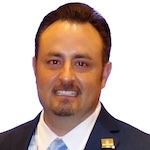 James SimonelliSimonelli formally assumed the role on January 1, following MFAC board approval the previous fall and a transition period with longtime executive director Brian Leiker. But his connection to the metal finishing industry stretches back nearly three decades through his work with the California Metals Coalition, where he has spent much of his career advocating for the broader metals sector.
Looking back, Simonelli says his journey into the industry began almost immediately after graduate school, almost 30 years ago, with the California Metals Coalition. This umbrella group covers foundries, heat treaters, forging, fabricating, and machinists. CNC.
For years, the coalition and California’s metal-finishing sector operated in proximity, often facing the same regulatory issues and serving many of the same customers. The relationship grew naturally as the industries realized their interests were aligned.
“We are always very close with the metal finishers because that’s part of our industry and our group,” Simonelli says. “Either they’re customers, or we need their services.”
Now, with Simonelli officially leading MFAC while continuing his work with the coalition, the partnership between the two organizations has become more formal—and more important than ever.
A Natural Partnership Years in the Making
 Simonelli started with the California Metals Coalition almost 30 years ago, an umbrella group that covers foundries, heat treaters, forging, fabricating, and machinists. CMC that represents about 315,000 workers in a $75 billion industry.Simonelli’s leadership comes at a time when collaboration across the metals industry has become essential. Over the past several years, companies have increasingly joined both MFAC and the California Metals Coalition, recognizing the value of a unified voice when facing regulatory challenges.
Several companies were part of the Metal Finishing Association chapters in California, but also worked closely with the California Metals Coalition, and then joined that group as well. Simonelli says these were key companies in the trade associations that saw the need to balance both overall.
That cross-membership created a network of businesses that understood the value of combining resources and knowledge.
“The metals industry is a close-knit industry,” Simonelli says. “When you bring people together, it doesn’t take long to realize we’re all pretty much working together with the same people and the same issues.”
Those shared issues ultimately set the stage for Simonelli’s leadership role.
The first discussions about strengthening the relationship between the organizations began around 2023, as regulatory pressures mounted on several sectors of the metals industry.
“I would say right around 2023 is when the initial discussion started,” Simonelli says. “One of the main reasons was just strength in numbers.”
The California Metals Coalition had grown rapidly by that time, representing companies across 17 different sectors of the metals industry. That growth created momentum that smaller, more specialized trade groups sometimes struggled to keep pace with.
“It only made sense for MFAC to be associated with a group that is literally a 360° full circle of the life for metal,” Guzman says. “It gives us a tremendous footprint in California, not only politically but also on the environmental side.”
“The California Metals Coalition has hundreds of facilities in it, and it had the mass and momentum,” Simonelli says. “The individual strains—it’s tough. You need to have money, you need to have resources, you need to have a groundswell of people.”
By 2024, conversations about deeper cooperation accelerated, culminating in MFAC’s decision to bring Simonelli on as executive director in 2025.
The timing was no coincidence.
Strength in Numbers
 Vince NoonanJust as those discussions were unfolding, California’s metal finishing industry found itself in the middle of one of the most consequential regulatory battles it has ever faced.
Vincent Noonan, Vice President of Strategic Operations for Sheffield Platers in San Diego, says the California surface finishing industry operates in one of the most complex regulatory environments in the country, which requires leadership that understands both the technical realities of our industry and the policy landscape in which we operate.
“James brings that balance,” says Noonan, who is on the MFAC board and is also on the NASF national board. “His 20+ years leading associations closely connected to our industry, along with his experience working with policymakers in Sacramento, made him the right choice to lead MFAC at a critical time. Our members need strong, credible representation, and James is well-positioned to deliver that.”
 Justin GuzmanJustin Guzman, President of Aircraft X-Ray in Huntington Park, and a former MFASC chapter president, has known Simonelli for several years and joined the CMC several years ago. He spearheaded efforts to get Simonelli to lead the metal finishing group, too, because of his involvement in metal shredding, casting, foundry, heat treating, and recycling in sustainable aluminum manufacturing.
“It only made sense for MFAC to be associated with a group that is literally a 360° full circle of the life for metal,” Guzman says. “It gives us a tremendous footprint in California, not only politically but also on the environmental side. We’re able to leverage our audience and have fantastic conversations, helping members maneuver through this very difficult universe of environmental regulation, as we all know.”
The California metals industry accounts for 315,000 jobs and a total economic impact of $75 billion, which Guzman says is definitely a strength in numbers.
“It now makes us the 800-pound gorilla in the room,” he says. “It has often seemed like all environmental battles are fought in California. But now we don’t stand alone—we stand shoulder to shoulder with colleagues, customers, and vendors across the entire metals industry.”
The CARB Chromium Rule
 The CARB rules were aimed at reducing emissions of the toxic compound, and set strict new limits.In 2023, the California Air Resources Board (CARB) approved sweeping new regulations targeting the use of hexavalent chromium in plating and finishing operations.
The rules, aimed at reducing emissions of the toxic compound, set strict new limits and effectively require many facilities to transition away from hexavalent chromium processes or invest heavily in new control technologies.
Compliance deadlines begin arriving in 2027. For many in the industry, the regulations represent a defining moment.
Simonelli sees the CARB rule as part of a broader regulatory pattern rather than a one-off event.
“Each sector that I’ve dealt with goes through a similar process where a government agency will look at a sector,” he says. “They might look at recycling, shredding, heat treating, and metal melting. But what you find is that the approach from the government is very similar.”
The challenge often centers on chemicals considered hazardous to workers or nearby communities.
“Especially when they look at a toxic chemical or something with inhalation issues for communities,” Simonelli says.
The lesson he draws from decades of regulatory battles is that industries must respond proactively rather than reactively.
“The industries that get ahead of that, the industries that look at it and say, ‘Okay, we’ve seen this impact other sectors,’ are the ones that survive,” he says.
“In a matter of hours, they become the experts,” Simonelli says of community groups. “They go to their city council or county and say, ‘I have a concern because I have this facility in my area.’”
In California, scrutiny of hexavalent chromium has been building for more than a decade.
“There was a ton of movement right around 2015 and 2016 under hexavalent chromium,” Simonelli says. “It impacted a few sectors, but it wasn’t long until it impacted all of them.”
By the time CARB finalized its rule in 2023, the debate had already been underway for years.
Still, Simonelli worries that some companies underestimate how quickly regulatory expectations can shift.
“Industry sometimes thinks there’s going to be an end,” he says. “They think their shop is going to comply, and that’s it. The reality is the companies that have survived this latest round have invested in the controls and invested in the solutions.”
A National Ripple Effect
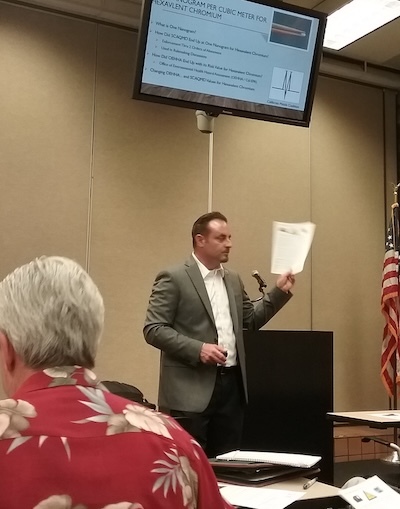 Simonelli’s leadership comes at a time when collaboration across the metals industry has become essential.While the CARB rule directly affects California facilities, its impact is already spreading beyond the state. Several other states are examining similar regulations, including Colorado, which has signaled it may adopt language similar to California’s chromium restrictions.
Simonelli believes that the trend should capture the attention of finishing companies nationwide.
“If there are companies in California that have already put in controls or already made changes, that’s going to be the new bar,” he says. “That’s where everything goes. It doesn’t fade away from that.”
Regulatory momentum, he said, often begins at the local level before expanding statewide and eventually nationally.
“It’s going to start local,” Simonelli says. “It’s going to start with your local community.”
In today’s information environment, community groups and local officials can quickly access technical information about industrial processes.
“In a matter of hours, they become the experts,” Simonelli says. “They go to their city council or county and say, ‘I have a concern because I have this facility in my area.’”
That dynamic places responsibility on companies to stay informed and engaged.
“There is a responsibility to know,” Simonelli said. “Businesses can’t play catch-up.”
Challenging the Science
 Simonelli helped foster a scientific study that analyzed extensive data about worker exposure levels, health outcomes, and environmental conditions.Although the CARB rule is now in place, MFAC and the California Metals Coalition continue to challenge the regulation's scientific basis.
Their argument centers on the age of the data used to establish exposure risks.
“It’s 40-year-old data,” Simonelli says. “It was mined from workers from the 1930s and 1940s.”
Modern plating operations, he argues, bear little resemblance to industrial workplaces of nearly a century ago.
“The workers from the 1930s and 1940s are not the workers that are in the 21st century,” Simonelli says. “The controls we have and the science we have—the ways to measure exposure—are completely different.”
To build a stronger scientific foundation, the coalition launched a major research effort in 2020 examining thousands of workers exposed to hexavalent chromium in metal facilities.
The project required a significant financial commitment.
“We spent over a million dollars on this,” Simonelli says.
The study analyzed extensive data about worker exposure levels, health outcomes, and environmental conditions.
“How long were they exposed? What were the levels of exposure? Did they smoke? Did they not smoke?” Simonelli says. “All the things that proper science goes into.”
“We spent a million dollars on a single study. We didn’t have a million dollars sitting in the bank. We had to raise it. That’s the only way it gets done.”
After years of analysis and peer review, the research was published in 2025.
“It took almost 16 months for third-party reviewers at the Journal of Occupational and Environmental Hygiene to pick apart the study,” Simonelli said. “That’s the beauty of coming up with a good final product.”
The findings now serve as the industry’s scientific foundation for discussions with regulators.
“We can stand in front of any government agency and hold this up and say it is better than anything that’s out there,” Simonelli says.
Still, changing regulatory frameworks takes time.
“Government is often an evolving process,” he says.
Building a Unified Industry Voice
Beyond the chromium fight, Simonelli’s broader goal as MFAC’s executive director is to strengthen cooperation across the industry—from local chapters to national organizations.
One of his first moves in the role was reaching out to leaders at the National Association for Surface Finishing (NASF).
“I reached out to Craig Addington, the executive director of NASF, and said, ‘Let’s work together,’” Simonelli says. “The NASF pledged funding to support us.”
For an industry composed largely of small and mid-sized businesses, pooling resources is essential.
“You spend half a million dollars without thinking about these things,” Simonelli says. “We spent a million dollars on a single study.”
That kind of funding rarely exists in association bank accounts.
“We didn’t have a million dollars sitting in the bank,” he says. “We had to raise it. That’s the only way it gets done.”
The Role of Trade Associations
 Simonelli also emphasizes the importance of professional advocacy in regulatory battles.
Many trade associations rely heavily on volunteer leadership from company executives, but he believes complex policy issues require dedicated expertise.
“Government relations is an area of expertise,” Simonelli said. “In California alone, there are 120 legislators and about 2,000 lobbyists. Anecdotes are not going to win the day. Saying ‘I’m a great employer’ might get you a few nods, but that’s not what wins.”
Instead, successful advocacy combines technical expertise, legal strategy, and grassroots industry participation.
“The volunteers are essential,” Simonelli says. “But you also need people who understand how to navigate the agencies.”
“I also hope he can help support growth within the association and assist in recruiting new members and potential board members,” Guzman says, “even though we all know that can sometimes feel like an almost impossible mission.”
As Simonelli settles into his role as MFAC's leader, he remains optimistic about the industry’s future despite regulatory challenges.
The key, he believes, lies in preparation and collaboration.
“The information is out there,” he says. “The time is of the essence. The ones who are reading about it, researching it, talking to engineers—those are the ones who will be prepared.”
For the metal finishing industry, the stakes extend far beyond California.
“This is going to go national,” Simonelli says, adding that the reality underscores the importance of building strong alliances across the industry. “The chapters, the national groups, the state groups—they have to work together.”
Simonelli’s leadership reflects that philosophy.
“I never want to be the one who comes in and dismantles things,” he says. “I want us to be a magnet with each other and join forces.”
Near-Term and Long-Term Goals
 MFAC board members with Simonelli, far left.Noonan says that, in the near term, he would like to see Simonelli continue to strengthen engagement with its members and ensure their concerns are represented with regulators and policymakers in Sacramento.
“Our industry is essential to advanced manufacturing, yet it’s often castigated or misunderstood, so strong, informed advocacy is imperative,” he says. “I’m also encouraged by the early steps he’s taken to strengthen the relationship between MFAC and the National Association for Surface Finishing. Alignment between the California chapter and NASF helps ensure California’s unique challenges are heard nationally while allowing our industry to speak with a unified voice.”
Guzman adds that, in the near term, he would like for Simonelli to bring a new perspective and share his knowledge with the MFAC group.
“I also hope he can help support growth within the association and assist in recruiting new members and potential board members,” he says, “even though we all know that can sometimes feel like an almost impossible mission.
In the long term, Noonan would like to see MFAC continue to expand its role as both an advocate and a resource for the industry, supporting workforce development and reinforcing the essential role that surface finishing plays in the U.S. manufacturing supply chain.
Guzman says he would like to see Simonelli contribute to strategic initiatives and play an active role in supporting the MFAC’s mission and future success.
“His knowledge and experience will be valuable in helping guide the direction and continued growth of the association,” he says.
In an era of increasing regulatory scrutiny, that unified approach may prove to be the industry’s most powerful tool. And as he begins his tenure at MFAC, Simonelli knows the challenges ahead will demand both patience and persistence.
“Time is a funny thing,” he says. “You tell people something is going to take a couple of years, and they say, ‘How about next quarter?’ This battleship moves one degree at a time.”