

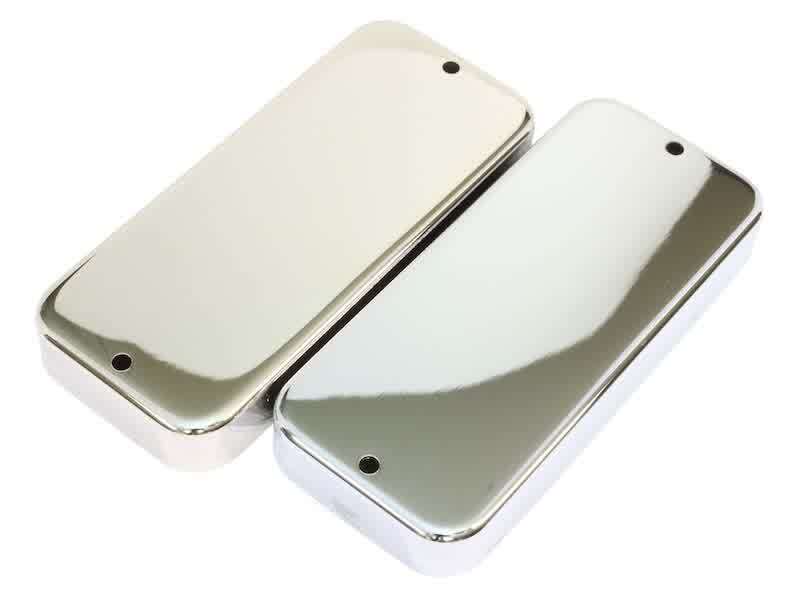
A reader needed some help with a corrosion issue, as it seems that one of their competitors was able to deposit nickel and chromium onto their parts, achieving a significantly higher level of corrosion resistance than the finish they are applying.
 Frank AltmayerThe reader says they had a sample of their competitor’s part tested by a laboratory, and were told that the competitor’s part has much more nickel than theirs. They had an uneasy feeling that the added thickness was not the whole story and wanted a second opinion.
The part they sent me had a significantly thicker plating. And they are right; that is not the whole story. It seems that the laboratory they used did not etch the part's cross-section to reveal the plating layers. For a nickel-chromium-plated part, a typical etchant we use is 2/3 acetic acid and 1/3 nitric acid. About three to five seconds in this acid will reveal the layers of nickel. Dull or semi-bright nickel typically will have an amorphous structure, while bright nickel will have a laminar appearance.
Under the metallograph, each layer of nickel can then be measured. This is important because nickel is not a sacrificial coating for steel substrates. To achieve significant corrosion protection, the nickel deposit must be relatively thick (to eliminate or minimize microscopic porosity). Further, for higher levels of corrosion protection, multiple layers of nickel are used.
Duplex Nickel
The most common multiple-nickel-layer system employed on decorative parts is often called “Duplex Nickel.” This is a layer of semi-bright nickel followed by bright nickel. An excellent specification for nickel-chromium electrodeposits is ASTM B456. This specification classifies these coatings into SC1 through 5, with 5 being the highest level of corrosion protection. As an example for SC5, the total nickel thickness should be a minimum of 1.4 mils, and the semi-bright nickel should be at least 75% of this total thickness (almost 1 mil).
Their competitor is applying about 0.3 mils of semi-bright and 0.6 mils of bright. Their parts are plated with 0.2 mil of semi-bright and 0.3 mil of bright, which helps explain some of the difference in salt spray performance.
STEP Value
Next we need to discuss the STEP value. Duplex nickel should be applied from solutions with additive packages formulated to produce a voltage step between the bright and semi-bright layers when tested with a “STEP tester” (STEP stands for Simultaneous Thickness and Electrochemical Potential). The additive package produces semi-bright nickel free of sulfur (<0.005%), whereas the bright nickel contains at least 0.04% sulfur. With this combination, the bright nickel will act as a sacrificial metal relative to the semi-bright nickel, causing corrosion to drift sideways rather than downward toward the base metal. Therefore, it prolongs the time to base metal corrosion. ASTM does not mandate a specific STEP voltage. Still, it indicates that 100- 200 mV is generally agreed to be generated between the semi-bright and bright nickel layers for optimal corrosion performance.
To make this discussion more general, platers are applying more than two layers of nickel. For those applying semi-bright, followed by high sulfur, followed by bright nickel, the STEP between the high sulfur and the bright nickel should be 15–35 mV, with the high sulfur nickel more active than the bright nickel. For those plating Duplex nickel followed by particle nickel before chromium, the STEP between the bright nickel and the particle nickel may be 035 mV, with the bright nickel more active than the particle nickel. When we tested their competitor’s part, it had a STEP of 150 mV, while the deposits they are applying have a STEP of only 10mV.
This means that their competitor has two advantages over their product: more thickness and the correct electrochemical potential. The added thickness is relatively easy to correct for. Still, they will need to contact their supplier of additives for their nickel plating solution to discuss ways of correcting the faulty STEP results.
I recommended they consider obtaining a STEP testing instrument to monitor the electrochemical potential of the duplex nickel they are applying.
Frank Altmayer is a Master Surface Finisher, an AESF Fellow, and the technical education director of the AESF Foundation and NASF. He owned Scientific Control Laboratories from 1986 to 2007 and has over 50 years of experience in the metal finishing industry. He received the AESF Past Presidents Award, the NAMF Award of Special Recognition, the AESF Leadership Award, the AESF Fellowship Award, the Chicago Branch AESF Geldzahler Service Award, and the NASF Award of Special Recognition.