


When representatives from Boeing arrived at 3P Processing in Wichita, Kansas, several years ago, they delivered a message that left Terry Karst both surprised and humbled.
The aerospace giant had begun visiting processing suppliers to better understand their capabilities and performance. During the conversation, Karst asked how many processors Boeing had visited as part of the effort.
“The answer caught me off guard,” he recalled. “They said, ‘You’re the first one.’ Then they told me they considered us one of the top processing houses in their supply chain.”
For Karst, who officially retired in June after a 40-year manufacturing career and 18 years as President at 3P Processing, the recognition represented much more than a compliment. It reflected years of investment in people, processes, metrics, and continuous improvement at a company that grew into one of the largest independent aerospace finishing operations in the United States.
Looking back from retirement, Karst sees his career not as a story about one individual but as a journey shaped by mentors, employees, and a team that transformed a Wichita finishing operation into a nationally recognized aerospace supplier.
 3P Processing was founded in 2012. The operation began in 1974 as Air Capital Plating, a small finishing business that expanded steadily over the decades by acquiring neighboring buildings and increasing its capabilities.
A Company Built on Aerospace Heritage
Although 3P Processing was founded in 2012, its roots stretch much further back. The operation began in 1974 as Air Capital Plating, a small finishing business that expanded steadily over the decades by acquiring neighboring buildings and increasing its capabilities.
By the time Karst arrived, the facility had already undergone several ownership changes and carried a long history within Wichita’s aerospace community. The operation eventually evolved into 3P Processing, a name inspired by the company’s mission.
“We process parts, we’re focused on performance, and we’re here to solve problems,” Karst said.
“At first, I didn’t know a great deal about finishing. I understood specifications from the engineering side, but I hadn’t worked directly in the processing business.”
The company’s footprint grew to approximately 115,000 square feet, with additional expansion opportunities nearby. More importantly, the facility became a critical supplier to aerospace manufacturers across the industry.
Unlike many processors that serve a handful of major customers, 3P Processing developed relationships throughout aerospace and defense. The company performed work for nearly every major aircraft and defense manufacturer, supporting programs connected to Boeing, Gulfstream, Cessna, Lockheed Martin, Sikorsky, and many others.
Managing requirements from so many original equipment manufacturers required a deep understanding of specifications, quality systems, and customer expectations.
“Every OEM has its own recipe,” Karst said. “People sometimes assume aerospace specifications are all the same, but they’re not. Learning all of those requirements was a significant challenge.”
From Engineer to Industry Leader
 3P Processing is a full-service provider of metal finishing, testing and inspection services to the aerospace and defense industry.Karst did not begin his career in finishing. He joined Boeing in Wichita in 1986 as an engineer, primarily working in material review and engineering support roles. While he gained valuable experience, he quickly realized he wanted to move into leadership rather than spend his career behind a computer designing components.
After earning an MBA, he transitioned to Honeywell, where he spent nearly a decade in the avionics sector. The move exposed him to broader management responsibilities and helped prepare him for future leadership roles.
Eventually, an opportunity arose to leave the corporate world and join a private-equity-backed aerospace operation. That decision ultimately brought him to the processing industry.
“At first, I didn’t know a great deal about finishing,” Karst admitted. “I understood specifications from the engineering side, but I hadn’t worked directly in the processing business.”
What he did possess was a strong understanding of aerospace requirements, engineering drawings, and customer expectations. Those skills proved invaluable.
According to Karst, many people who entered finishing management from other backgrounds lacked experience interpreting engineering documentation. His engineering experience allowed him to challenge assumptions, communicate effectively with customers, and better understand the intent behind specifications.
That perspective helped bridge the gap between processors and aerospace engineers.
Building Capacity for Growth
One of the defining accomplishments during Karst’s tenure was the company’s remarkable growth.
When he joined the organization, 3P Processing faced capacity constraints that limited production. One of the biggest bottlenecks involved reverse-osmosis water, a critical requirement for aerospace finishing processes.
“We had small RO systems and storage tanks,” Karst said. “We couldn’t really run continuously because we had to spend time making water for the next production cycle.”
The solution was a significant investment in infrastructure. The company installed a high-capacity reverse-osmosis system capable of producing substantially more purified water.
The impact was immediate. With increased water availability, anodizing operations could run longer hours, increase throughput, and support weekend production when necessary. Additional investments in waste treatment and water recycling further expanded the company’s capabilities.
“We promoted from within whenever possible. We spent a lot of time talking with employees about what they wanted to do in the future and how they wanted to grow.”
The improvements created a foundation for growth across the facility.
As production increased, other departments expanded as well. Masking and painting operations experienced particularly dramatic growth. What had once been a relatively small workforce eventually became a large, highly specialized operation supporting aerospace production demands.
“We went from about 10 maskers when I first arrived to more than 65 at one point,” Karst said.
Those investments helped transform 3P Processing from a successful regional supplier into a major aerospace finishing operation.
Growing to More Than 300 Employees
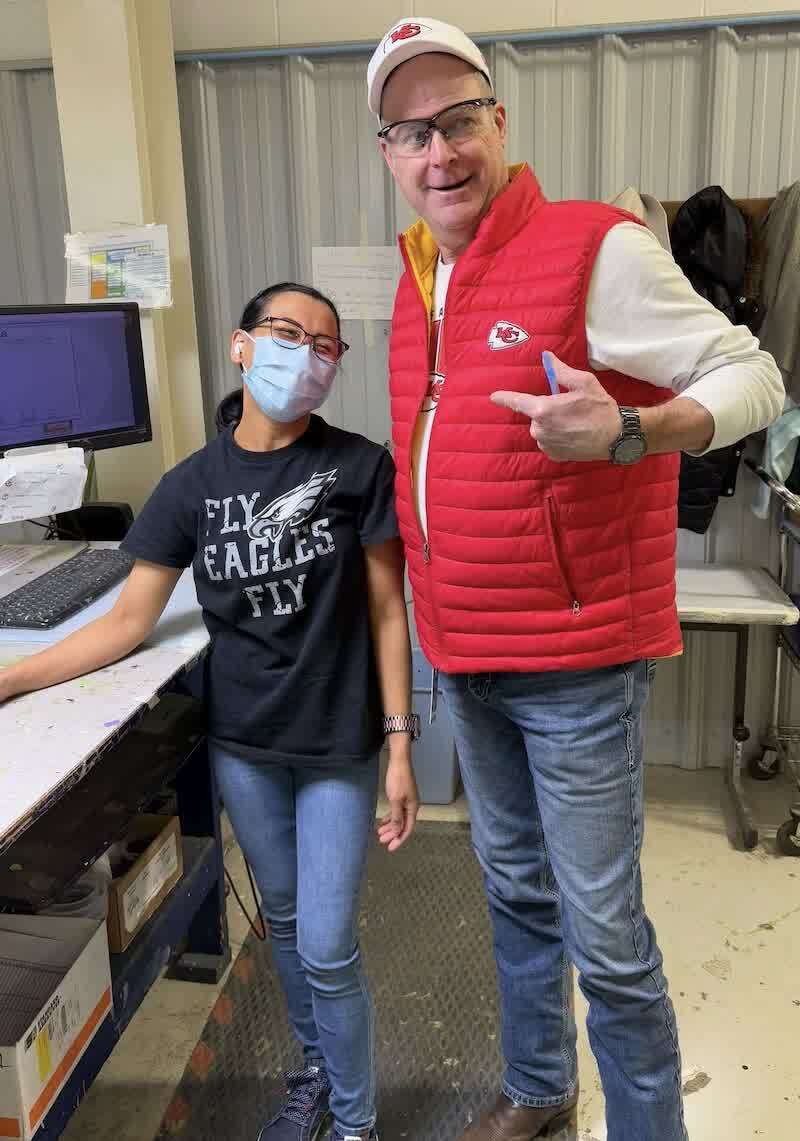 Wearing his KC Chiefs apparel, Karst jokes with a staff member who wore Philadelphia Eagles swag just before the Super Bowl.Perhaps the clearest indicator of the company’s growth was its workforce. Before the disruptions caused by the COVID-19 pandemic, 3P Processing employed approximately 320 people, making it one of the largest finishing operations in the country.
Managing an organization of that size required more than technical expertise.
Karst credits the company’s success to strong supervisors, internal promotions, employee development, and a management philosophy focused on visibility and engagement.
“We promoted from within whenever possible,” he said. “We spent a lot of time talking with employees about what they wanted to do in the future and how they wanted to grow.”
Not every employee aspired to management, and Karst understood that. Some preferred to remain technical specialists, while others wanted leadership opportunities. The company worked to support both paths.
Despite the size of the operation, the management structure remained relatively lean. Karst worked closely with a production manager, business development manager, and supervisors responsible for specific departments and shifts.
Regular Gemba walks kept leadership connected to operations.
“I spent a lot of time on the floor,” Karst said. “We were out there helping solve problems and supporting employees.”
Looking back, he admits he is sometimes surprised by how effectively the organization operated given its size.
Yet the results speak for themselves. Revenue grew dramatically, customer relationships expanded, and the company established itself as one of aerospace finishing’s most respected suppliers.
The Power of Metrics
One of the biggest differences Karst brought to the business was a deep commitment to metrics.
Drawing on experiences at Boeing and Honeywell, he implemented measurement systems that provided objective data on performance, delivery, and operational efficiency.
At the time, many suppliers relied heavily on perceptions and anecdotes when discussing performance with customers. Karst believed facts mattered more than opinions.
“When we visited customers, we wanted to talk in facts, not feelings,” he said.
The company tracked key performance indicators such as on-time delivery, turnaround time, order status, and expedite activity. These metrics gave customers visibility into performance while helping 3P Processing identify opportunities for improvement.
“He was tough on me,” Karst said. “But he helped me mature as a leader.”
The approach attracted attention. Karst recalls Boeing representatives expressing surprise when they saw the level of operational data available.
“They asked where all the metrics came from,” he said. “For us, it was just part of how we managed the business.”
The strategy strengthened customer relationships because discussions focused on measurable performance rather than assumptions.
Equally important, the metrics created accountability within the organization.
“If you lie to yourself about the numbers, you’re only fooling yourself,” Karst said. “Your customers already know the truth.”
Learning from Mentors
 Karst along with Director of Quality Kris Rey, Director of Operations Julia Johnston, and Chief Financial Officer Michael Marstall.As Karst reflects on his career, his thoughts frequently return to the individuals who shaped his development. One of the earliest influences was his Boeing supervisor, Paul Miller.
According to Karst, Miller taught an important lesson about humility and respect.
“He reminded me that the people building the airplanes were the ones making everything happen,” Karst said. “When they had problems, you talked with them, not down to them.”
That lesson remained with him throughout his career and influenced how he interacted with employees across the shop floor.
At Honeywell, another mentor, Bill Speranzo, challenged him to grow as a manager.
“He was tough on me,” Karst said. “But he helped me mature as a leader.”
Later, Tom Gibbons and Neil Bishkin provided opportunities that allowed him to take ownership of business performance and implement new ideas.
Yet one of the most influential figures in his finishing career came from inside the facility itself. Charlie Cravens was part of the original Air Capital Plating team and a legendary figure in Wichita’s finishing community.
“If you had an anodizing problem, Charlie could figure it out,” Karst said.
Cravens possessed decades of knowledge and became an invaluable resource as Karst learned the industry. Even after reaching his 80s, Cravens remained actively involved with the company.
Karst credits him with helping preserve institutional knowledge and teaching lessons that could never be learned from a textbook.
A Process-Oriented Mindset
For Karst, one theme surfaces repeatedly: process. He believes many organizations focus too heavily on fixing individual problems while overlooking the underlying causes that created them.
“You can’t solve a problem until you understand the process,” he said.
That philosophy guided his leadership approach. When issues occurred, he encouraged teams to identify root causes rather than simply correcting immediate defects.
Similarly, when supervisors solved customer problems, he challenged them to prevent recurrence.
“I would tell them not to just fix the order,” Karst said. “Fix the process so the next order goes through without the same problem.”
The mindset helped create sustainable improvements and supported the company’s long-term growth.
Advice for the Next Generation
 As retirement begins, Karst offers practical advice for those stepping into leadership roles within finishing operations.
First, he encourages patience.
“There are so many specifications and requirements,” he said. “You’re not going to learn everything in a day.”
He also recommends listening closely to employees. Many of the people working on production floors possess decades of experience and practical knowledge. Leaders who take time to ask questions often gain valuable insights.
Finally, he stresses the importance of understanding process flow.
Whether dealing with quality issues, customer complaints, or operational challenges, leaders must understand how work moves through the organization before attempting to implement solutions.
“Follow the process,” Karst said. “That’s where you’ll find the answers.”
A Legacy Beyond Revenue
Although Karst is proud of the financial growth achieved during his tenure, the accomplishments he values most involve people.
The transformation from approximately 140 employees to more than 320 employees represented far more than a business statistic. It meant hundreds of families benefited from stable employment, career development, and opportunities for advancement.
During the uncertainty of the pandemic, maintaining those opportunities became one of his greatest concerns.
“I spent a lot of nights thinking about how we could keep people working,” Karst said. “We knew the business would come back, and we didn’t want to lose the team.”
Today, he looks back on a career that began at Boeing in 1986 and concluded 40 years later after helping lead one of aerospace finishing’s largest and most respected operations.
The shop he inherited looked very different from the one he left behind. Facilities were upgraded. Capacity expanded. Revenue multiplied. Customer relationships deepened. Most importantly, a culture built around people, process, and continuous improvement took root.
The Boeing visit remains one of his proudest memories because it validated years of hard work.
Yet even that recognition seems secondary to the relationships formed along the way.
As he begins retirement, Karst’s story serves as a reminder that successful manufacturing organizations are built not only through equipment and technology, but through mentorship, teamwork, discipline, and a willingness to keep learning.