


After more than 40 years in the electroplating and surface finishing industry, I have witnessed significant change—though for decades, that progress moved at a deliberate crawl.
 Paul CookProprietary chemical houses gradually refined process formulations. Plating lines evolved from manual hand-dipping to hoists and programmable hoists. Filtration systems, rectifiers, and wastewater treatment equipment became progressively more modern.
Yet, through all of this, the foundational way a plating shop operated remained rooted in a highly manual, "hands-on" approach.
Then, the inflection point arrived.
A Convergence of Technologies
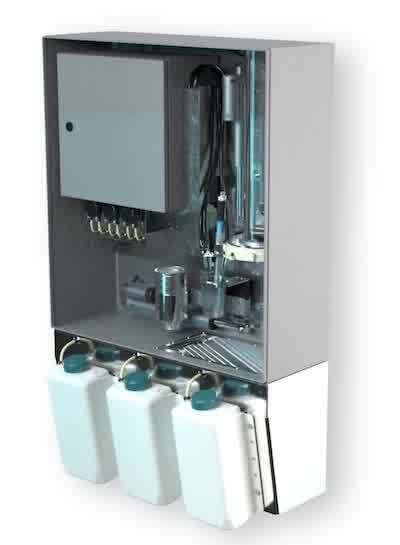 A chemical titrator.Today, we are witnessing a convergence of technologies that was unimaginable early in my career. Robotics, real-time chemical process control, closed-loop water purification, direct metal recovery, automated micro-dosing, smart energy management, advanced telemetry, and Artificial Intelligence (AI) are coming together to redefine how a finishing line operates fundamentally.
The opportunity is no longer simply automating one piece of the puzzle. Imagine online analytical chemistry—moving beyond basic pH, ORP, dissolved oxygen, and conductivity to real-time, online X-ray, UV-Vis, CVS, AA, and ICP analysis coupled with continuous logging and automated micro-dosing. Chemical baths can now be continuously maintained within tight operating windows dictated by the supplier's Technical Data Sheet, triggering immediate mobile or email alerts to operations personnel the moment a parameter drifts.
Imagine a modern finishing facility where vision-guided robots identify incoming parts and automatically call up the required recipe and process parameters, where day-tank additions are driven by real-time bath chemistry and amp-hour consumption rather than a fixed calendar schedule. Process water is continuously purified and recirculated back to the line. Where valuable heavy metals are selectively recovered for reuse at the source—eliminating the traditional "hydroxide sludge manufacturing department." Imagine smart rectifiers and pumps communicating energy consumption and diagnostic health in real time, with an AI layer analyzing these streams to optimize plant throughput and yield.
A Fundamentally Different Vision
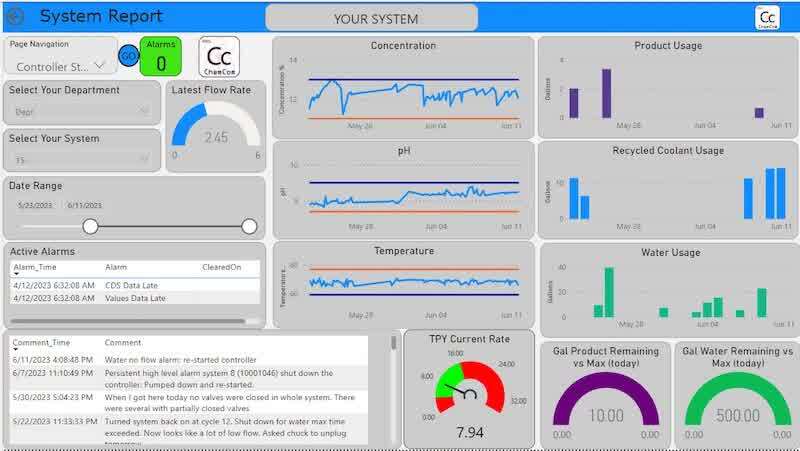 A finishing line's system report.This is a fundamentally different vision than the electroplating shop many of us grew up with. It is a fully connected ecosystem, much like the human body—where every component relies on an intelligent network of continuous communication.
This connectivity is where AI will make its greatest impact. A modern finishing line generates massive amounts of operational data: part geometry, cycle times, temperature profiles, analytical chemistry, bath additions, water flow rates, rectifier outputs, filter differential pressures, and energy usage.
Ultimately, the greatest shift facing our industry could be philosophical. Any single piece of hardware will not define the finishing facility of the future—be it a robot, a rectifier, or an analytical controller. Its true competitive advantage will stem from how seamlessly these systems communicate and collaborate.
The technology to perform most of these individual tasks already exists; the next major frontier is full integration. Far from replacing human expertise, this transformation relies on the tribal knowledge of experienced platers to guide and fine-tune these intelligent systems.
After 40 years in this business, that potential makes me optimistic about the future of advanced manufacturing in the US. We have immense innovation ahead of us, and together, we can turn this vision into standard practice.
Paul Cook, CEF SME specializing in proprietary electroplating chemistry, troubleshooting, chemical process control, and metal recovery and purification systems. Email him at sales@metalsrx.com.