


With a comprehensive expansion of its research infrastructure, the Fraunhofer Institute for Surface Engineering and Thin Films IST is establishing a new platform for localized electrochemical surface processing.
 Rowena DucksteinBy combining proven electroplating processes with innovative technologies such as Electrochemical Jet Processing (EJP) and intelligent robotics, the institute enables precise, resource-efficient processing of complex workpieces. In doing so, the institute is creating new opportunities for industry in fields such as electronics, energy technology, medical engineering, and aerospace.
Electroplated coatings play a central role in numerous future-oriented industries. They impart specific functional properties to components, improve durability and performance, and extend product service life, thereby supporting resource conservation and reducing CO₂ emissions over the entire life cycle. In this context, Fraunhofer IST is advancing electrochemical manufacturing technologies and combining established electroplating processes with selective surface-treatment approaches.
Top photo: The Desktop Jet from TextureJet for electrochemical jet machining (EJM) as part of the Fraunhofer IST electrochemical jet processing (EJP) platform.
Expansion for the Next Generation of Electrochemical Manufacturing
At the heart of the facility expansion is the new Electrochemical Jet Processing (EJP) platform, which combines various selective electrochemical processes to process and functionalize surfaces locally. These include Electrochemical Jet Machining (EJM) for non-contact, micrometer-precise material machining, as well as Electrochemical Jet Deposition (EJD) for the localized deposition of functional layers. This allows surfaces to be selectively structured, smoothed, repaired, or coated.
Unlike conventional electroplating, which treats entire components in process baths, the EJP platform uses a movable electrochemical jet that acts only where material needs to be processed or layers deposited. This makes it possible, in the future, to flexibly process even complex or large-scale components. Restrictions imposed by the dimensions of process baths or potential masking and demasking steps are eliminated. At the same time, it minimizes the use of chemicals, energy, and raw materials, as well as waste generation.
Intelligent Process Control for Complex Component Geometries
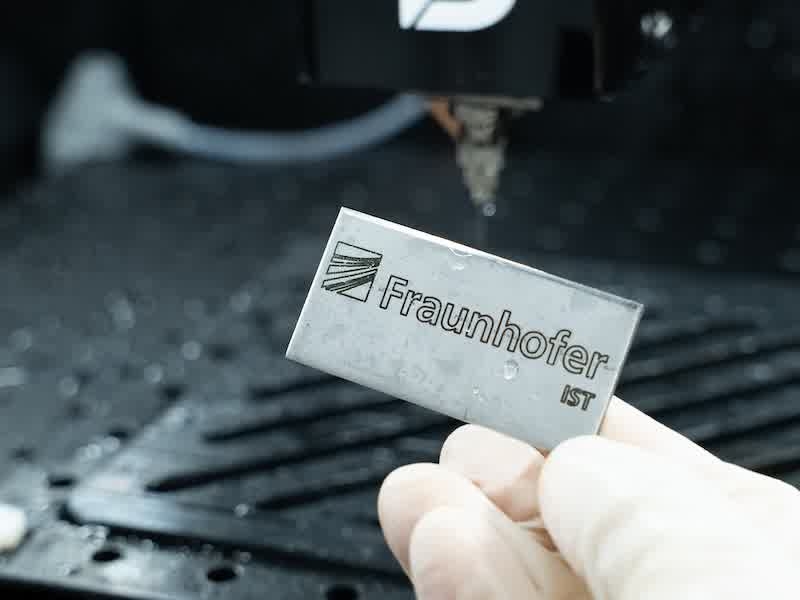 Local surface structure on a stainless steel substrate created by electrochemical jet machining (EJM).A modern robotics and automation infrastructure complements the platform. In addition to high-precision industrial robots, autonomous mobile robots (AMRs) flexibly support material and tool logistics and navigate their environment independently. This results in highly precise, reproducible processes that adapt to different component geometries and integrate into automated production lines.
“With our new system design, we combine selective electrochemical processes and robotics into a comprehensive system. Unlike conventional systems, the process adapts to the component and its requirements – not the other way around,” explains Rowena Duckstein, a research scientist at Fraunhofer IST.
Diverse Applications for High-Tech Industries
The new system technology is relevant wherever the highest precision, flexibility, and sustainability are required. For example, it enables the material-conserving production of microstructures with high deposition rates, as well as more targeted filling and thus better coating of, for instance, micro-holes. Localized deposition eliminates the need for stencils and masking.
In the future, the EJP platform is to be integrated even more closely with robotics, sensor technology, and data-driven control methods. The goal is an adaptive manufacturing system that continuously optimizes processes and reduces resource consumption and scrap. In this way, Fraunhofer IST is laying the foundation for adaptive manufacturing concepts that flexibly integrate local electrochemical processes into industrial production lines and open up new possibilities for micro-machining, repair processes, and functionalized surfaces.
“Our goal is to develop further a technology platform that not only meets current industrial requirements but also actively sets new standards – more precise, more sustainable, and more application-oriented than existing solutions,” Duckstein summarizes.