


If you’ve spent any time around a finishing line, you’ve probably heard some variation of the same conversation.
 Marhya Osheaski“We need more throughput.”
“We’re running out of oven.”
“We can’t justify a major capital project right now.”
It’s a familiar challenge across both powder coating and liquid paint operations. Demand increases, production schedules tighten, and suddenly the curing process becomes the bottleneck that limits everything upstream.
Traditionally, the solution has been straightforward—but expensive. Add oven length. Increase floor space. Install a larger curing system. Invest heavily and hope the increased capacity arrives quickly enough to justify the cost.
But what if there was another option?
What if the fastest path to increased throughput wasn’t replacing equipment, but helping existing equipment perform better?
That’s the thinking behind a growing category of curing technology known as Radiant Heat Technology (RHT), and it’s generating interest among finishers looking for practical ways to increase production without taking on major capital projects.
The Hidden Challenge Inside Every Cure Cycle
 To understand why RHT is attracting attention, it helps to look at what happens inside a traditional convection oven.
Convection systems deliver consistent, controllable heat. But the process itself is inherently indirect. Heat must first warm the air, then the substrate, and finally the coating. That sequence takes time.
In many operations, the most critical—and often most limiting—part of the cure cycle happens early, when the coating moves toward flow-out and gel formation. Until that happens, the rest of the curing process is essentially waiting for the coating to reach the starting line.
Think of it like preheating an oven before baking. Nothing productive happens until the temperature gets to where it needs to be.
For many manufacturers, this early-stage heating requirement quietly becomes the production bottleneck that limits line speed and overall throughput.
A Different Approach To Heating
 Radiant Heat Technology approaches the problem differently.
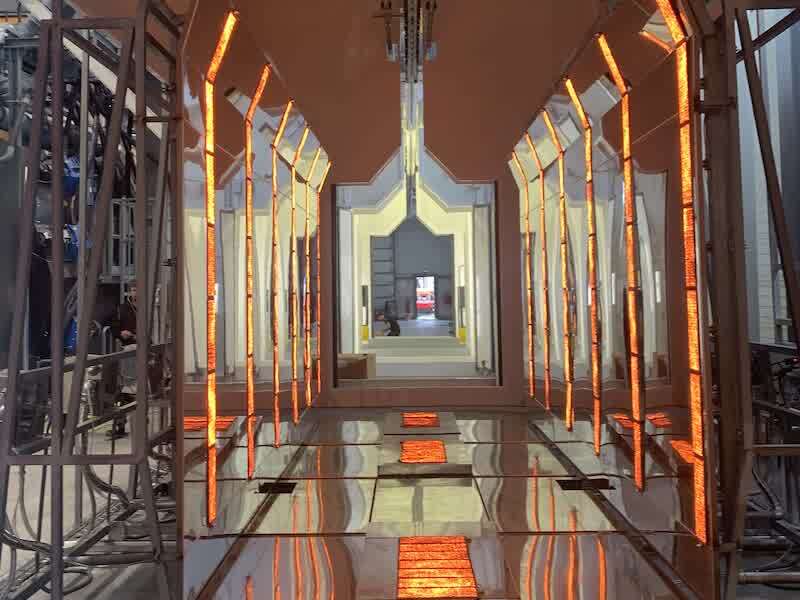
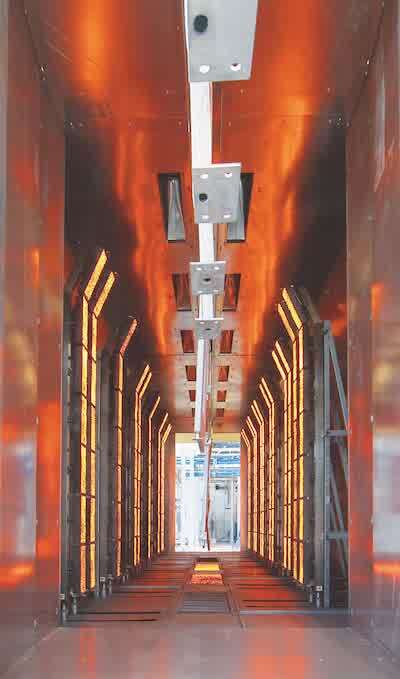
Rather than relying primarily on heated air, RHT uses high-intensity medium-to-short-wave infrared energy to deliver heat directly to the coated surface. The energy is applied precisely where it’s needed most, accelerating temperature rise and helping coatings reach gel formation more quickly.
The key is understanding where the bottleneck actually occurs. In many curing systems, the greatest opportunity isn't at the end of the cure cycle—it's at the beginning. By applying concentrated radiant energy during those critical early stages, we can accelerate thermal ramp-up and help coatings reach gel formation much faster. Once that happens, the rest of the curing process becomes significantly more efficient.
The concept isn’t entirely new. Industrial finishing has used infrared curing for decades. What’s changing is the accessibility.
Historically, many high-performance infrared solutions required substantial investment, major system modifications, or entirely new curing equipment. That often made adoption difficult for operations seeking incremental improvements rather than complete process overhauls.
New modular RHT systems are changing that equation by letting manufacturers add thermal capacity at critical points in existing curing processes rather than redesigning the entire line.
Why Throughput Gains Deliver the Fastest ROI
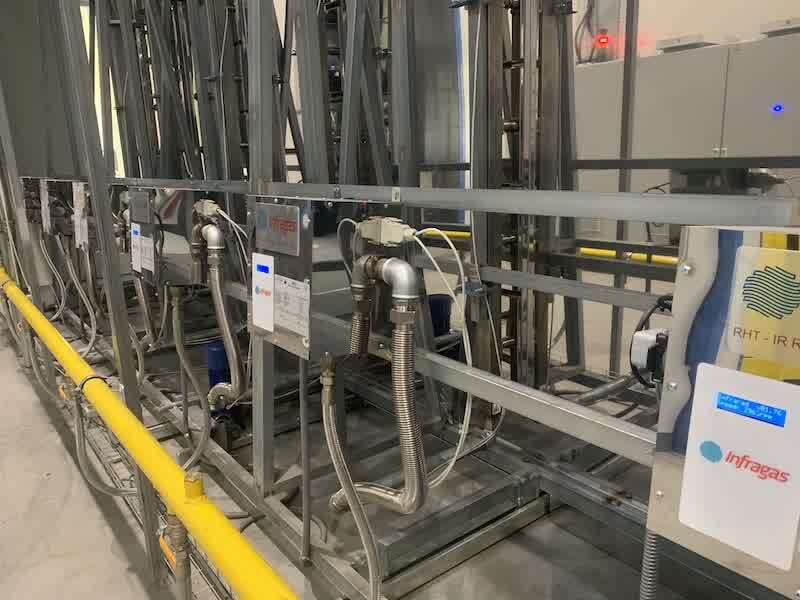 One of the most interesting aspects of RHT isn’t necessarily the technology itself—it’s the economics.
When production demand increases, most manufacturers immediately start evaluating larger ovens, longer dwell times, or additional equipment.
Those options certainly work, but they can also involve significant capital expense, engineering effort, installation downtime, and facility modifications.
In contrast, adding thermal capacity where it creates the greatest impact can often deliver measurable production gains with a much smaller investment.
By accelerating the most demanding portion of the cure cycle, RHT can help manufacturers:
- Increase conveyor speeds
- Improve oven utilization
- Process more parts per shift
- Reduce curing bottlenecks
- Increase throughput without extending oven length
- Maximize production from existing assets
For many operations, that’s where the return on investment becomes compelling. Instead of investing in more square footage, they’re effectively extracting more performance from equipment already on the floor.
Manufacturers today are under constant pressure to increase output while being more disciplined with spending. What excites us about Radiant Heat Technology is that it gives finishers another path forward. Instead of assuming they need a larger oven or a major expansion project, they can often unlock additional throughput from assets they already own. In many cases, that translates into a much faster payback and a lower-risk investment."
The Manufacturing Equivalent of Finding Extra Storage in Your Garage
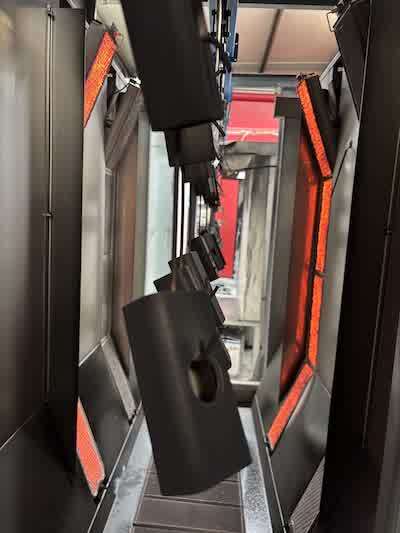 Most of us have cleaned out a garage or workshop and suddenly discovered far more usable space than we thought we had.
The equipment didn’t get bigger. The footprint didn’t change. You used the space more effectively. RHT often creates a similar effect inside a curing process.
By adding concentrated thermal energy at the beginning of the cure cycle, manufacturers can unlock capacity that was already present but inaccessible because of heating limitations.
The result isn’t magic. It’s simply better thermal management.
And unlike many production improvements, it doesn’t necessarily require tearing down walls, moving equipment, or convincing the finance department that a seven-figure expansion project is somehow a bargain.
A Practical Solution for Today’s Manufacturing Reality
Manufacturing has become increasingly focused on efficiency, flexibility, and capital discipline.
Many finishers are being asked to increase output while minimizing spending, reducing energy consumption, and using existing assets better. That reality is driving interest in technologies that improve performance without requiring wholesale replacement of functioning equipment.
One reason RHT systems are gaining traction is their modular nature. Many installations require only fuel, electrical power, a blower package, and integration with existing controls. In many applications, installation can be completed in days rather than weeks, minimizing disruption to production schedules.
For operations that need additional throughput but aren’t ready for a major expansion, that can be an attractive proposition.
Not A Replacement, A Complement
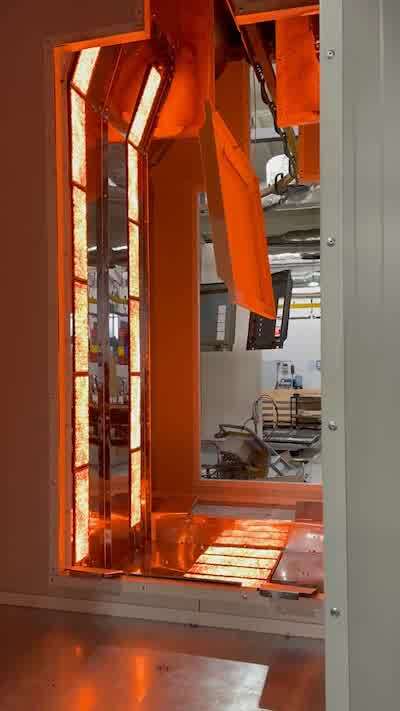 One common misconception about infrared technology is that it must replace traditional curing methods.
In reality, many of the most effective curing systems today are hybrid systems.
Radiant heat can rapidly drive coatings toward gel formation, while downstream convection or gas catalytic infrared systems provide the controlled heating needed to complete the cure process.
The goal isn’t choosing one technology over another; it’s using each technology where it performs best. For many finishers, that’s where the greatest efficiency gains occur.
Looking Ahead
The future of industrial curing is unlikely to be defined by bigger ovens alone.
Instead, we’re seeing increased interest in smarter heat application, targeted energy delivery, and technologies that help manufacturers do more with the equipment they already own. Radiant Heat Technology reflects that shift.
By addressing throughput bottlenecks and making advanced infrared heating more accessible, RHT offers manufacturers an option between “keep things as they are” and “replace the entire curing system.”
In today’s manufacturing environment, having a practical middle ground may be one of the most valuable improvements of all. After all, sometimes the best way to increase capacity isn’t building something bigger. It’s helping what you already have work smarter.
Marhya Osheaski is President of WolfRayet and has over 20 years of business experience and a distinguished track record in the chemicals and coatings industry. Her previous roles included vice president of sales at IFS Coatings, where she helped drive sales growth; sales manager at Axalta Coatings; and sales manager at Clariant Masterbatches.